The debate around me either vs me neither confuses many English learners and native speakers alike. You have probably heard both expressions in conversations, movies, social media comments, and casual chats. While they may sound similar, they are not always used the same way grammatically.
Understanding the difference between these two phrases can instantly improve your conversational English and help you sound more natural. The confusion often comes from informal speech patterns, regional preferences, and the fact that native speakers frequently bend grammar rules in everyday conversation.
In this guide, you will learn the meaning of “me either” and “me neither,” when each phrase is appropriate, grammar rules, pronunciation tips, common mistakes, examples, and differences between American and British English.
Quick Answer
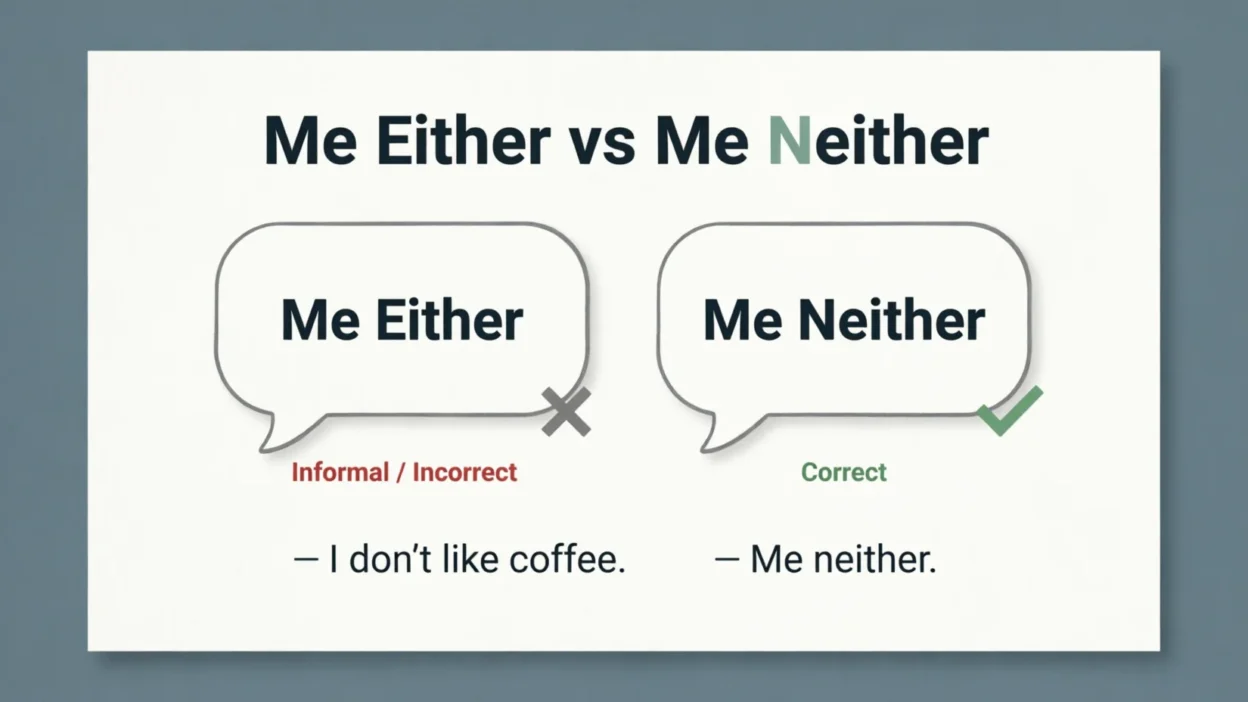
Traditionally, “me neither” is grammatically correct after a negative statement. However, “me either” is extremely common in informal American English and widely accepted in casual conversation.
Examples:
- “I don’t like coffee.”
“Me neither.” ✅ (formal and grammatically standard) - “I don’t like coffee.”
“Me either.” ✅ (informal but common)
What Does “Me Neither” Mean?
“Me neither” means:
- neither do I
- I also do not
- I agree with your negative statement
It is used to respond to something negative.
Examples of Me Neither
- “I’m not hungry.”
“Me neither.” - “I can’t swim.”
“Me neither.” - “I don’t enjoy horror movies.”
“Me neither.”
Why “Me Neither” Is Grammatically Correct
“Neither” already carries a negative meaning.
So when someone says:
- “I don’t like broccoli.”
You can respond:
- “Me neither.”
because it means:
- “Neither do I.”
What Does “Me Either” Mean?
“Me either” is an informal conversational variation used mostly in spoken American English.
Although grammar purists may criticize it, millions of native speakers use it naturally.
Examples of Me Either
- “I don’t want to go.”
“Me either.” - “I can’t understand this.”
“Me either.” - “I don’t watch that show.”
“Me either.”
Is “Me Either” Wrong?
Technically, traditional grammar favors:
- “me neither”
But in casual conversation:
- “me either” sounds natural and widely accepted.
Me Either vs Me Neither Comparison Table
| Phrase | Formality | Grammar Accuracy | Common Usage | Example |
|---|---|---|---|---|
| Me neither | Formal/standard | Grammatically correct | Very common | “I don’t agree.” “Me neither.” |
| Me either | Informal | Conversationally accepted | Extremely common in American English | “I don’t agree.” “Me either.” |
When to Use “Me Neither”
Use “me neither” in:
- formal writing
- academic settings
- professional communication
- grammar-sensitive situations
Correct Situations
- Business conversations
- School assignments
- Professional emails
- Formal speaking environments
Example Sentences
- “I haven’t finished the report.”
“Me neither.” - “I don’t speak French.”
“Me neither.”
When to Use “Me Either”
Use “me either” mainly in:
- casual conversation
- texting
- informal speech
- relaxed social settings
Example Sentences
- “I don’t feel tired.”
“Me either.” - “I’m not ready yet.”
“Me either.”
Why Native Speakers Use It
Many people naturally connect:
- either = also
So in conversation, “me either” feels intuitive even though “neither” is technically more accurate.
Grammar Rule Behind Me Either vs Me Neither
The key grammar concept involves negative agreement.
Negative Agreement With Neither
Traditional English uses:
- neither
after negative statements.
Example:
- “I don’t like onions.”
- “Neither do I.”
Shortened version:
- “Me neither.”
Why “Either” Seems Strange Grammatically
“Either” usually appears in positive structures or after negatives differently.
Example:
- “I don’t like onions either.”
In this sentence:
- “either” modifies the sentence correctly.
But when shortened to:
- “Me either”
the grammar becomes less formal.
Common Mistakes With Me Either vs Me Neither
Many English learners accidentally misuse these phrases.
Mistake 1: Using Them After Positive Statements
Incorrect:
- “I love pizza.”
“Me neither.” ❌
Correct:
- “I love pizza.”
“Me too.” ✅
Mistake 2: Using “Me Too” After Negative Statements
Incorrect:
- “I don’t like math.”
“Me too.” ❌
Correct:
- “I don’t like math.”
“Me neither.” ✅
Mistake 3: Overusing “Me Either” in Formal Writing
Informal:
- “Me either.”
Formal alternative:
- “Neither do I.”
Practical Example Paragraphs
Real examples help the difference feel more natural.
Example Using Me Neither
During the discussion, Sarah admitted she had never traveled abroad. James smiled and replied, “Me neither,” explaining that he hoped to visit Europe someday.
Example Using Me Either
Two friends were discussing a difficult homework assignment after class. One sighed and said, “I don’t understand any of this.” The other laughed and replied casually, “Me either.”
Me Neither vs Neither Do I
Both phrases express the same meaning, but one sounds more formal.
Me Neither
- shorter
- conversational
- relaxed tone
Example:
- “I don’t like spicy food.”
“Me neither.”
Neither Do I
- grammatically complete
- more formal
- polished speech
Example:
- “I don’t like spicy food.”
“Neither do I.”
Placement and Grammar Rules Table
| Phrase | Sentence Placement | Tone | Example Sentence |
|---|---|---|---|
| Me neither | Response to negative statement | Neutral/Formal | “I’m not ready.” “Me neither.” |
| Me either | Informal response | Casual | “I don’t know.” “Me either.” |
| Neither do I | Full grammatical structure | Formal | “I don’t agree.” “Neither do I.” |
| I don’t either | Alternative response | Neutral | “I can’t swim.” “I don’t either.” |
American vs British English Differences
There are slight regional preferences.
American English
Americans commonly use:
- me either
- me neither
in casual speech.
“Me either” is especially widespread in spoken American English.
British English
British English tends to favor:
- me neither
- neither do I
especially in more formal speech.
Why This Confusion Happens
English conversation often simplifies grammar naturally.
Native speakers prioritize:
- speed
- rhythm
- familiarity
As a result, informal phrases become widely accepted even if they are not technically perfect according to traditional grammar rules.
This is why:
- “me either” sounds normal to many people.
Synonyms and Related Expressions
Learning related phrases improves fluency naturally.
Alternatives to Me Neither
- neither do I
- nor do I
- I don’t either
Alternatives to Me Either
- same here
- me too (only for positive statements)
- I don’t either
Related Grammar Searches
People searching for “me either vs me neither” also search for:
- neither do I meaning
- me too vs me neither
- either vs neither
- negative agreement in English
- conversational English phrases
Helpful Memory Trick
A simple trick makes this easier to remember.
Negative Statement = Neither
If the original sentence is negative:
- use neither
Example:
- “I don’t like spinach.”
- “Me neither.”
Informal Exception
Remember:
- “me either” is casual spoken English, especially in America.
So:
- acceptable in conversation
- less ideal in formal writing
Why Correct Usage Matters
Using these phrases correctly improves:
- conversational fluency
- grammar accuracy
- professional communication
- listening comprehension
Even small grammar choices affect how polished and natural your English sounds.
Understanding informal versus formal English also helps you adapt your speech depending on the situation.
FAQs About Me Either vs Me Neither
Which is grammatically correct: me either or me neither?
“Me neither” is traditionally grammatically correct.
Is “me either” wrong?
Not exactly. It is informal but extremely common in spoken American English.
Can I use “me either” in writing?
It is best avoided in formal writing.
What is the formal alternative to me either?
“Neither do I” is the most formal option.
Why do native speakers say me either?
Because conversational English often simplifies grammar naturally.
Is me neither rude?
No. It is a normal conversational response.
Can I say “me too” after a negative statement?
No. Use “me neither” or “I don’t either” instead.
Final Thoughts
The difference between me either vs me neither comes down to grammar versus conversational usage. “Me neither” is the traditional and grammatically correct response to negative statements, while “me either” has become extremely common in informal American English.
Understanding both forms helps you communicate more naturally while also knowing when formal grammar matters. In casual conversations, either phrase may sound normal depending on the setting. In professional or academic contexts, however, “me neither” or “neither do I” remains the safer and more polished choice.
Actionable Takeaway
Remember this simple rule:
- negative statement → “me neither”
- casual American speech → “me either” is often acceptable
For professional writing or formal speaking, choose:
- “me neither”
or - “neither do I”
This approach keeps your English both natural and grammatically strong.