Have you ever typed tittle when you meant title, or wondered whether both words are correct? You’re not alone. Because these words look very similar, many writers accidentally confuse them, especially when typing quickly.
The truth is that title and tittle are both real English words, but they have completely different meanings. One is extremely common in everyday writing, while the other is a specialized term that most people rarely use. Understanding the difference will help you avoid mistakes and improve your vocabulary.
Quick Answer
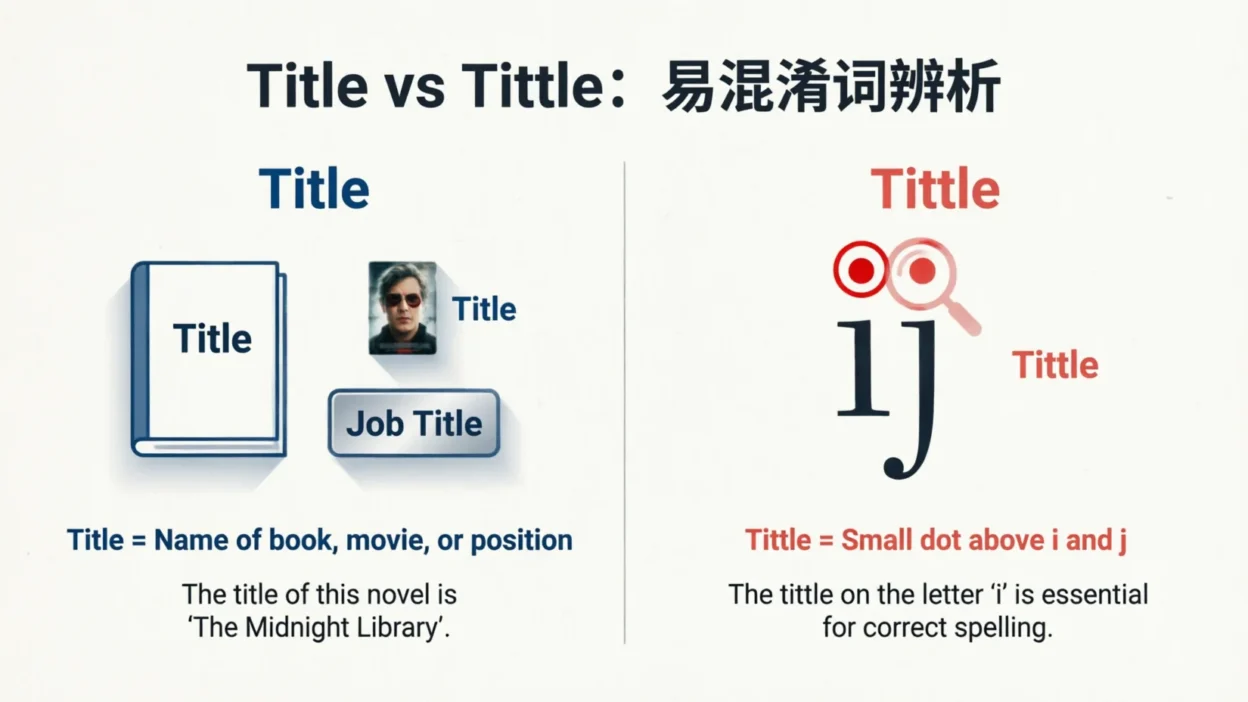
- Title refers to the name of a book, article, movie, job position, or honor.
- Tittle refers to a very small mark in writing, especially the dot above the letters i and j.
Examples:
- The title of the book is fascinating. ✅
- Don’t forget the tittle above the letter i. ✅
A simple rule:
👉 Title = name or heading
👉 Tittle = tiny writing mark
What Does “Title” Mean?
Definition of Title
Title is a noun that refers to the name of a work, position, rank, or designation.
It is one of the most commonly used words in English.
Examples of Title in Sentences
- The title of the novel caught my attention.
- She earned the title of team captain.
- What is the title of that movie?
- The article’s title appears at the top of the page.
In each example, title refers to a name, label, or designation.
Common Uses of Title
Books
- Book title
- Chapter title
Example:
- The title of the book is memorable.
Movies and TV Shows
Example:
- The movie title was changed before release.
Job Positions
Examples:
- Job title
- Professional title
Sentence:
- Her job title is Marketing Manager.
Awards and Honors
Examples:
- Championship title
- Royal title
Sentence:
- He defended his world title successfully.
Synonyms for Title
Depending on context, title can mean:
- Name
- Heading
- Designation
- Label
- Rank
- Position
What Does “Tittle” Mean?
Definition of Tittle
Tittle is a noun referring to a small distinguishing mark in writing, especially the dot above the lowercase letters i and j.
It is a legitimate English word, but it is rarely used in everyday conversation.
Examples of Tittle in Sentences
- The dot above the i is called a tittle.
- Typography experts pay attention to every tittle.
- The designer carefully adjusted each tittle in the font.
In these examples, tittle refers to a tiny mark in written language.
Origin of Tittle
The word comes from historical grammatical and typographical traditions.
It has been used for centuries to describe small marks that help distinguish letters.
Title vs Tittle: Key Differences
| Feature | Title | Tittle |
|---|---|---|
| Meaning | Name, heading, rank, or designation | Small mark in writing |
| Usage Frequency | Very common | Rare |
| Part of Speech | Noun | Noun |
| Example | Book title | Dot above an i |
| Everyday Use | Yes | Rarely |
The easiest way to remember:
Title names something. Tittle marks something.
Why People Confuse Title and Tittle
Similar Spelling
The words differ by only one letter:
- Title
- Tittle
This similarity often leads to typing mistakes.
Pronunciation Similarities
Although the pronunciation differs slightly, many people mishear or mistype the words.
Title Is Much More Common
Because title appears frequently in books, websites, articles, and workplaces, people may accidentally type tittle when they mean title.
When to Use Title
Naming Books and Articles
Examples:
- The title of the article is informative.
- The title page contains the author’s name.
Referring to Job Positions
Examples:
- Her title is Senior Accountant.
- He received a new title after the promotion.
Discussing Awards
Examples:
- The boxer won the championship title.
- She defended her title successfully.
Referring to Headings
Examples:
- The title appears at the top of the document.
- Use a descriptive title for your presentation.
When to Use Tittle
Typography and Fonts
Examples:
- The font designer modified the tittle.
- The tittle helps distinguish the letter i.
Grammar and Linguistics
Examples:
- Students learned that the dot above an i is called a tittle.
- Every tittle contributes to readability.
Historical Texts
Examples:
- The manuscript preserved every tittle and mark.
- Scholars examined each tittle carefully.
Common Mistakes to Avoid
Mistake 1: Using Tittle Instead of Title
Incorrect:
- What is the tittle of the book? ❌
Correct:
- What is the title of the book? ✅
Books have titles, not tittles.
Mistake 2: Assuming Tittle Is a Misspelling
Incorrect Assumption:
- Tittle isn’t a real word.
Correct:
- Tittle is a real word, but it has a specialized meaning.
Mistake 3: Using Title for Letter Marks
Incorrect:
- The title above the letter i is missing.
Correct:
- The tittle above the letter i is missing.
Real-Life Examples
Example 1
Correct:
- The title of the presentation should be clear.
Incorrect:
- The tittle of the presentation should be clear.
Example 2
Correct:
- The designer adjusted the tittle above the lowercase i.
Incorrect:
- The designer adjusted the title above the lowercase i.
Example 3
Correct:
- She earned the title of Employee of the Year.
Incorrect:
- She earned the tittle of Employee of the Year.
Easy Memory Tricks
Title Contains “Name”
Think of a title as the name of something.
Examples:
- Book title
- Movie title
- Job title
Tittle Is Tiny
The word tittle sounds similar to little.
Both refer to something very small.
Think:
- Tittle = tiny dot
Quick Reminder
- Title = name
- Tittle = tiny mark
American vs British English Differences
There is virtually no difference between American and British English regarding title and tittle.
American English
- The title of the article is clear.
- The tittle above the i is visible.
British English
- The title of the article is clear.
- The tittle above the i is visible.
Both forms have the same meanings in both varieties of English.
Related Words and LSI Keywords
When learning title vs tittle, you may also encounter:
- Heading
- Name
- Designation
- Caption
- Typography
- Font design
- Grammar terms
- Writing symbols
- Publishing terminology
- Linguistic marks
These related concepts help provide a deeper understanding of written English.
FAQs About Title vs Tittle
Is tittle a real word?
Yes. It refers to the small dot above the letters i and j.
What is the difference between title and tittle?
A title is a name or heading, while a tittle is a tiny mark in writing.
Which word is used for a book’s name?
Title is the correct word.
What is the dot above an i called?
It is called a tittle.
Is tittle commonly used?
No. It is mainly used in typography, linguistics, and grammar discussions.
Can title and tittle be used interchangeably?
No. Their meanings are completely different.
Is tittle a misspelling of title?
No. It is a separate word with its own meaning.
Which word is more common?
Title is far more common in everyday English.
Final Summary
Understanding title vs tittle is straightforward once you know their meanings. Title refers to the name, heading, rank, or designation of something and is commonly used in books, articles, movies, jobs, and awards. It is one of the most frequently used words in English.
Tittle, on the other hand, is a specialized term referring to the small dot above the letters i and j. While it is a legitimate English word, it appears mostly in typography, grammar, and linguistic contexts.
Actionable Takeaway
Before choosing between title and tittle, ask yourself:
Am I talking about a name or a tiny writing mark?
- Name, heading, or rank → Title
- Dot above an i or j → Tittle
Remember this simple phrase:
Title names it. Tittle dots it.
Using this quick rule will help you choose the correct word every time.

Fenwick Quentin is a creative blogging author known for his analytical yet engaging writing style.
He explores topics such as innovation, digital culture, and personal development with depth and clarity.
Through his articles, Fenwick encourages readers to think critically and embrace continuous growth.