Have you ever wondered whether to write despite or in spite of? These expressions often confuse English learners because they have very similar meanings and are frequently used in the same situations.
The good news is that despite and in spite of are almost interchangeable. Both are used to show contrast and indicate that something happened even though there was an obstacle, difficulty, or opposing condition. Understanding their subtle differences will help you write and speak more naturally and confidently.
Quick Answer
- Despite and in spite of mean almost the same thing.
- Both show that something happened regardless of a difficulty or obstacle.
- Despite is slightly more concise and common in formal writing.
- In spite of is a little more conversational and emphatic.
Examples:
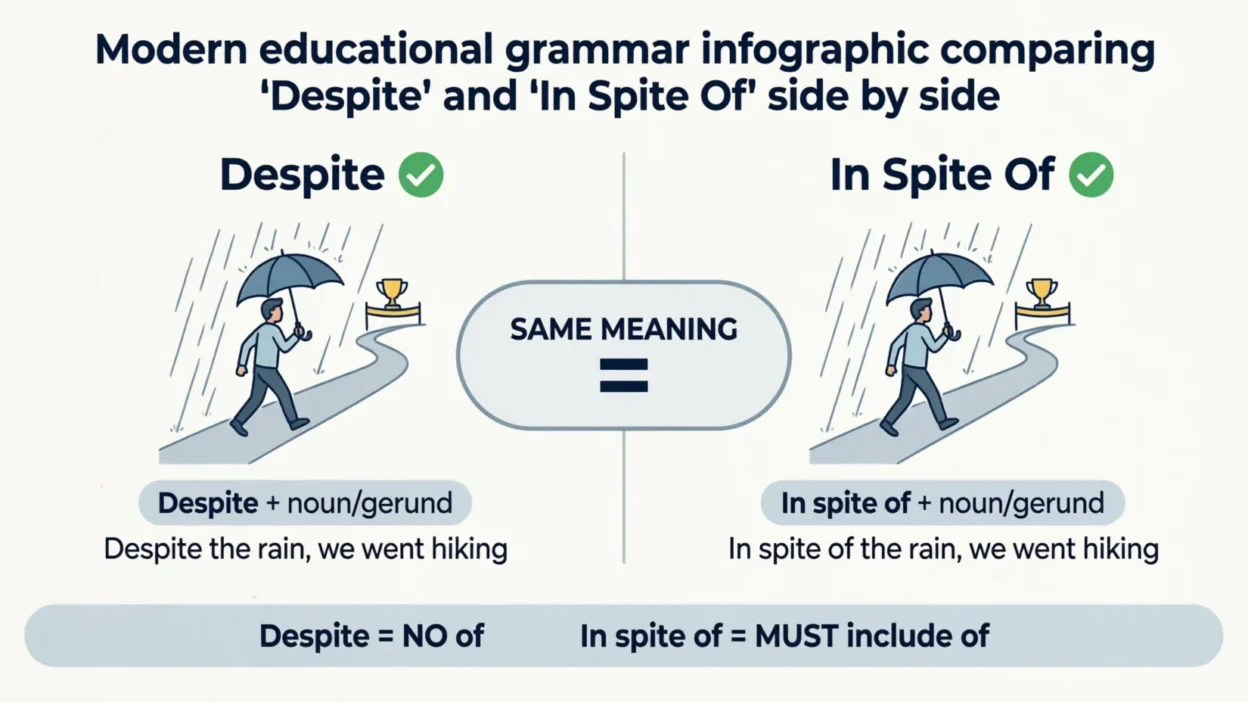
- Despite the rain, we went hiking. ✅
- In spite of the rain, we went hiking. ✅
A simple rule:
👉 Despite = regardless of
👉 In spite of = regardless of
What Does “Despite” Mean?
Definition of Despite
Despite is a preposition that means without being affected by or regardless of.
It introduces a contrast between two ideas.
Examples of Despite in Sentences
- Despite the heavy traffic, we arrived on time.
- She smiled despite feeling nervous.
- Despite the challenges, the project succeeded.
- He continued working despite the pain.
In each example, something happened even though there was a difficulty.
Common Uses of Despite
- Despite the weather
- Despite the cost
- Despite the risks
- Despite the difficulties
Examples:
- Despite the cold weather, they played outside.
- Despite the expense, they bought the house.
What Does “In Spite Of” Mean?
Definition of In Spite Of
In spite of is a prepositional phrase that means regardless of or not affected by.
Its meaning is nearly identical to despite.
Examples of In Spite Of in Sentences
- In spite of the rain, the match continued.
- She passed the exam in spite of limited preparation.
- In spite of his fears, he gave the presentation.
- The event was successful in spite of several setbacks.
The message remains the same: an obstacle existed, but the result still occurred.
Despite vs In Spite Of: Key Differences
Although their meanings are nearly identical, there are slight differences in style.
| Feature | Despite | In Spite Of |
|---|---|---|
| Meaning | Regardless of | Regardless of |
| Part of Speech | Preposition | Prepositional phrase |
| Length | One word | Three words |
| Formality | Slightly more formal | Slightly more conversational |
| Example | Despite the rain | In spite of the rain |
For most situations, either option is correct.
Are Despite and In Spite Of Interchangeable?
Yes, Most of the Time
These sentences have the same meaning:
- Despite the snow, schools remained open.
- In spite of the snow, schools remained open.
- Despite his injury, he finished the race.
- In spite of his injury, he finished the race.
In everyday writing, choosing one over the other is usually a matter of style.
Grammar Rules for Despite and In Spite Of
Use a Noun, Pronoun, or Gerund After Them
Both expressions are followed by:
- A noun
- A pronoun
- A gerund (-ing form)
Examples with Nouns
- Despite the storm, we traveled.
- In spite of the storm, we traveled.
Examples with Pronouns
- Despite him, the team succeeded.
- In spite of her, they continued.
Examples with Gerunds
- Despite working late, she finished early.
- In spite of studying hard, he felt nervous.
Common Mistakes to Avoid
Mistake 1: Using “Despite Of”
Incorrect:
- Despite of the rain, we went outside. ❌
Correct:
- Despite the rain, we went outside. ✅
Remember:
- Despite ✅
- In spite of ✅
- Despite of ❌
Mistake 2: Following with a Full Clause
Incorrect:
- Despite it was raining, we left. ❌
Correct:
- Despite the rain, we left. ✅
Or:
- Although it was raining, we left. ✅
Mistake 3: Mixing Structures
Incorrect:
- In spite the delay, the flight departed. ❌
Correct:
- In spite of the delay, the flight departed. ✅
The word of is required after in spite.
Despite vs Although
Many learners confuse these expressions.
Despite
Followed by a noun or gerund.
Example:
- Despite the rain, we played soccer.
Although
Followed by a full clause.
Example:
- Although it was raining, we played soccer.
Comparison
| Expression | Followed By |
|---|---|
| Despite | Noun, pronoun, or gerund |
| In spite of | Noun, pronoun, or gerund |
| Although | Full clause |
Examples in Everyday Situations
Work
- Despite budget cuts, the company expanded.
- In spite of budget cuts, the company expanded.
Education
- Despite missing classes, she passed the exam.
- In spite of missing classes, she passed the exam.
Travel
- Despite flight delays, we arrived on schedule.
- In spite of flight delays, we arrived on schedule.
Sports
- Despite the injury, he played the entire game.
- In spite of the injury, he played the entire game.
Easy Memory Tricks
Despite Is Shorter
Think:
- Despite = one word
- In spite of = three words
If you want a concise sentence, choose despite.
Remember the “Of”
Many learners forget the of.
Correct:
- In spite of the weather
Incorrect:
- In spite the weather
Quick Rule
- Despite + noun
- In spite of + noun
Same meaning, different structure.
American vs British English Differences
There is virtually no difference between American and British English regarding despite and in spite of.
American English
- Despite the traffic, we arrived early.
- In spite of the traffic, we arrived early.
British English
- Despite the traffic, we arrived early.
- In spite of the traffic, we arrived early.
Both forms are widely accepted in both varieties.
Related Words and Phrases
When learning despite vs in spite of, you may also encounter:
- Although
- Though
- Even though
- Regardless of
- Nevertheless
- However
- Yet
- Nonetheless
- Contrast words
- Concession phrases
Understanding these related expressions will improve your writing and speaking skills.
FAQs About Despite vs In Spite Of
What is the difference between despite and in spite of?
There is very little difference. Both mean regardless of and are usually interchangeable.
Is despite more formal than in spite of?
Yes, despite is often considered slightly more formal and concise.
Can I say despite of?
No. Despite of is incorrect.
Do I need “of” after in spite?
Yes. The correct phrase is in spite of.
Which is more common in writing?
Both are common, but despite is often preferred because it is shorter.
Can despite and in spite of start a sentence?
Yes.
Examples:
- Despite the weather, we traveled.
- In spite of the weather, we traveled.
What comes after despite?
A noun, pronoun, or gerund.
Is despite the same as although?
Not exactly. Despite is followed by a noun or gerund, while although is followed by a full clause.
Final Summary
Understanding despite vs in spite of is easier than many learners expect. Both expressions mean regardless of and show that something happened even though there was a challenge, obstacle, or contrasting condition. In most situations, they can be used interchangeably without changing the meaning of a sentence.
The main difference is style. Despite is shorter and slightly more formal, while in spite of is a longer phrase that may sound a little more conversational. Whichever you choose, make sure to follow the correct grammar structure.
Actionable Takeaway
Before choosing between despite and in spite of, remember:
- Despite + noun/gerund
- In spite of + noun/gerund
- Both mean regardless of
A simple memory trick:
Despite is shorter, but both expressions say the same thing.
Using this rule will help you write clearer and more natural English.

Fenwick Quentin is a creative blogging author known for his analytical yet engaging writing style.
He explores topics such as innovation, digital culture, and personal development with depth and clarity.
Through his articles, Fenwick encourages readers to think critically and embrace continuous growth.