The confusion between laying vs lying has frustrated English learners and native speakers for generations. These two words look similar, sound related, and even share overlapping meanings involving resting or placing something down. Because of this, many people accidentally use the wrong form in everyday speech and writing.
If you have ever wondered whether you should say “I’m lying on the bed” or “I’m laying on the bed,” you are definitely not alone. The difference comes down to grammar and whether the verb needs an object. Once you understand this simple rule, choosing the correct word becomes much easier.
In this complete guide, you will learn the meanings of “laying” and “lying,” grammar rules, sentence examples, pronunciation help, comparison tables, common mistakes, memory tricks, and practical examples to improve your English confidently and naturally.
Quick Answer
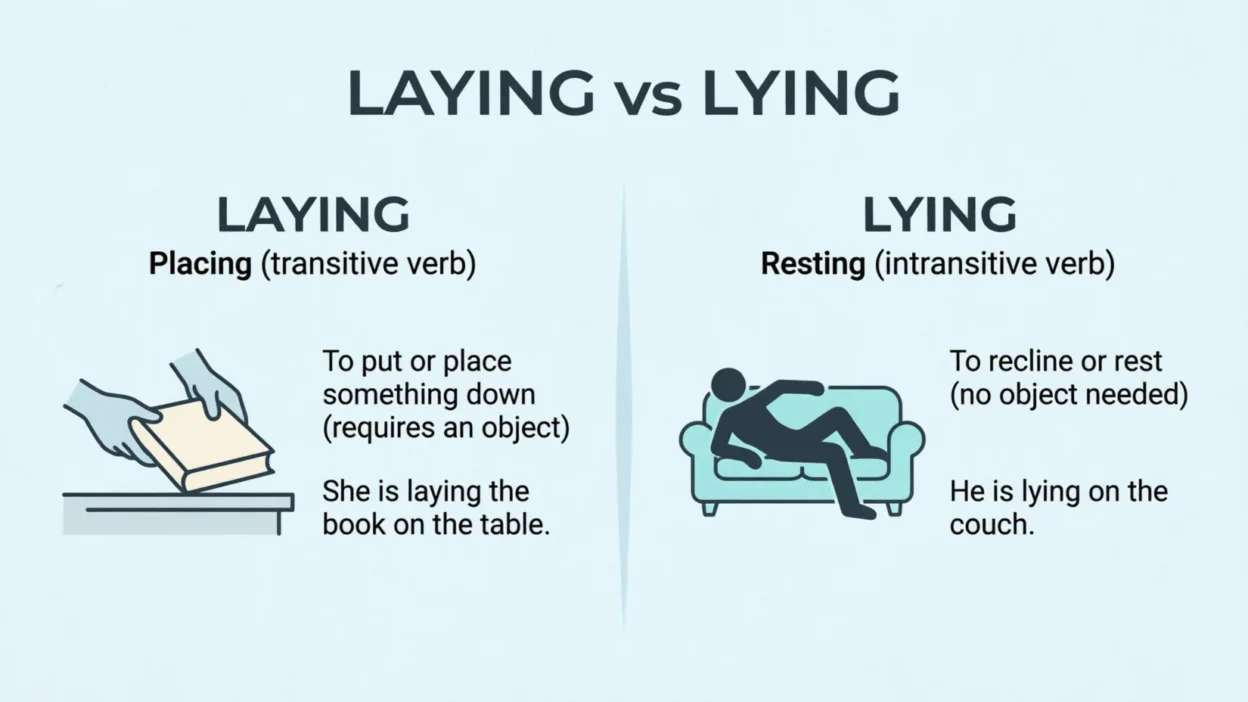
- Lying means reclining or resting.
- Laying means placing something down.
Examples:
- I am lying on the couch. ✅
- She is laying the book on the table. ✅
Simple rule:
- If there is an object receiving the action, use laying.
- If there is no object, use lying.
What Does “Lying” Mean?
“Lying” is the present participle of the verb lie, meaning:
- to recline
- to rest
- to be in a horizontal position
It does not require a direct object.
Examples of Lying
- The cat is lying on the sofa.
- I was lying in bed all morning.
- He enjoys lying in the sun.
- The papers are lying on the desk.
In each sentence, nobody is placing an object somewhere. The subject is simply resting or existing in a position.
What Does “Laying” Mean?
“Laying” is the present participle of the verb lay, meaning:
- to place something down
- to put something somewhere
This verb requires a direct object.
Examples of Laying
- She is laying the plates on the table.
- He was laying bricks all afternoon.
- They are laying fresh carpet in the office.
- The hen is laying eggs.
Notice that something receives the action:
- plates
- bricks
- carpet
- eggs
Laying vs Lying Comparison Table
| Word | Meaning | Needs an Object? | Example |
|---|---|---|---|
| Lying | Reclining/resting | No | She is lying on the couch |
| Laying | Putting something down | Yes | He is laying the book down |
The Core Grammar Rule
The easiest way to understand the difference is by identifying whether there is a direct object.
Lying = No Object
Correct:
- I am lying on the floor.
No object receives the action.
Laying = Requires Object
Correct:
- I am laying the blanket on the bed.
The object is:
- blanket
Why People Confuse Laying and Lying
These verbs confuse people because:
- they sound similar
- their meanings overlap
- irregular verb forms create confusion
The verb forms become even trickier in past tense.
| Base Verb | Present Participle | Past Tense |
|---|---|---|
| Lie | Lying | Lay |
| Lay | Laying | Laid |
This overlap causes many grammar mistakes.
How to Use “Lying” Correctly
Use “lying” when someone or something:
- reclines
- rests
- remains positioned somewhere
Correct Examples
- The dog is lying near the fireplace.
- She spent the afternoon lying in bed.
- My phone is lying on the counter.
- We were lying under the stars.
How to Use “Laying” Correctly
Use “laying” when placing or setting something somewhere.
Correct Examples
- He is laying the tools in the garage.
- She is laying clothes on the chair.
- Workers are laying concrete today.
- The bird is laying eggs.
Common Mistakes With Laying vs Lying
These errors happen frequently in both speech and writing.
Mistake 1: Using Laying Without an Object
Incorrect:
- I am laying on the couch. ❌
Correct:
- I am lying on the couch. ✅
Why?
There is no object being placed anywhere.
Mistake 2: Using Lying With an Object
Incorrect:
- She is lying the keys on the counter. ❌
Correct:
- She is laying the keys on the counter. ✅
Why?
“Keys” receive the action.
Mistake 3: Confusing Present and Past Forms
Incorrect:
- Yesterday I laid in bed all day. ❌
Correct:
- Yesterday I lay in bed all day. ✅
Practical Example Paragraphs
Example Using Lying
After the long hike, Daniel spent the evening lying on the couch while watching movies and drinking tea. He felt exhausted but relaxed.
Example Using Laying
The workers were laying tiles carefully across the kitchen floor. Their attention to detail made the entire room look beautiful and professional.
Placement and Grammar Rules Table
| Phrase | Sentence Placement | Tone | Example Sentence |
|---|---|---|---|
| Lying down | End/middle | Neutral | She is lying down upstairs |
| Lying on | Position phrase | Conversational | The keys are lying on the desk |
| Laying bricks | Action phrase | Professional | Workers are laying bricks |
| Laying eggs | Nature/agriculture | Neutral | Chickens are laying eggs |
American vs British English Differences
There are no major spelling differences between American and British English regarding:
- lying
- laying
However, casual spoken English in both regions sometimes incorrectly uses “laying” instead of “lying.”
Informal Speech Example
Many people casually say:
- “I’m laying down.”
But formal grammar considers:
- “I’m lying down.”
to be correct.
Easy Memory Tricks for Laying vs Lying
Trick 1: Laying = Placing
If you can ask:
- “laying what?”
Then “laying” is probably correct.
Example:
- She is laying the blanket down.
Trick 2: Lying = Resting
If someone is simply resting or reclining, use:
- lying
Example:
- He is lying on the sofa.
Similar Grammar Confusions
People searching for “laying vs lying” often also struggle with:
- laid vs layed
- lie vs lay
- set vs sit
- farther vs further
- who’s vs whose
These confusing verb pairs are common in English because of irregular grammar patterns.
Everyday Examples of Laying and Lying
Correct Uses of Lying
- The baby is lying asleep.
- My jacket is lying on the chair.
- We were lying on the beach.
Correct Uses of Laying
- She is laying the dishes on the table.
- They are laying a foundation for the house.
- Farmers are laying fresh straw in the barn.
Incorrect Examples
- I am laying in bed. ❌
- He is lying the book down. ❌
Why Grammar Accuracy Matters
Using the correct word improves:
- writing clarity
- professionalism
- communication confidence
- grammar accuracy
Mixing up “laying” and “lying” may:
- confuse readers
- weaken formal writing
- sound awkward in professional communication
This matters especially in:
- academic writing
- blogs
- business emails
- educational content
- public speaking
FAQs About Laying vs Lying
What is the difference between laying and lying?
“Lying” means reclining or resting. “Laying” means placing something down.
Is it lying in bed or laying in bed?
Correct:
- lying in bed
Why do people say laying down?
Informal speech often uses “laying” incorrectly, even among native speakers.
Does laying need an object?
Yes. “Laying” always requires something receiving the action.
Is lying grammatically correct?
Yes. “Lying” is the correct form when no object is involved.
What is the past tense of lie?
The past tense of “lie” is:
- lay
What is the past tense of lay?
The past tense of “lay” is:
- laid
Final Thoughts
Understanding the difference between laying vs lying becomes much easier once you focus on one key grammar rule: whether the verb needs an object. “Lying” describes resting or reclining, while “laying” describes placing something somewhere.
Although these words confuse many English speakers, mastering them can instantly improve your grammar, writing confidence, and communication clarity. With practice and the simple memory tricks in this guide, you can use both words naturally and correctly.
Actionable Takeaway
Use this quick rule:
- lying = resting
- laying = placing something
Easy memory trick:
- if you can ask “placing what?” use “laying”
- if no object exists, use “lying”
Before writing the sentence, quickly identify whether an object receives the action. That simple step will help you choose the correct word every time.