The confusion between past vs passed is one of the most common grammar challenges in English. These two words sound exactly alike, but they have completely different meanings and grammatical functions. Because they are homophones, many writers accidentally use one when they actually mean the other.
If you have ever paused while writing a sentence like “She walked past the store” or “He passed the exam,” you are definitely not alone. The good news is that the difference becomes very easy once you understand how each word works in a sentence.
In this guide, you will learn the meanings of “past” and “passed,” grammar rules, pronunciation insights, comparison tables, sentence examples, common mistakes, memory tricks, and practical usage tips to help you write with confidence and clarity.
Quick Answer
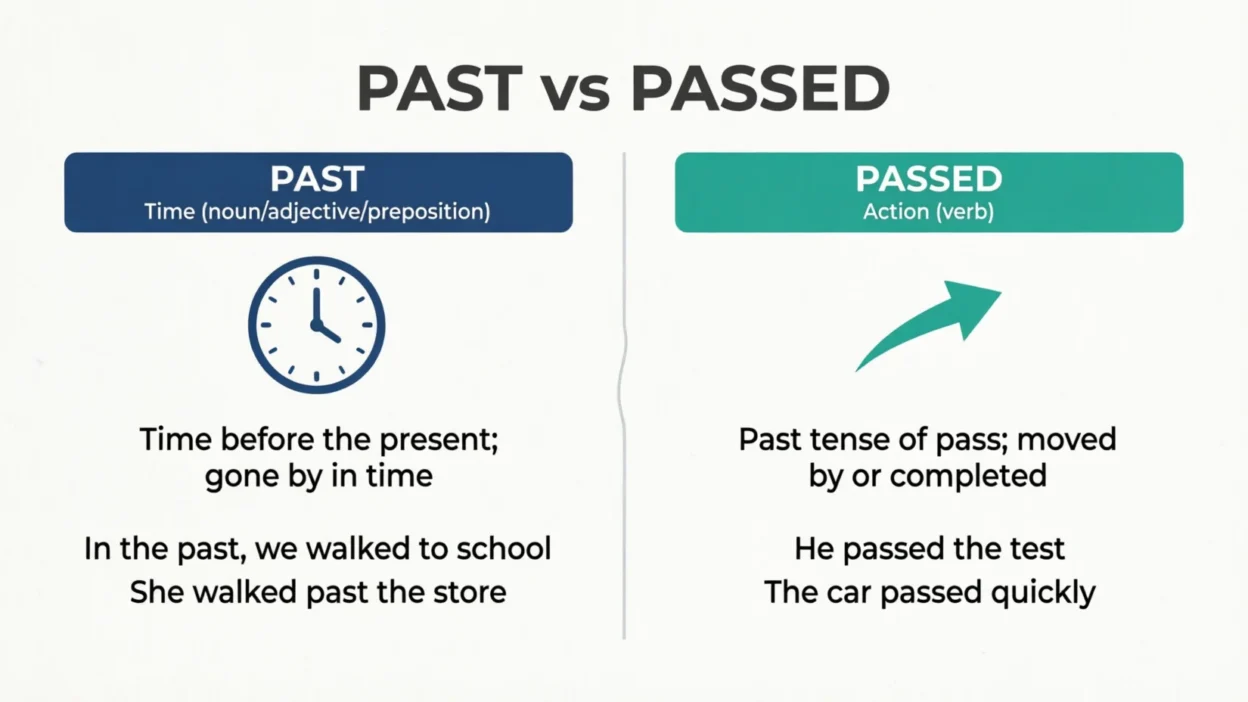
- Past usually relates to time, direction, or position.
- Passed is the past tense of the verb “pass.”
Examples:
- We drove past the museum. ✅
- She passed her driving test. ✅
Simple rule:
- If the sentence involves an action verb, use passed.
- If it refers to time or location, use past.
What Does “Past” Mean?
“Past” can function as:
- a noun
- adjective
- adverb
- preposition
It usually refers to:
- previous time
- movement beyond something
- earlier events
Examples of Past
- The past cannot be changed.
- We walked past the restaurant.
- It is half past seven.
- Past mistakes can teach valuable lessons.
What Does “Passed” Mean?
“Passed” is the past tense and past participle of the verb pass.
It describes:
- moving beyond something
- succeeding
- transferring
- completing
Examples of Passed
- She passed the exam.
- The car passed us quickly.
- He passed the salt to me.
- Time passed slowly during the storm.
Past vs Passed Comparison Table
| Word | Part of Speech | Meaning | Example |
|---|---|---|---|
| Past | Noun/adjective/adverb/preposition | Earlier time or beyond | We walked past the park |
| Passed | Verb | Completed or moved beyond | She passed the test |
The Main Grammar Difference
The easiest way to remember the difference is grammatical function.
Passed = Verb
If you can replace the word with:
- completed
- moved
- succeeded
Then “passed” is usually correct.
Example:
- He passed the course.
Past = Time or Position
If the sentence discusses:
- earlier time
- direction
- location
Use “past.”
Example:
- We drove past the station.
How to Use “Past” Correctly
“Past” is extremely flexible in English grammar.
Past as a Noun
- We should learn from the past.
Past as a Preposition
- The dog ran past the gate.
Past as an Adjective
- Past experiences shape us.
Past as an Adverb
- The crowd rushed past.
How to Use “Passed” Correctly
“Passed” always functions as a verb.
Correct Examples
- She passed the ball.
- He passed away peacefully.
- The students passed their exams.
- We passed several villages on the trip.
Common Mistakes With Past vs Passed
These mistakes are very common because the words sound identical.
Mistake 1: Using Past as a Verb
Incorrect:
- She past the exam. ❌
Correct:
- She passed the exam. ✅
Mistake 2: Using Passed for Time
Incorrect:
- In the passed, people wrote letters. ❌
Correct:
- In the past, people wrote letters. ✅
Mistake 3: Confusing Direction and Action
Incorrect:
- We passed the store and parked. ❌
(If you mean location/direction)
Correct:
- We drove past the store and parked. ✅
Practical Example Paragraphs
Example Using Past
The past often teaches lessons that help people make wiser decisions in the future. Reflecting on earlier experiences can lead to personal growth and stronger relationships.
Example Using Passed
After months of studying, Sarah finally passed her final exams. She felt relieved and proud of all the effort she had invested throughout the semester.
Placement and Grammar Rules Table
| Word/Phrase | Sentence Placement | Tone | Example Sentence |
|---|---|---|---|
| Past experiences | Beginning/middle | Formal/neutral | Past experiences shaped her |
| Walked past | Action/location | Conversational | He walked past the school |
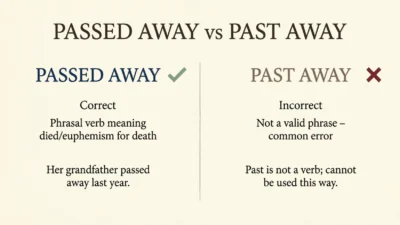
| Passed away | Euphemistic phrase | Respectful | Her grandfather passed away |
| Passed the test | Achievement phrase | Neutral | They passed the exam easily |
Why “Passed Away” Uses Passed
One of the most common phrases using “passed” is:
- passed away
This is a softer, respectful way to say:
- died
Example:
- His uncle passed away last year.
Because it involves the verb “pass,” the correct word is always:
- passed
American vs British English Differences
There are no major spelling differences between American and British English regarding:
- past
- passed
Both varieties follow the same grammar rules.
In Both Variations
Correct:
- She passed the test.
- We walked past the library.
Easy Memory Tricks for Past vs Passed
Trick 1: Passed Has an “Ed”
“Passed” ends in:
- -ed
That usually signals:
- a verb/action
Example:
- He passed the football.
Trick 2: Past Relates to Time
Think:
- the past = history
Example:
- The past is behind us.
Similar Word Confusions
People searching for “past vs passed” often also struggle with:
- than vs then
- affect vs effect
- farther vs further
- breath vs breathe
- laying vs lying
These confusing English word pairs are common because pronunciation overlaps while meanings differ.
Everyday Examples of Past and Passed
Correct Uses of Past
- It is past midnight.
- She looked past his mistakes.
- The past still influences society.
- We ran past the stadium.
Correct Uses of Passed
- He passed me on the highway.
- They passed the new law.
- The teacher passed out worksheets.
- Time passed quickly during vacation.
Incorrect Examples
- She past the interview. ❌
- We drove passed the mall. ❌
Why Grammar Accuracy Matters
Using “past” and “passed” correctly improves:
- writing professionalism
- sentence clarity
- communication confidence
- grammar accuracy
Confusing the two can:
- distract readers
- weaken credibility
- create awkward sentences
This matters especially in:
- academic writing
- business communication
- resumes
- blogs
- professional emails
Helpful Sentence Test
Before choosing the word, ask yourself:
Is It an Action?
Use:
- passed
Example:
- He passed the note.
Is It About Time or Position?
Use:
- past
Example:
- We walked past the building.
FAQs About Past vs Passed
What is the difference between past and passed?
“Past” usually refers to time or position, while “passed” is the past tense of the verb “pass.”
Is it walked past or walked passed?
Correct:
- walked past
Is passed always a verb?
Yes. “Passed” functions only as a verb.
Can past be a noun?
Yes. Example:
- The past affects the future.
Is it past midnight or passed midnight?
Correct:
- past midnight
Why do people confuse past and passed?
Because they sound exactly alike in pronunciation.
Is passed away grammatically correct?
Yes. “Passed away” is a common euphemism for death.
Final Thoughts
Understanding the difference between past vs passed becomes much easier once you remember one key idea: “passed” is always a verb, while “past” usually relates to time, direction, or position. Although the words sound identical, their grammatical roles are very different.
Mastering this distinction can instantly improve your writing clarity, professionalism, and grammar confidence. Whether you are writing essays, emails, blog posts, or casual messages, using the correct word helps your communication feel polished and natural.
Actionable Takeaway
Use this quick rule:
- passed = action verb
- past = time or position
Easy memory trick:
- “passed” has “-ed,” which often signals an action
- “past” relates to history, direction, or placement
Before choosing the word, ask:
- “Is someone doing an action?”
If yes, use passed. If not, choose past.