The confusion between whos vs whose is one of the most common punctuation and grammar mistakes in English. These two words sound exactly alike, but they serve completely different purposes in a sentence. One is a contraction, while the other is a possessive pronoun. Because they are homophones, many writers accidentally mix them up in emails, essays, social media posts, and professional communication.
If you have ever paused while typing “whose bag is this?” or “who’s coming tonight?”, you are definitely not alone. Even experienced writers occasionally second-guess themselves with this word pair. The good news is that the rule is actually simple once you understand how each word functions grammatically.
In this complete guide, you will learn the meaning of “who’s” and “whose,” grammar rules, pronunciation tips, sentence examples, common mistakes, memory tricks, comparison tables, and practical ways to use both correctly every time.
Quick Answer
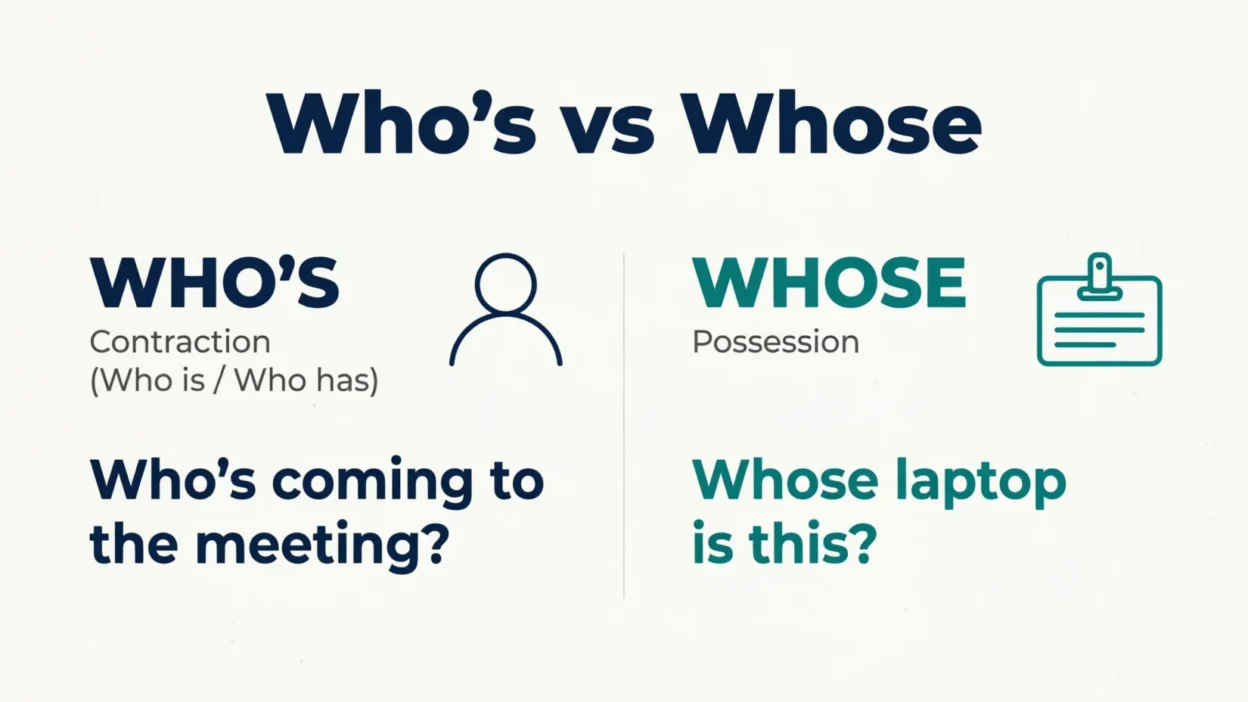
- Who’s = contraction of who is or who has
- Whose = possessive pronoun showing ownership
Examples:
- Who’s coming to dinner tonight? ✅
- Whose phone is ringing? ✅
Simple memory trick:
- If you can replace the word with “who is,” use who’s.
- If you are showing ownership, use whose.
What Does “Who’s” Mean?
“Who’s” is a contraction.
It combines:
- who + is
- who + has
Examples of Who’s
- Who’s at the door?
- Who’s ready to leave?
- Who’s been using my laptop?
- Do you know who’s calling?
Expanded Versions
- Who’s coming? → Who is coming?
- Who’s finished the project? → Who has finished the project?
If the expanded sentence still makes sense, “who’s” is correct.
What Does “Whose” Mean?
“Whose” is a possessive pronoun.
It shows:
- ownership
- belonging
- association
Examples of Whose
- Whose jacket is this?
- I met the author whose book became famous.
- Whose idea was this?
- Do you know whose keys these are?
Whos vs Whose Comparison Table
| Word | Meaning | Grammar Role | Example |
|---|---|---|---|
| Who’s | Who is / who has | Contraction | Who’s coming tonight? |
| Whose | Belonging to whom | Possessive pronoun | Whose car is outside? |
| Whos | Incorrect spelling | Not standard English | ❌ |
Is “Whos” Ever Correct?
No. “Whos” without an apostrophe is considered incorrect in standard English.
The correct forms are:
- who’s
- whose
Many people accidentally type “whos” because:
- they forget the apostrophe
- they type quickly
- autocorrect misses the error
The Main Grammar Difference
The easiest way to remember the difference is this:
Who’s = Who Is
Example:
- Who’s responsible for this mess?
- Who is responsible for this mess?
Whose = Ownership
Example:
- Whose shoes are these?
How to Use “Who’s” Correctly
Use “who’s” when you mean:
- who is
- who has
Correct Examples
- Who’s going to the meeting?
- Who’s been eating the cookies?
- Do you know who’s online?
- Who’s excited for the trip?
Incorrect Uses
Incorrect:
- Who’s backpack is on the floor? ❌
Correct:
- Whose backpack is on the floor? ✅
How to Use “Whose” Correctly
Use “whose” to show possession or ownership.
Correct Examples
- Whose turn is it?
- She is the teacher whose students won awards.
- Whose notebook did I borrow?
- We found the child whose dog was missing.
Common Mistakes With Whos vs Whose
These mistakes happen frequently in casual and professional writing.
Mistake 1: Forgetting the Apostrophe
Incorrect:
- Whos coming tonight? ❌
Correct:
- Who’s coming tonight? ✅
Mistake 2: Using Who’s for Possession
Incorrect:
- Who’s laptop is this? ❌
Correct:
- Whose laptop is this? ✅
Mistake 3: Avoiding Apostrophes Completely
Some writers avoid contractions entirely because they feel unsure. However, understanding the rule makes writing smoother and more natural.
Practical Example Paragraphs
Example Using Who’s
Who’s planning the event this weekend? Everyone wants to know who is organizing the schedule and handling the invitations.
Example Using Whose
The company hired a designer whose portfolio impressed the entire marketing team. Her creativity and professionalism stood out immediately.
Placement and Grammar Rules Table
| Word/Phrase | Sentence Placement | Tone | Example Sentence |
|---|---|---|---|
| Who’s | Questions/statements | Informal to formal | Who’s calling right now? |
| Whose | Ownership questions | Neutral | Whose umbrella is this? |
| Whose + noun | Before object | Formal/neutral | Whose jacket was left behind? |
| Who’s been | Conversational | Informal | Who’s been using my charger? |
American vs British English Differences
There are no significant differences between American and British English regarding:
- spelling
- punctuation
- grammar rules
Both forms remain:
- who’s = contraction
- whose = possessive pronoun
Why Correct Usage Matters
Using the correct word improves:
- grammar accuracy
- professionalism
- readability
- writing confidence
Mixing up “who’s” and “whose” may:
- confuse readers
- weaken academic writing
- make emails appear careless
This distinction matters especially in:
- business communication
- school essays
- resumes
- website content
- professional blogging
Easy Memory Tricks for Whos vs Whose
Trick 1: Expand the Contraction
If you can replace it with:
- who is
- who has
Then use:
- who’s
Example:
- Who’s at the door?
- Who is at the door?
Trick 2: Think About Ownership
If the sentence talks about possession, use:
- whose
Example:
- Whose bag is this?
Similar Grammar Pairs
English has many confusing contractions and possessives.
| Contraction | Possessive |
|---|---|
| It’s | Its |
| Who’s | Whose |
| They’re | Their |
| You’re | Your |
Learning one pair often helps you understand the others more easily.
Everyday Examples of Who’s and Whose
Correct Uses of Who’s
- Who’s ready for lunch?
- Who’s been texting me?
- Do you know who’s singing?
Correct Uses of Whose
- Whose headphones are these?
- Whose car blocked the driveway?
- I met a writer whose articles went viral.
Incorrect Examples
- Whos ready to leave? ❌
- Who’s jacket is blue? ❌
Why “Whose” Has No Apostrophe
This confuses many learners because possession often uses apostrophes.
However, possessive pronouns usually do not contain apostrophes.
Examples:
- his
- hers
- yours
- ours
- whose
That is why:
- whose = correct
- who’s = contraction only
FAQs About Whos vs Whose
Is whos a real word?
No. “Whos” without an apostrophe is incorrect.
What is the difference between who’s and whose?
“Who’s” means “who is” or “who has.”
“Whose” shows ownership.
How do I know which one to use?
Replace “who’s” with “who is.” If the sentence still works, it is correct.
Is whose possessive?
Yes. “Whose” is a possessive pronoun.
Why does whose not use an apostrophe?
Possessive pronouns usually do not use apostrophes in English grammar.
Can who’s show possession?
No. “Who’s” is only a contraction.
Are who’s and whose pronounced differently?
No. They sound the same when spoken.
Final Thoughts
Understanding the difference between whos vs whose can instantly improve your grammar and writing confidence. “Who’s” is simply a contraction for “who is” or “who has,” while “whose” is used to show possession or ownership.
Although the two words sound identical, their grammatical functions are completely different. Once you learn the contraction test and the ownership rule, choosing the correct form becomes much easier in both casual and professional writing.
Actionable Takeaway
Use this quick grammar rule:
- who’s = who is/who has
- whose = possession
Easy memory trick:
- apostrophe = contraction
- no apostrophe = ownership
Before writing, quickly test the sentence with “who is.” If it fits naturally, choose “who’s.” If the sentence shows ownership, use “whose.”

Fenwick Quentin is a creative blogging author known for his analytical yet engaging writing style.
He explores topics such as innovation, digital culture, and personal development with depth and clarity.
Through his articles, Fenwick encourages readers to think critically and embrace continuous growth.