Have you ever written “I sitted down” and wondered if it sounded right? You’re not alone. This is a very common confusion, especially for learners and even native speakers who rely on instinct rather than grammar rules.
The difference between sitted vs seated comes down to how English verbs actually work. While both may seem logical, only one is correct in standard usage.
In this guide, you’ll learn the right form, how to use it naturally, and how to avoid this mistake for good.
Quick Answer
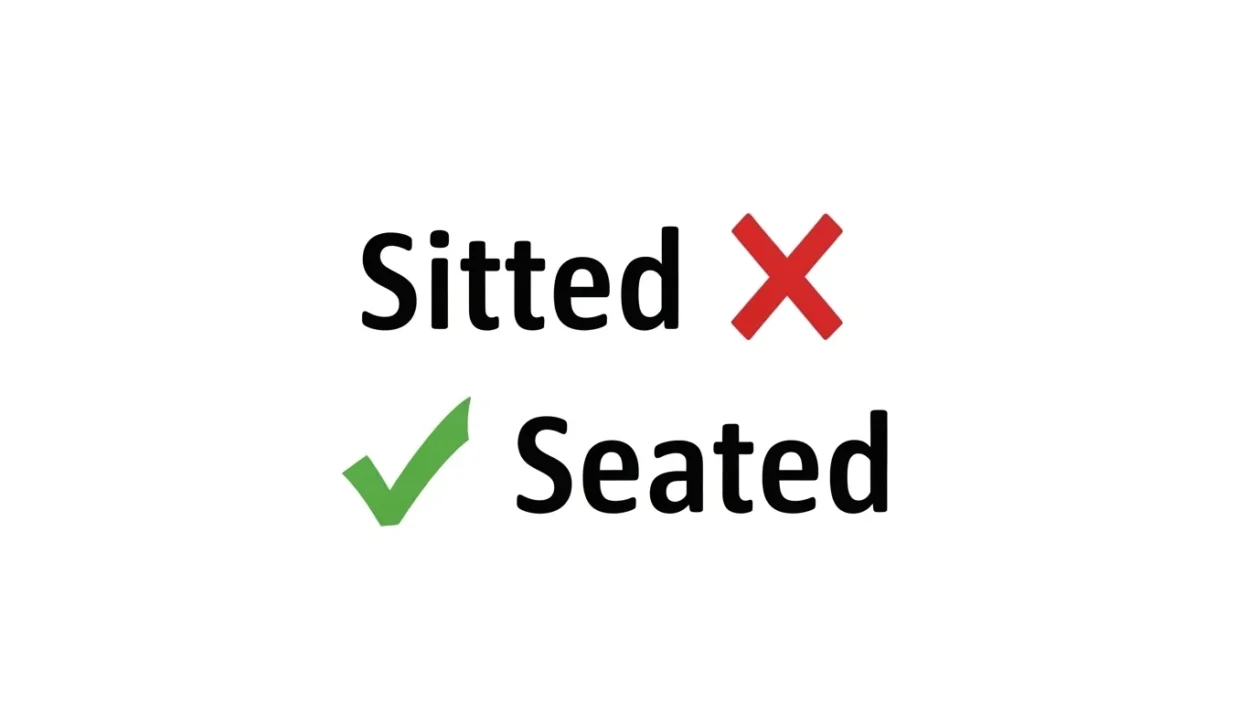
- ❌ Sitted is incorrect in standard English
- ✅ Seated is correct (in specific contexts)
- The correct past tense of “sit” is sat, not sitted
Understanding the Verb “Sit”
To fully understand sitted vs seated, we need to look at the verb “sit.”
Verb forms:
- Present: sit
- Past: sat
- Past participle: sat
Examples:
- I sit here every day.
- Yesterday, I sat by the window.
- I have sat in that chair before.
👉 Notice: “sitted” does not exist as a correct verb form
What Does “Seated” Mean?
The word seated comes from the verb “seat,” which means to place someone in a sitting position or to be in that position.
Core meanings:
- Sitting down (often in a formal or descriptive way)
- Placed in a seat
Examples:
- She was seated near the window.
- The guests were seated at the table.
- He remained seated throughout the meeting.
LSI keywords and related phrases:
- sitting
- positioned
- settled
- placed in a seat
- taking a seat
- arranged seating
These help improve clarity and SEO.
What Is “Sitted”? Is It Ever Correct?
Let’s make this clear: “sitted” is not correct in standard English.
It’s a common mistake caused by trying to apply regular verb rules to an irregular verb.
Why people say “sitted”:
- Assuming “sit” follows regular patterns (like “walk → walked”)
- Confusing it with verbs that add “-ed”
- Learning English as a second language
Important:
- ❌ Sitted → Incorrect
- ✅ Sat / Seated → Correct
Sitted vs Seated: Side-by-Side Comparison
| Feature | Sitted ❌ | Seated ✅ |
|---|---|---|
| Valid word | No | Yes |
| Grammar | Incorrect verb form | Correct (from “seat”) |
| Meaning | Intended past of sit | In a sitting position |
| Usage | Incorrect | Correct in formal contexts |
| Example | ✖ I sitted there | ✔ I was seated there |
Sat vs Seated: What’s the Difference?
This is where many learners get confused.
“Sat” (from sit):
- Used for general past tense
- More common in everyday speech
Examples:
- I sat on the chair.
- She sat quietly.
“Seated” (from seat):
- More formal
- Often used in passive voice
Examples:
- He was seated at the front.
- Guests were seated by the host.
Quick comparison:
- Casual → sat
- Formal/descriptive → seated
How to Use “Seated” Correctly
The word seated is commonly used in formal or structured contexts.
1. Formal situations
- The audience was seated before the event began.
- She was seated at the head of the table.
2. Hospitality and service
- The waiter seated the guests.
- Please remain seated during the show.
3. Descriptive writing
- He sat quietly, already seated and relaxed.
Tip:
Use seated when emphasizing position or arrangement, not just the action.
Common Mistakes to Avoid
Here are the most frequent errors with sitted vs seated:
1. Using “sitted” as past tense
- ❌ I sitted there
- ✅ I sat there
2. Confusing “sat” and “seated”
- ❌ I seated on the chair
- ✅ I sat on the chair
- ✅ I was seated on the chair
3. Overusing “seated”
In casual speech, “sat” is usually more natural.
4. Ignoring irregular verb rules
“Sit” is irregular—memorize its forms.
American vs British English Differences
Good news—this is consistent:
- Sat and seated are used in both American English and British English
- No spelling differences exist
- Usage patterns are similar globally
Slight nuance:
- British English may use “sat” more frequently in casual contexts
- American English often uses “seated” in formal writing
Synonyms and Alternatives
To improve variety and readability, consider these alternatives:
For “seated”:
- sitting
- positioned
- placed
- settled
For “sat”:
- rested
- perched
- stayed
Examples:
- She was seated → She was positioned
- He sat down → He rested
These alternatives enhance flow and SEO.
Real-Life Usage Examples
Let’s explore how seated and sat are used:
Everyday speech:
- I sat on the sofa.
Formal writing:
- Guests were seated at their tables.
Hospitality:
- The host seated the visitors.
Descriptive:
- She remained seated, calm and composed.
These examples show when each form works best.
FAQs About Sitted vs Seated
Is “sitted” ever correct?
No, it is not a correct form in standard English.
What is the past tense of “sit”?
The correct past tense is sat.
What does “seated” mean?
It means being in a sitting position or placed in a seat.
Can I say “I was seated”?
Yes, that is correct and often used in formal contexts.
Is “seated” the same as “sat”?
Not exactly—“seated” is more formal and descriptive.
Why do people say “sitted”?
Because they mistakenly apply regular verb rules.
Which is better: “sat” or “seated”?
Use “sat” for casual speech and “seated” for formal contexts.
Summary: Sitted vs Seated Made Simple
The difference between sitted vs seated is all about correct verb usage. Sitted is not a valid word in standard English, while seated is correct but used in specific contexts.
The true past tense of “sit” is sat, which is the most commonly used form in everyday language.
Understanding this distinction helps you communicate more clearly and naturally. By choosing the right word based on context—casual or formal—you can improve both your writing and speaking skills.
Actionable Takeaway
Here’s your simple rule:
👉 Never use sitted—use sat for past tense and seated for formal descriptions
Before finishing your writing, double-check verb forms. Small grammar corrections like this can make your communication more polished, accurate, and professional.