The confusion between theirs vs theres is one of the most common grammar mistakes in English writing. Many people type “theres” when they actually mean “theirs” or even “there’s.” Since these words sound similar in conversation, it is easy to mix them up while writing emails, essays, social media captions, or professional documents.
The good news is that the difference is actually simple once you understand the grammar rules behind each word. One word shows possession, while the other is usually a spelling mistake unless written correctly with an apostrophe as “there’s.” Learning when and how to use these words correctly can instantly improve your writing clarity and confidence.
In this complete guide, you will learn the meanings of theirs and theres, grammar rules, examples, common mistakes, memory tricks, comparison tables, and practical usage tips to help you avoid confusion every time.
Quick Answer
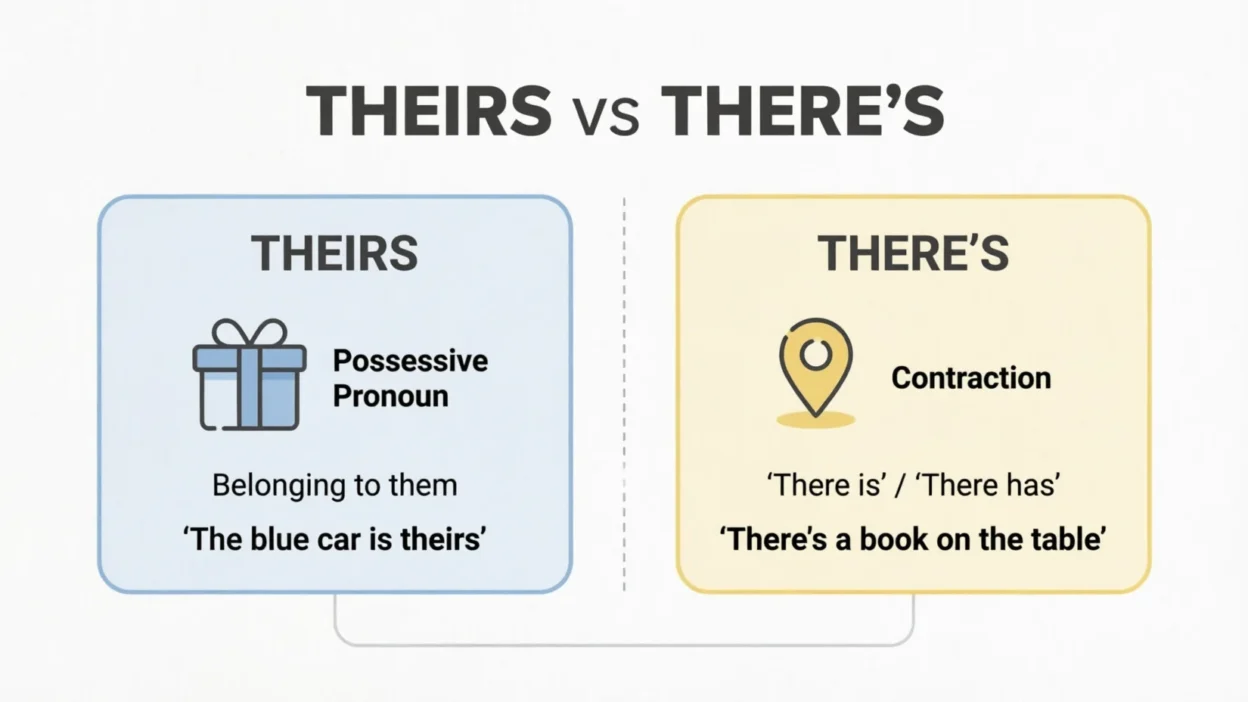
- Theirs is a possessive pronoun showing ownership.
- Theres is usually incorrect because it is missing an apostrophe. The correct form is there’s.
- The blue car is theirs. ✅
- There’s a problem with the schedule. ✅
Incorrect example:
- Theres a book on the table. ❌
Simple rule:
- Theirs = possession
- There’s = there is / there has
What Does “Theirs” Mean?
“Theirs” is a possessive pronoun used to show ownership or belonging.
It replaces a noun phrase to avoid repetition.
Examples of Theirs
- That house is theirs.
- The final decision was theirs.
- These bags are theirs.
- The victory belongs to them, so it’s theirs.
Why Use “Theirs”?
Using “theirs” helps sentences sound smoother and less repetitive.
Instead of:
- The books belong to them.
You can say:
- The books are theirs.
What Does “Theres” Mean?
“Theres” without an apostrophe is generally considered incorrect in standard English.
Most people actually mean:
- there’s
What Does “There’s” Mean?
“There’s” is a contraction of:
- there is
or - there has
Examples of There’s
- There’s a cat outside.
- There’s been a mistake.
- There’s no reason to worry.
- There’s plenty of food left.
Theirs vs Theres Comparison Table
| Word | Grammar Type | Meaning | Correct Example |
|---|---|---|---|
| Theirs | Possessive pronoun | Shows ownership | The jackets are theirs |
| Theres | Incorrect spelling | Usually meant to be “there’s” | Theres a car ❌ |
| There’s | Contraction | There is / there has | There’s a meeting today |
The Main Difference Between Theirs and Theres
The key difference is grammatical purpose.
Theirs = Ownership
Use “theirs” when something belongs to people.
Example:
- The responsibility is theirs.
There’s = Existence or Presence
Use “there’s” when introducing something.
Example:
- There’s a solution to the problem.
How to Use “Theirs” Correctly
“Theirs” always shows possession.
Common Uses of Theirs
- the decision is theirs
- the house is theirs
- the responsibility is theirs
- the choice is theirs
Correct Examples
- The large office is theirs.
- These shoes are theirs, not ours.
- The success was entirely theirs.
- The final vote was theirs to make.
How to Use “There’s” Correctly
“There’s” introduces:
- existence
- presence
- situations
Common Uses of There’s
- there’s a problem
- there’s time
- there’s someone here
- there’s been confusion
Correct Examples
- There’s a meeting tomorrow.
- There’s nothing to fear.
- There’s been a delay.
- There’s plenty of coffee left.
Common Mistakes With Theirs vs Theres
These words are frequently confused because of pronunciation similarities.
Mistake 1: Writing “Theres” Without an Apostrophe
Incorrect:
- Theres a new manager today. ❌
Correct:
- There’s a new manager today. ✅
Why?
The contraction requires an apostrophe.
Mistake 2: Using Theirs Instead of There’s
Incorrect:
- Theirs no reason to panic. ❌
Correct:
- There’s no reason to panic. ✅
Why?
The sentence means:
- there is no reason
Mistake 3: Apostrophe Confusion
Some writers incorrectly add an apostrophe to:
- theirs
Incorrect:
- Their’s laptop is expensive. ❌
Correct:
- The laptop is theirs. ✅
Why?
Possessive pronouns do not use apostrophes.
Practical Example Paragraphs
Example Using Theirs
After the competition ended, the championship trophy was officially theirs. The team celebrated together after months of hard work and dedication.
Example Using There’s
There’s always an opportunity to improve your writing skills when you practice grammar consistently and pay attention to common mistakes.
Placement and Grammar Rules Table
| Phrase | Sentence Placement | Tone/Formality | Example Sentence |
|---|---|---|---|
| The choice is theirs | End | Neutral/formal | The final decision is theirs |
| The responsibility is theirs | End | Professional | The outcome is theirs to manage |
| There’s a problem | Beginning | Neutral | There’s a mistake in the report |
| There’s been | Beginning/middle | Formal/informal | There’s been confusion recently |
Theirs vs There’s vs Their
Many English learners also confuse:
- theirs
- there’s
- their
Their
“Their” is a possessive adjective.
Example:
- Their car is parked outside.
Theirs
“Theirs” is a possessive pronoun.
Example:
- The car is theirs.
There’s
“There’s” means:
- there is
or - there has
Example:
- There’s a car outside.
American vs British English Differences
There are no major spelling differences between American and British English for:
- theirs
- there’s
Both forms follow the same grammar rules in each variety of English.
Examples
American English:
- There’s a package outside.
British English:
- There’s a package outside.
Easy Memory Tricks for Theirs vs Theres
Trick 1: Theirs = Ownership
“Theirs” contains:
- heir
Think of:
- heirs owning something
This helps connect the word to possession.
Trick 2: There’s = There Is
The apostrophe replaces:
- i
Example:
- there is → there’s
If you can expand the sentence into:
- there is
or - there has
then “there’s” is correct.
Why Correct Usage Matters
Using the correct word improves:
- grammar accuracy
- professionalism
- readability
- communication clarity
Mistakes involving:
- theirs
- there’s
- their
are extremely noticeable in:
- academic writing
- resumes
- emails
- business communication
- website content
Correct grammar helps your writing appear more polished and trustworthy.
Similar English Word Confusions
People searching for “theirs vs theres” often also confuse:
- who’s vs whose
- your vs you’re
- its vs it’s
- passed vs past
- discreet vs discrete
Mastering these grammar differences strengthens overall English fluency.
Everyday Examples of Theirs and There’s
Correct Uses of Theirs
- The large cabin is theirs.
- Those ideas were theirs.
- The responsibility is theirs alone.
- The victory belongs to them, so it’s theirs.
Correct Uses of There’s
- There’s a message for you.
- There’s no need to hurry.
- There’s been an update.
- There’s enough food for everyone.
Incorrect Examples
- Theres a problem here. ❌
- Theirs no reason to leave. ❌
FAQs About Theirs vs Theres
What is the difference between theirs and theres?
“Theirs” shows ownership, while “theres” is usually an incorrect spelling of “there’s.”
Is theres a real word?
Not in standard English. The correct form is:
- there’s
What does theirs mean?
“Theirs” means something belongs to them.
Why does there’s need an apostrophe?
Because it is a contraction of:
- there is
or - there has
Can theirs have an apostrophe?
No. Possessive pronouns do not use apostrophes.
How do you use theirs in a sentence?
Example:
- That decision is theirs.
How do you use there’s in a sentence?
Example:
- There’s a meeting this afternoon.
Final Thoughts
Understanding the difference between theirs vs theres can instantly improve your grammar and writing clarity. “Theirs” is a possessive pronoun showing ownership, while “theres” is generally incorrect and should usually be written as “there’s.”
Mastering these small grammar details helps your writing sound more polished, professional, and trustworthy. Whether you are writing emails, essays, social posts, or business documents, choosing the correct form ensures your message stays clear and accurate.
Actionable Takeaway
Use this quick rule:
- theirs = ownership
- there’s = there is / there has
Easy memory trick:
- if you can replace the word with “there is,” use “there’s”
Before writing, ask yourself:
- “Am I showing ownership or introducing something?”
That simple check will help you choose the correct word every time.