The confusion between cue vs que is extremely common, especially in online writing, texting, subtitles, and casual conversations. Since these words look similar and are sometimes pronounced alike depending on accent and language background, many people accidentally use one in place of the other. However, their meanings are completely different, and understanding the distinction can improve your grammar and communication instantly.
In English, cue is a real word with several meanings related to signals, prompts, and entertainment. On the other hand, que is usually not an English word at all unless it appears in Spanish, French, or certain names and expressions. Many writers mistakenly type “que” when they actually mean “cue” or “queue.” That small spelling mistake can make sentences confusing or grammatically incorrect.
This complete guide explains the meanings of cue and que, how to use them properly, examples, grammar rules, comparison tables, common mistakes, and practical memory tricks so you can write with confidence every time.
Quick Answer
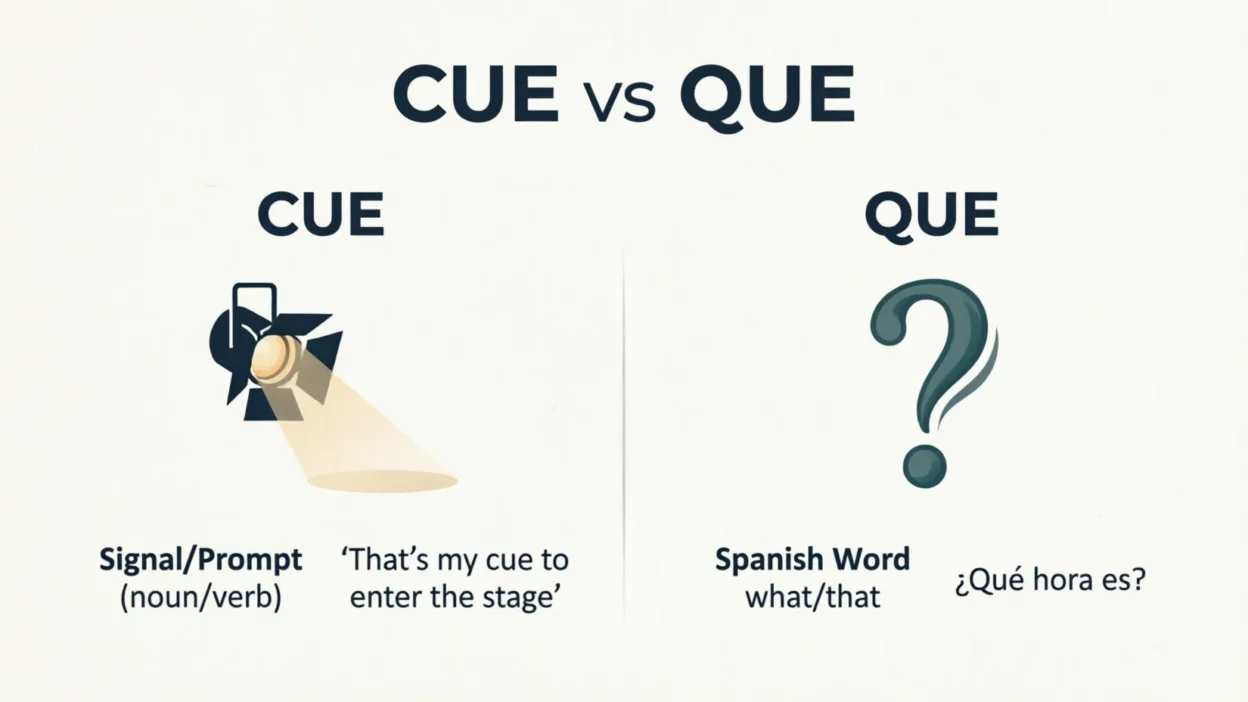
- Cue is an English word meaning a signal, prompt, or indication to act.
- Que is generally not standard English and is mostly used in Spanish, French, or informal internet slang.
- That was my cue to leave. ✅
Incorrect example:
- That was my que to leave. ❌
Simple rule:
- Cue = signal or prompt
- Que = usually incorrect in English sentences
What Does “Cue” Mean?
The word “cue” has several meanings in English, but it usually refers to:
- a signal
- a prompt
- an indication to act
- a reminder or trigger
It is commonly used in:
- theater
- music
- films
- conversations
- psychology
- daily communication
Examples of Cue
- The actor waited for his cue.
- That was my cue to start speaking.
- Her smile was a cue that everything was fine.
- The music cue began softly.
What Does “Que” Mean?
“Que” is generally not an English word in standard grammar.
However, it may appear in:
- Spanish
- French
- internet slang
- names or phrases
In Spanish
“Que” often means:
- that
- what
- which
Example:
- ¿Qué pasa?
In Internet Slang
Some people incorrectly type:
- que
when they actually mean:
- cue
or - queue
Cue vs Que Comparison Table
| Word | Language | Meaning | Correct Example |
|---|---|---|---|
| Cue | English | Signal or prompt | That was my cue |
| Que | Spanish/French | Foreign-language word | ¿Qué quieres? |
The Main Difference Between Cue and Que
The key difference is simple:
- “Cue” is correct English.
- “Que” is generally not correct in English writing unless used in another language.
Cue = Prompt or Signal
Use “cue” when discussing:
- timing
- signals
- reactions
- reminders
Example:
- The teacher gave the cue to begin.
Que = Foreign Language Usage
Use “que” only in:
- Spanish
- French
- quoted expressions
- names
Example:
- Qué bonito.
How to Use “Cue” Correctly
“Cue” can function as:
- a noun
- a verb
Cue as a Noun
Meaning:
- signal or prompt
Example:
- The audience laughed right on cue.
Cue as a Verb
Meaning:
- to prompt or prepare someone
Example:
- The director cued the music.
Common Uses of Cue
Everyday Phrases
- right on cue
- take the cue
- visual cue
- social cue
- cue the music
Correct Examples
- She missed her cue during the play.
- Facial expressions provide social cues.
- The presenter cued the next video.
- Rain started right on cue.
Common Mistakes With Cue vs Que
These words are often confused because:
- they sound alike
- autocorrect changes spelling
- people mix them with “queue”
Mistake 1: Using Que Instead of Cue
Incorrect:
- That was my que to leave. ❌
Correct:
- That was my cue to leave. ✅
Why?
The sentence refers to a signal or prompt.
Mistake 2: Confusing Cue With Queue
Incorrect:
- We stood in a cue at the airport. ❌
Correct:
- We stood in a queue at the airport. ✅
Why?
“Queue” means:
- a line of people waiting
Mistake 3: Using Que in Formal English
Incorrect:
- Her smile was my que. ❌
Correct:
- Her smile was my cue. ✅
Why?
Standard English requires:
- cue
Practical Example Paragraphs
Example Using Cue
As soon as the lights dimmed, the musicians took it as their cue to begin performing. The audience became silent immediately.
Example Using Que
In Spanish class, students learned that “que” can mean “that” or “what” depending on the sentence structure.
Placement and Grammar Rules Table
| Phrase | Sentence Placement | Tone/Formality | Example Sentence |
|---|---|---|---|
| Right on cue | End | Informal/neutral | The rain started right on cue |
| Social cue | Middle | Professional | Children learn social cues early |
| Cue the music | Beginning/middle | Informal | Cue the music for the ceremony |
| Qué pasa | Beginning | Informal Spanish | ¿Qué pasa contigo? |
Cue in Theater and Entertainment
The word “cue” is heavily used in:
- acting
- directing
- music
- broadcasting
Examples
- lighting cue
- sound cue
- stage cue
- performance cue
Example Sentences
- The actor forgot his cue.
- The sound cue came too early.
Cue in Psychology and Communication
In psychology and social interaction, cues help people:
- understand emotions
- react appropriately
- interpret behavior
Types of Social Cues
- facial expressions
- body language
- tone of voice
- gestures
Example
- Children gradually learn emotional cues from parents.
Cue vs Queue vs Que
Many writers also confuse:
- cue
- queue
- que
Cue
Means:
- signal or prompt
Example:
- That was my cue.
Queue
Means:
- line of waiting people
Example:
- We joined the queue.
Que
Usually belongs to:
- Spanish or French
Example:
- ¿Qué haces?
American vs British English Differences
There are no spelling differences between American and British English for:
- cue
Both English variants use the same spelling and meaning.
Example
American English:
- The actor waited for his cue.
British English:
- The actor waited for his cue.
Easy Memory Tricks for Cue vs Que
Trick 1: Cue = Signal
Think:
- cue = clue to act
Both words relate to:
- guidance
- signals
Trick 2: Que Looks Foreign
“Que” commonly appears in:
- Spanish
- French
So if you are writing normal English, you probably need:
- cue
Why Correct Usage Matters
Using the correct spelling improves:
- writing clarity
- professionalism
- communication accuracy
- grammar confidence
Mistakes involving:
- cue
- queue
- que
can make writing look careless in:
- emails
- essays
- business communication
- academic writing
- website content
Correct grammar helps readers understand your message immediately.
Similar English Word Confusions
People searching for “cue vs que” often also confuse:
- cue vs queue
- discreet vs discrete
- passed vs past
- breath vs breathe
- affect vs effect
Learning confusing word pairs improves overall English fluency and writing skills.
Everyday Examples of Cue
Correct Uses
- That was my cue to start talking.
- The audience clapped right on cue.
- She picked up on subtle social cues.
- The director cued the lights.
Incorrect Uses
- That was my que to speak. ❌
- The actor missed his que. ❌
FAQs About Cue vs Que
What is the difference between cue and que?
“Cue” is an English word meaning signal or prompt, while “que” is generally a foreign-language word.
Is que an English word?
Not usually. It mainly appears in Spanish and French.
How do you use cue in a sentence?
Example:
- That was my cue to leave.
What does cue mean?
It means:
- signal
- prompt
- indication to act
Is que the same as queue?
No. “Queue” means a line of waiting people.
What is a social cue?
A social cue is a signal from body language, tone, or facial expression.
Why do people confuse cue and que?
Because the words look similar and may sound alike depending on pronunciation.
Final Thoughts
Understanding the difference between cue vs que can instantly improve your grammar and writing clarity. “Cue” is the correct English word for signals, prompts, and indications, while “que” usually belongs to foreign languages such as Spanish or French.
Mastering commonly confused words helps your writing become more professional, polished, and easy to understand. Whether you are writing emails, essays, scripts, or social media content, using the correct spelling ensures your message stays accurate and credible.
Actionable Takeaway
Use this quick rule:
- cue = signal or prompt
- que = usually foreign-language usage
Easy memory trick:
- “cue” gives you a clue about what happens next
Before writing, ask yourself:
- “Am I talking about a signal or prompt?”
If yes, the correct word is almost always:

Fenwick Quentin is a creative blogging author known for his analytical yet engaging writing style.
He explores topics such as innovation, digital culture, and personal development with depth and clarity.
Through his articles, Fenwick encourages readers to think critically and embrace continuous growth.