The confusion between cord vs chord is very common because these words sound exactly alike in spoken English. They are homophones, meaning they share the same pronunciation but have completely different meanings and spellings. One word usually relates to ropes, cables, or anatomy, while the other is strongly connected to music, mathematics, and emotions.
If you have ever written phrases like “guitar cord” when talking about music or “extension chord” instead of “extension cord,” you are definitely not alone. Small spelling mistakes can change the meaning of an entire sentence. Understanding the difference between cord and chord will help your writing appear clearer, more polished, and grammatically accurate.
In this complete guide, you will learn the meanings of cord and chord, grammar rules, sentence examples, common mistakes, practical tips, comparison tables, and easy memory tricks to help you use the correct word every time.
Quick Answer
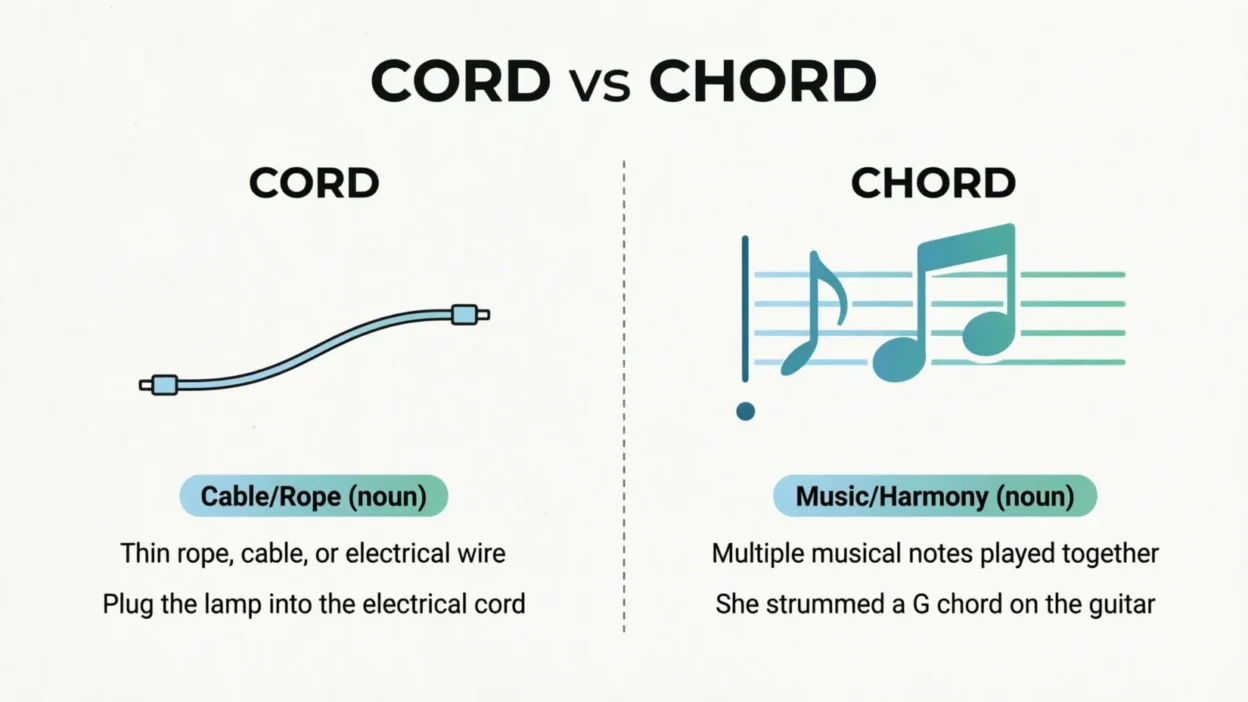
- Cord usually refers to a rope, cable, string, or long flexible material.
- Chord commonly refers to a group of musical notes played together.
- Plug the charger into the extension cord. ✅
- She played a beautiful chord on the piano. ✅
Simple rule:
- Cord = rope or cable
- Chord = music or harmony
What Does “Cord” Mean?
The word “cord” is generally used for:
- ropes
- strings
- cables
- flexible connectors
It can also appear in anatomy and measurements.
Common Meanings of Cord
- electrical cable
- rope or string
- spinal cord
- vocal cords
- decorative cord
Examples of Cord
- The power cord is damaged.
- He tied the package with a cord.
- The microphone cord stretched across the stage.
- Doctors examined the patient’s spinal cord.
What Does “Chord” Mean?
“Chord” is most commonly associated with:
- music
- harmony
- emotional resonance
- geometry
In music, a chord is:
- a group of notes played together
Examples of Chord
- She played a major chord on the guitar.
- The piano chord sounded beautiful.
- His speech struck a chord with the audience.
- Students learned basic guitar chords.
Cord vs Chord Comparison Table
| Word | Meaning | Common Context | Example |
|---|---|---|---|
| Cord | Rope, cable, string | Electronics, anatomy, objects | The cord is unplugged |
| Chord | Group of musical notes | Music, emotions, geometry | She played a chord |
The Main Difference Between Cord and Chord
The easiest way to separate these words is by context.
Cord = Physical Object
Use “cord” when talking about:
- wires
- ropes
- cables
- strings
Example:
- The lamp cord is too short.
Chord = Music or Harmony
Use “chord” when discussing:
- musical notes
- instruments
- harmony
- emotional impact
Example:
- He practiced guitar chords daily.
How to Use “Cord” Correctly
“Cord” is usually a noun referring to something long and flexible.
Common Uses of Cord
- extension cord
- power cord
- spinal cord
- vocal cords
- bungee cord
Correct Examples
- The extension cord reached the garage.
- She wrapped the cord neatly.
- The spinal cord controls many body functions.
- His headphones came with a long cord.
How to Use “Chord” Correctly
“Chord” mainly appears in:
- music theory
- musical instruments
- emotional expressions
Common Uses of Chord
- guitar chord
- piano chord
- major chord
- minor chord
- strike a chord
Correct Examples
- The guitarist played a difficult chord.
- That emotional story struck a chord with readers.
- Beginners often learn simple chords first.
- The final chord ended the performance beautifully.
Common Mistakes With Cord vs Chord
Because the words sound identical, writers often mix them up.
Mistake 1: Writing “Guitar Cord”
Incorrect:
- She practiced a new guitar cord. ❌
Correct:
- She practiced a new guitar chord. ✅
Why?
Musical notes use:
- chord
Mistake 2: Writing “Extension Chord”
Incorrect:
- Plug it into the extension chord. ❌
Correct:
- Plug it into the extension cord. ✅
Why?
Electrical cables use:
- cord
Mistake 3: Confusing Emotional Expressions
Incorrect:
- His story struck a cord with listeners. ❌
Correct:
- His story struck a chord with listeners. ✅
Why?
The phrase relates to emotional resonance.
Practical Example Paragraphs
Example Using Cord
Before starting the presentation, the technician carefully checked every power cord and microphone connection to avoid technical problems during the event.
Example Using Chord
The pianist played a soft chord that instantly created an emotional atmosphere throughout the concert hall.
Placement and Grammar Rules Table
| Phrase | Sentence Placement | Tone/Formality | Example Sentence |
|---|---|---|---|
| Extension cord | Middle/end | Neutral | The extension cord is missing |
| Power cord | Middle/end | Technical | The power cord needs replacement |
| Guitar chord | Middle/end | Informal/professional | She learned a guitar chord |
| Strike a chord | Middle/end | Emotional/formal | His words struck a chord |
Cord in Anatomy and Science
The word “cord” also appears in medical and scientific terminology.
Examples
- spinal cord
- vocal cords
- umbilical cord
Example Sentences
- The spinal cord connects the brain to the body.
- Singers protect their vocal cords carefully.
Chord in Music Theory
In music, chords form the foundation of:
- harmony
- melodies
- accompaniment
Types of Chords
- major chords
- minor chords
- diminished chords
- seventh chords
Example Sentences
- The beginner learned three basic chords.
- The song uses a simple chord progression.
The Phrase “Strike a Chord”
One of the most popular uses of “chord” is the idiom:
- strike a chord
It means:
- create an emotional connection
Example
- Her speech struck a chord with parents.
American vs British English Differences
There are no major spelling differences between American and British English for:
- cord
- chord
Both forms follow the same spelling and grammar rules in each variety of English.
Examples
American English:
- The extension cord is outside.
British English:
- The extension cord is outside.
Easy Memory Tricks for Cord vs Chord
Trick 1: Cord = Cable
Think:
- cord = cable
Both words relate to:
- physical connectors
Trick 2: Chord = Harmony
“Chord” contains:
- h
Think:
- harmony
This helps connect it to music.
Why Correct Usage Matters
Using the correct word improves:
- communication clarity
- professionalism
- grammar accuracy
- reader understanding
- create awkward writing
- change sentence meaning
- weaken credibility
Correct spelling is especially important in:
- music education
- technical writing
- academic work
- professional communication
- SEO content
Similar English Word Confusions
People searching for “cord vs chord” often also confuse:
- discreet vs discrete
- breath vs breathe
- passed vs past
- stationary vs stationery
- affect vs effect
Learning commonly confused words strengthens overall English fluency and writing confidence.
Everyday Examples of Cord and Chord
Correct Uses of Cord
- The charging cord stopped working.
- She tied the curtain with a decorative cord.
- The extension cord reached the backyard.
- The doctor examined the spinal cord.
Correct Uses of Chord
- He learned a new piano chord.
- That emotional speech struck a chord.
- The guitarist switched chords quickly.
- The final chord sounded dramatic.
Incorrect Examples
- The guitar cord sounded beautiful. ❌
- Hand me the extension chord. ❌
FAQs About Cord vs Chord
What is the difference between cord and chord?
“Cord” refers to ropes, cables, or strings, while “chord” usually relates to music or harmony.
Is it guitar chord or guitar cord?
The correct phrase is:
- guitar chord
What is an extension cord?
An extension cord is a flexible electrical cable used to extend power access.
What does “strike a chord” mean?
It means something creates an emotional connection or strong reaction.
Can chord be used outside music?
Yes. It can also refer to emotional resonance and geometry.
How do you use cord in a sentence?
Example:
- The power cord needs replacement.
How do you use chord in a sentence?
Example:
- She played a beautiful chord on the piano.
Final Thoughts
Understanding the difference between cord vs chord can instantly improve your grammar and writing accuracy. Although these words sound identical, their meanings are completely different. “Cord” relates to cables, ropes, and physical connectors, while “chord” is mainly connected to music, harmony, and emotional resonance.
Mastering commonly confused words helps your writing become clearer, more polished, and more professional. Whether you are discussing electronics, anatomy, music, or everyday communication, choosing the correct word ensures your message stays accurate and easy to understand.
Actionable Takeaway
Use this quick rule:
- cord = rope, cable, or wire
- chord = music or harmony
Easy memory trick:
- “chord” contains an “h” for harmony
Before choosing the word, ask yourself:
- “Am I talking about a physical cable or musical harmony?”
That simple question will help you use the correct word every time.

Fenwick Quentin is a creative blogging author known for his analytical yet engaging writing style.
He explores topics such as innovation, digital culture, and personal development with depth and clarity.
Through his articles, Fenwick encourages readers to think critically and embrace continuous growth.