
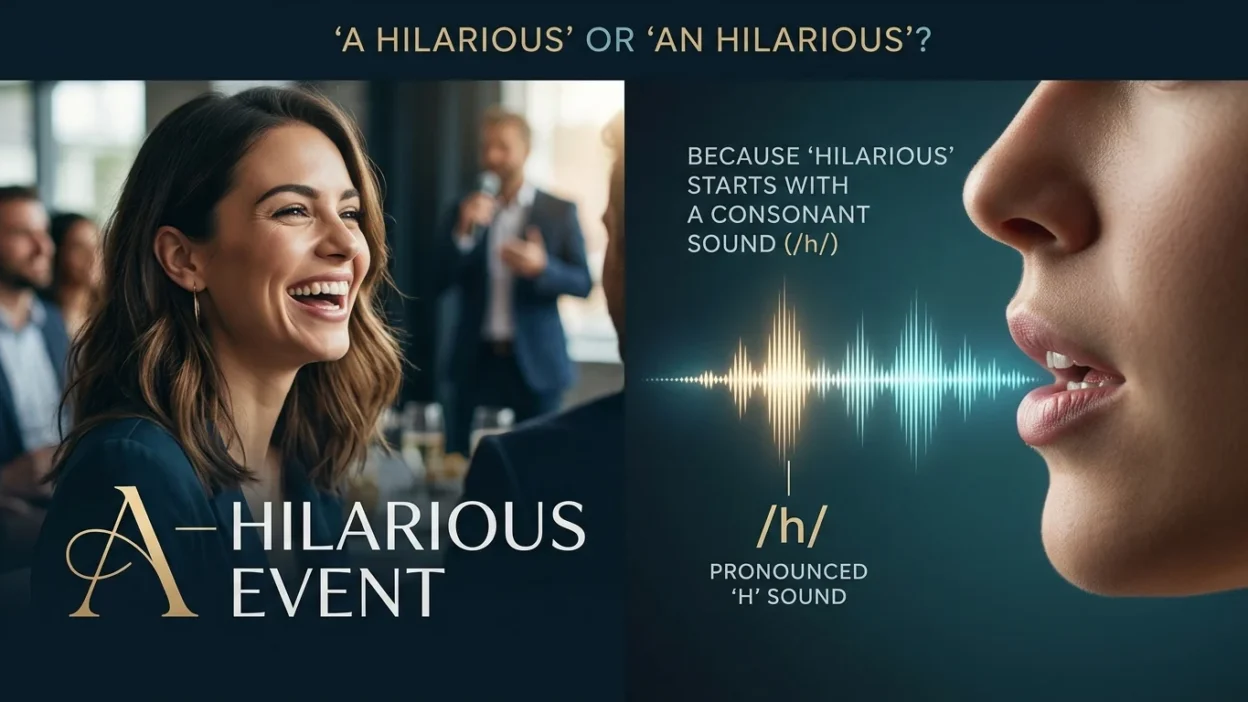
“A hilarious” is correct, while “an hilarious” is generally incorrect in modern standard English. The reason is that the choice between a and an depends on the sound that follows the article. The word hilarious begins with a pronounced /h/ sound, so we use a hilarious, not an hilarious.
For example, you can say, “That was a hilarious movie” or “She told a hilarious story.” You may occasionally see “an hilarious” in older texts or historical writing, but it is not the normal choice in contemporary English. Understanding the pronunciation of the first sound makes this rule much easier. The same principle applies to many other words beginning with h, such as a happy person, a helpful teacher, and a hilarious joke.
Quick Answer
“A hilarious” is correct in modern English because “hilarious” begins with a pronounced /h/ sound. Use “a” before a consonant sound and “an” before a vowel sound. Therefore, write “a hilarious joke,” not “an hilarious joke.”
Why People Confuse It
The confusion usually comes from the fact that h can behave differently in English pronunciation.
Some words beginning with h have a clearly pronounced /h/ sound:
- happy
- helpful
- hilarious
- historic
- hotel
These normally take a.
Other words have a silent h, so the following sound is a vowel sound:
- an hour
- an honest person
- an honor
- an heir
Because hilarious has a pronounced h, the correct article is a.
First Word: A
A is an indefinite article used before a word beginning with a consonant sound.
Examples:
- a book
- a car
- a happy child
- a hilarious story
- a helpful answer
The important point is sound, not simply spelling.
Since hilarious starts with a pronounced /h/ sound, we say:
a hilarious
Example
That was a hilarious joke.
The phrase sounds natural because the /h/ in hilarious is pronounced.
Second Word: An
An is an indefinite article used before a word beginning with a vowel sound.
Examples:
- an apple
- an interesting book
- an umbrella
- an hour
- an honest answer
Notice that an is based on pronunciation.
For example:
an hour
The h in hour is silent, so the word begins with the vowel sound /aʊ/.
But:
a hilarious story
The h in hilarious is pronounced, so a is required.
A Hilarious vs An Hilarious: Comparison Table
| Phrase | Correct? | Reason | Example |
| a hilarious | ✅ Correct | “Hilarious” begins with a pronounced /h/ sound | a hilarious joke |
| an hilarious | ❌ Not standard | “Hilarious” does not begin with a vowel sound | an hilarious joke |
| a happy | ✅ Correct | Pronounced /h/ sound | a happy child |
| an hour | ✅ Correct | The /h/ is silent | an hour later |
| an honest | ✅ Correct | The /h/ is silent | an honest person |
When to Use Each
Use “A Hilarious”
Use a hilarious when hilarious directly modifies a singular countable noun.
Examples:
- a hilarious movie
- a hilarious joke
- a hilarious story
- a hilarious mistake
- a hilarious situation
- a hilarious character
Use “An Hilarious”
In standard modern English, do not normally use “an hilarious.”
Instead, write:
a hilarious
For example:
❌ She told an hilarious story.
✅ She told a hilarious story.
10+ Examples of “A Hilarious”
1. A Hilarious Joke
He told a hilarious joke at dinner.
2. A Hilarious Movie
We watched a hilarious movie last night.
3. A Hilarious Story
She shared a hilarious story about her childhood.
4. A Hilarious Mistake
I made a hilarious mistake during the presentation.
5. A Hilarious Video
They sent me a hilarious video.
6. A Hilarious Character
The comedian created a hilarious character for the show.
7. A Hilarious Situation
It became a hilarious situation after everyone started laughing.
8. A Hilarious Comment
His comment was a hilarious addition to the conversation.
9. A Hilarious Experience
The trip turned into a hilarious experience.
10. A Hilarious Scene
That was a hilarious scene in the movie.
11. A Hilarious Person
My brother is a hilarious person.
12. A Hilarious Answer
She gave a hilarious answer to the question.
Common Mistakes
Mistake 1: Using “an” because “h” is a letter
Some learners think an should be used simply because a word starts with a vowel-like sound or because the spelling looks unusual.
The rule is based on pronunciation.
Hilarious begins with a pronounced consonant sound, so use a.
Mistake 2: Confusing “hilarious” with “hour”
Compare:
- a hilarious story
- an hour
The difference is pronunciation.
The h in hilarious is pronounced.
The h in hour is silent.
Mistake 3: Writing “an hilarious” in normal modern English
Although you may encounter “an hilarious” in older or historical writing, it is not the normal modern construction.
For contemporary standard English, choose:
a hilarious
Mistake 4: Thinking every “h” requires “a”
This is also incorrect.
You cannot simply memorize “h = a.”
Instead, listen to the beginning sound:
- a house
- a hilarious joke
- an hour
- an honest man
Memory Trick
Remember this simple rule:
Consonant sound → A
Vowel sound → AN
So:
a hilarious ✅
an hour ✅
Ask yourself:
“Can I hear the H?”
If the h is pronounced, a is normally used.
a hilarious
If the h is silent and the word starts with a vowel sound, use an.
an hour
American vs British English
In both American English and British English, the standard modern form is:
a hilarious
The pronunciation of hilarious begins with a pronounced h sound in standard usage, so a is appropriate.
You may encounter older British writing or historical texts using “an” before certain words beginning with h, particularly where pronunciation conventions differed. However, this does not change the normal modern usage of a hilarious.
Similar Words
The same article rule applies to many related examples.
With “A”
- a hilarious joke
- a happy person
- a helpful teacher
- a historic building
- a healthy meal
- a huge mistake
With “An”
- an honest person
- an honorable decision
- an hour
- an heir
- an unusual story
- an interesting movie
The key is always the initial sound, not just the first letter.
Final Verdict
The correct modern standard expression is “a hilarious,” not “an hilarious.”
Use a because hilarious begins with a pronounced /h/ consonant sound.
For example:
That was a hilarious joke. ✅
Not:
That was an hilarious joke. ❌
The easiest way to remember the rule is to focus on sound rather than spelling. If the beginning of the word has a consonant sound, use a; if it has a vowel sound, use an.
FAQs
Is “a hilarious” correct?
Yes. “A hilarious” is the standard modern English form because hilarious begins with a pronounced /h/ sound.
Is “an hilarious” grammatically correct?
“An hilarious” is not the normal form in modern standard English. Use “a hilarious” instead.
Why do we say “a hilarious” instead of “an hilarious”?
Because hilarious starts with a pronounced consonant /h/ sound. The indefinite article a comes before consonant sounds.
Do we use “a” or “an” before hilarious?
Use a:
a hilarious story
Is the H in hilarious silent?
No. In standard pronunciation, the h in hilarious is pronounced.
What is the difference between “a hilarious” and “an hilarious”?
“A hilarious” follows modern standard English pronunciation and grammar. “An hilarious” may appear in older or historical writing but is not the normal modern form.
Is “a hilarious joke” correct?
Yes. “A hilarious joke” is completely natural and grammatically correct.
Remember This
A hilarious ✅
An hilarious ❌
The rule is:
A + consonant sound
AN + vowel sound
Because hilarious begins with a pronounced H sound, use a.
Conclusion
The difference between “a hilarious” and “an hilarious” becomes easy once you focus on pronunciation. Hilarious begins with a pronounced /h/ sound, so the correct modern expression is “a hilarious.” This applies whether you are talking about a joke, movie, story, person, video, or situation.
Remember that English articles depend on sounds rather than letters alone. That is why we say “a hilarious joke” but “an hour.” Learning this sound-based rule will help you choose between a and an more confidently in many other English expressions.