If you’ve ever paused while writing because you weren’t sure whether to use it or its, you’re not alone. These two words look almost identical, but they perform very different jobs in a sentence. The good news is that once you understand one simple rule, the confusion becomes much easier to avoid.
In this guide, I’ll explain it vs its in clear, everyday English. You’ll learn what each word means, when to use it, common mistakes to avoid, and practical examples that make the difference easy to remember.
Quick Answer:
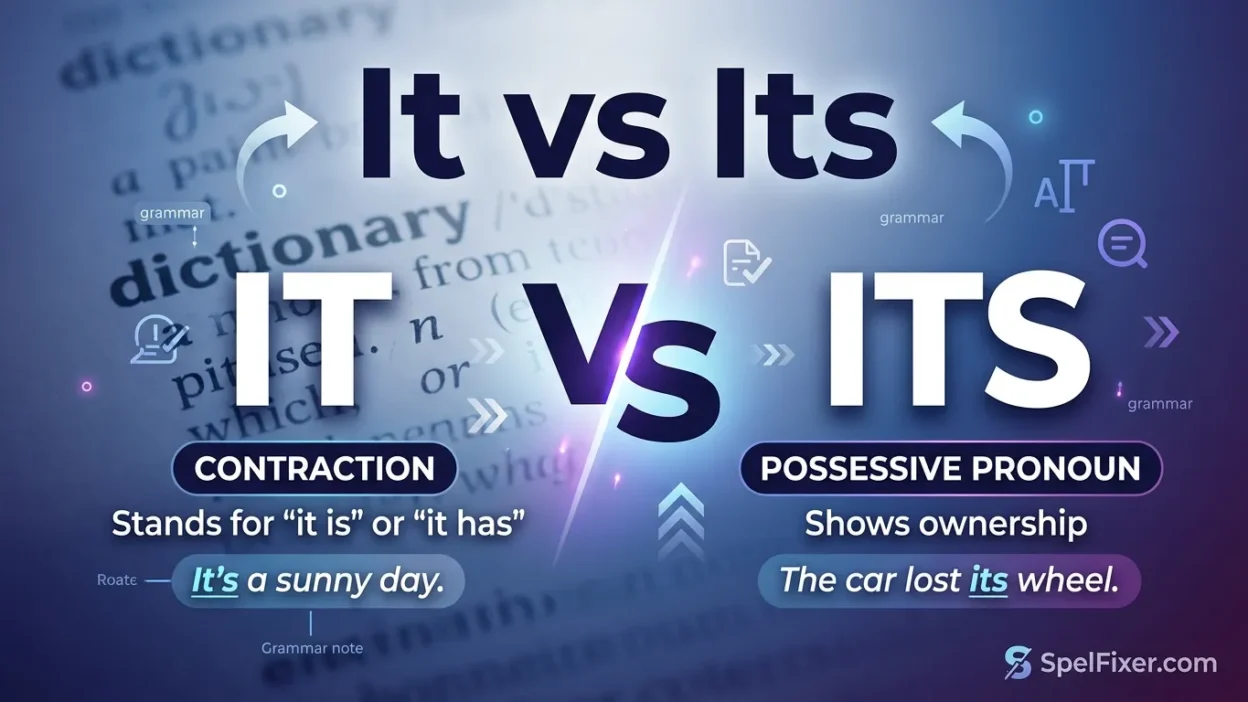
It is usually a pronoun that refers to a thing, animal, situation, or idea.
Its is a possessive determiner that shows that something belongs to or is associated with something else.
- It is raining outside.
- The dog wagged its tail.
- It looks beautiful.
- The company changed its policy.
The easiest rule to remember
It = refers to something
Its = belongs to something
The confusing part is that its does not have an apostrophe, even though possessive forms such as John’s normally do.
What Does “It” Mean?
It is a pronoun. We use it to refer to a previously mentioned noun, an object, an animal, a situation, or an idea.
For example:
- I bought a new phone. It works perfectly.
- Where is the book? It is on the table.
- The weather is terrible. It is raining heavily.
- I watched the movie. It was surprisingly good.
In these examples, it replaces a noun so that we do not have to repeat the same word.
Instead of saying:
The phone is new, and the phone works perfectly.
We can naturally say:
The phone is new, and it works perfectly.
“It” Can Refer to a Situation
“It” is also commonly used for situations or conditions.
- It is getting late.
- It was difficult to find the address.
- It seems like a good idea.
- It is important to practice.
Here, it does not necessarily refer to a specific physical object.
What Does “Its” Mean?
Its is used to show possession or association. It tells us that something belongs to, comes from, or is connected with another thing.
For example:
- The cat cleaned its paws.
- The company updated its website.
- The tree lost its leaves.
- The computer restarted its system.
Think of its as meaning something similar to “belonging to it.”
A Simple Test
If you can replace its with “belonging to it”, you probably need its.
For example:
The dog hurt its leg.
You could think:
The leg belonging to it.
That makes its the correct choice.
It vs Its: Comparison Table
| Word | Function | Meaning | Example |
| it | Pronoun | Refers to a thing, animal, situation, or idea | It is very expensive. |
| its | Possessive determiner | Shows possession or association | The car lost its wheel cover. |
| it’s | Contraction | Means “it is” or “it has” | It’s getting cold. |
This third word, it’s, is especially important because it causes many it vs its mistakes.
It vs Its vs It’s
The biggest source of confusion is actually the difference between it, its, and it’s.
It
Use it as a pronoun.
- It is my favorite book.
- I found the phone and returned it.
- It looks expensive.
Its
Use its to show possession.
- The bird spread its wings.
- The company changed its name.
- The house has its own garden.
It’s
It’s is a contraction of either:
- it is
- it has
Examples:
- It’s cold. = It is cold.
- It’s beautiful. = It is beautiful.
- It’s been a long day. = It has been a long day.
- It’s already started. = It has already started.
The Replacement Trick
When you’re unsure whether to use it’s or its, replace it’s with it is or it has.
If the sentence still makes sense, it’s is probably correct.
Example:
It’s raining.
Replace it:
It is raining. ✓
So it’s is correct.
Now consider:
The dog wagged it’s tail.
Replace it:
The dog wagged it is tail. ✗
That doesn’t work, so the correct sentence is:
The dog wagged its tail. ✓
Common Mistakes With It and Its
Even experienced writers sometimes mix these words up. Here are some of the most common errors.
Mistake 1: Using “It’s” to Show Possession
Incorrect:
The company changed it’s logo.
Correct:
The company changed its logo.
Why? The logo belongs to the company, so its is possessive.
Mistake 2: Adding an Apostrophe to “Its”
Incorrect:
The cat hurt it’s paw.
Correct:
The cat hurt its paw.
Remember that its is already the possessive form.
Mistake 3: Confusing “It” With “Its”
Incorrect:
The phone lost it battery.
Correct:
The phone lost its battery.
Here, the battery belongs to the phone, so its is required.
Mistake 4: Forgetting That “It’s” Can Mean “It Has”
For example:
It’s been raining all morning.
Here, it’s means “it has”, not “it is.”
It has been raining all morning.
How to Remember It vs Its
A simple memory trick can make this much easier.
Remember: Apostrophe = Missing Letters
In it’s, the apostrophe represents missing letters.
- it’s = it is
- it’s = it has
But its has no apostrophe because it is a possessive form.
This is similar to other contractions:
- can’t = cannot
- don’t = do not
- you’re = you are
- it’s = it is / it has
So whenever you see it’s, ask yourself:
Can I replace it with “it is” or “it has”?
If yes, use it’s.
If you are showing possession, use its.
Real-Life Examples of It vs Its
Understanding examples in context is often easier than memorizing grammar rules.
Everyday Conversation
- I bought a new laptop. It is fast.
- My laptop needs its charger.
- It’s working perfectly now.
Animals
- The dog is eating its food.
- It looks hungry.
- It’s probably waiting for dinner.
Technology
- The phone has lost its connection.
- It needs to restart.
- It’s probably having a software problem.
Business
- The company announced its new product.
- It received positive feedback.
- It’s expected to launch soon.
It vs Its in Formal Writing
Choosing the correct word is particularly important in academic, professional, and formal writing.
A small grammatical mistake can make otherwise strong writing look less polished.
For example:
Incorrect:
The organization updated it’s privacy policy.
Correct:
The organization updated its privacy policy.
When proofreading an article, essay, email, or report, search specifically for it’s and check whether each use means “it is” or “it has.”
If neither meaning works, you probably need its or it instead.
American vs British English
There is no meaningful difference between American and British English in the basic use of “it,” “its,” and “it’s.”
Both varieties follow the same grammatical rules:
- it = pronoun
- its = possessive determiner
- it’s = contraction of “it is” or “it has”
You may notice differences between American and British English in vocabulary, spelling, punctuation, or style, but the distinction between it, its, and it’s remains essentially the same.
For example, both American and British writers would use:
The company changed its policy.
And:
It’s a good decision.
How to Choose the Correct Word
When you’re writing and become unsure, follow these three steps.
Step 1: Ask What Job the Word Is Doing
Does it refer to something?
Use it.
Does it show that something belongs to something?
Use its.
Does it mean “it is” or “it has”?
Use it’s.
Step 2: Look at the Words Around It
If a noun follows the word and you are showing possession, its may be appropriate.
The car lost its mirror.
If the sentence describes something, it may be the correct pronoun.
It looks expensive.
Step 3: Try the “It Is” Test
For it’s, substitute it is or it has.
- It’s easy. → It is easy. ✓
- It’s finished. → It has finished. ✓
- The dog wagged it’s tail. → The dog wagged it is tail. ✗
This quick test catches many errors.
Frequently Asked Questions
Is “its” possessive?
Yes. Its is a possessive determiner used to show that something belongs to or is associated with something.
Example:
The company changed its website.
Is “it’s” the same as “its”?
No. It’s is a contraction meaning “it is” or “it has.” Its shows possession.
When should I use “it”?
Use it as a pronoun when referring to a thing, animal, situation, or idea.
Example:
I found the book, and it was damaged.
When should I use “its”?
Use its when showing possession or association.
Example:
The tree lost its leaves.
Why does “its” not have an apostrophe?
Because its is the established possessive form of it. The apostrophe in it’s indicates a contraction instead.
Is “it’s” always short for “it is”?
No. It’s can mean either “it is” or “it has.”
For example:
It’s raining. = It is raining.
It’s been a great day. = It has been a great day.
Does American English use “its” differently from British English?
No. The basic grammatical distinction between it, its, and it’s is the same in both varieties of English.
Summary
The difference between it vs its becomes much easier when you focus on their jobs. It is a pronoun used to refer to something, while its shows possession or association. For example, “The dog hurt its leg” uses its because the leg belongs to the dog.
The word it’s is different again because it is a contraction of “it is” or “it has.” Whenever you’re unsure, try replacing it’s with “it is” or “it has.” If that works, it’s is correct. If you’re showing possession, choose its. With this simple test, you can avoid one of the most common grammar mistakes in English.
Actionable Takeaway
Before publishing or submitting your writing, check every use of it’s. Ask:
- Does it mean it is?
- Does it mean it has?
- If neither works, should it be its?
- Am I simply referring to something, in which case it may be needed?
Remember: It refers, its belongs, and it’s means “it is” or “it has.”