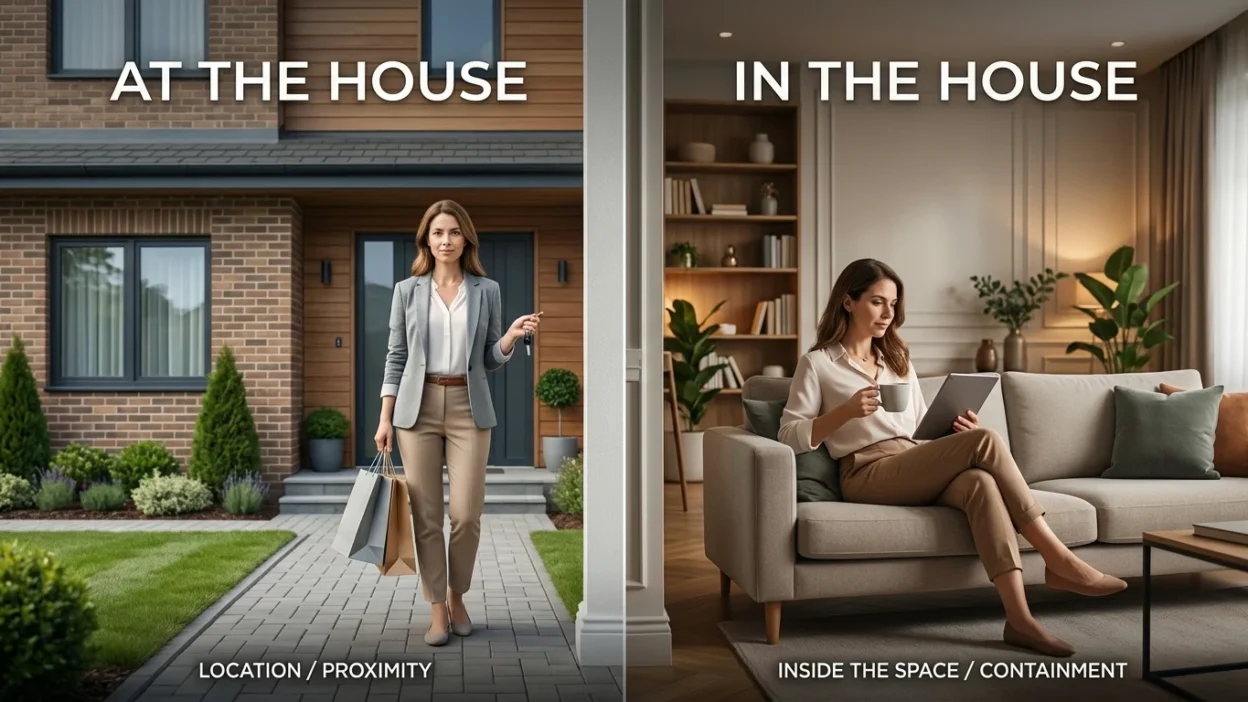
“At the house” and “in the house” are both correct English phrases, but they do not mean exactly the same thing. The main difference is whether you are talking about the house as a location or specifically being inside the building.
If you say, “I’m at the house,” you usually mean that you are at that location. You could be inside the house, outside it, in the yard, or somewhere around the property. If you say, “I’m in the house,” you clearly mean that you are physically inside the building. Understanding this small difference can help ESL learners and beginners sound more natural and avoid common preposition mistakes. The same idea applies to other expressions such as at school vs. in the school and at work vs. in the office.
Quick Answer
“At the house” refers generally to the location of a house or property, while “in the house” specifically means inside the building. For example, “She is at the house” gives a general location, while “She is in the house” tells us she is indoors.
Why Do People Confuse “At the House” and “In the House”?
People often confuse these expressions because both can describe someone’s location.
The key difference is the level of detail:
- At focuses on a general place or location.
- In focuses on being inside an enclosed space.
Compare:
- “Tom is at the house.” → Tom is at that property or location.
- “Tom is in the house.” → Tom is inside the building.
The first sentence does not tell us exactly where Tom is. The second does.
What Does “At” Mean in “At the House”?
The preposition at is commonly used to identify a general point or location.
When you say “at the house,” you are identifying the house as the place where someone is located.
For example:
“I’ll meet you at the house.”
This means the house is the meeting location. The speaker does not necessarily emphasize whether the person will be inside, outside, or in the yard.
Other examples include:
- “They are waiting at the house.”
- “I left my car at the house.”
- “We met at the house.”
- “He is staying at the house.”
What Does “In” Mean in “In the House”?
The preposition in means inside an enclosed area, space, or container.
Therefore, “in the house” specifically indicates that someone or something is inside the building.
For example:
“The children are playing in the house.”
This tells us that the children are indoors rather than outside.
More examples:
- “My phone is in the house.”
- “She is in the house.”
- “There is someone in the house.”
- “The dog is in the house.”
At the House vs. In the House: Comparison Table
| Phrase | Main Meaning | Focus | Example |
| At the house | At the house/property location | General location | “I’m at the house.” |
| In the house | Inside the house | Interior/inside | “I’m in the house.” |
| At my house | At my home/location | General location | “Come over at 7.” |
| In my house | Inside my home | Interior | “There’s a cat in my house.” |
When Should You Use “At the House”?
Use “at the house” when the exact position inside or outside the building is not important.
Use “at the house” for:
- A general location
- Meeting someone
- Arriving at a property
- Describing where an activity takes place
- Talking about a location without emphasizing the interior
Examples:
- “I’ll see you at the house.”
- “Dad is at the house.”
- “We had a meeting at the house.”
- “She is waiting at the house.”
- “There are several people at the house.”
When Should You Use “In the House”?
Use “in the house” when you specifically mean inside the building.
Use “in the house” for:
- People who are indoors
- Objects located indoors
- Activities happening inside
- Something physically contained within the house
- Emphasizing the interior
Examples:
- “The kids are in the house.”
- “My keys are in the house.”
- “Someone is in the house.”
- “We stayed in the house during the storm.”
- “There is a strange smell in the house.”
10+ Examples of “At the House” vs. “In the House”
Here are practical examples that show the difference clearly:
1. General location
At: “John is at the house.”
John is somewhere at the property.
In: “John is in the house.”
John is inside the building.
2. Meeting someone
“I’ll meet you at the house.”
The house is the meeting location.
3. Finding an object
“My laptop is in the house.”
The laptop is specifically inside.
4. Talking about visitors
“There are five people at the house.”
The sentence gives their general location.
5. Talking about people indoors
“There are five people in the house.”
This specifically suggests they are inside.
6. Arriving
“We arrived at the house at noon.”
The focus is the destination.
7. Staying indoors
“We stayed in the house all day.”
The focus is remaining inside.
8. A noise
“I heard a noise in the house.”
The noise is coming from inside.
9. An outdoor activity
“They are working at the house.”
This could mean they are doing work somewhere on the property.
10. An indoor activity
“They are cooking in the house.”
The cooking is taking place indoors.
11. Waiting
“I’ll wait at the house.”
The house is the general location.
12. Hiding
“The children are hiding in the house.”
They are hiding somewhere inside.
Common Mistakes
Mistake 1: Thinking “at” means outside
At the house does not necessarily mean outside.
Someone can say:
“I’m at the house.”
and still be inside the house. The phrase simply gives a general location.
Mistake 2: Using “in” for a general location
If you are talking about meeting someone at a property, at may be more natural:
“Meet me at the house.”
If you specifically want to say the person should come inside:
“Come in the house.”
However, in many situations, native speakers would say “come into the house” when emphasizing movement from outside to inside.
Mistake 3: Assuming the phrases are interchangeable
They can sometimes describe the same real-world situation, but they provide different information.
- At the house = general location
- In the house = specifically inside
Memory Trick
A simple way to remember the difference is:
AT = location
IN = inside
Think of at as pointing to a place on a map:
📍 At the house
Think of in as being inside a box:
🏠 In the house
If you are talking about where the property is, think at.
If you are talking about what is inside the building, think in.
American vs. British English
The basic distinction between “at the house” and “in the house” is understood in both American and British English.
There can be differences in preferred wording depending on the context, but the fundamental meaning remains the same:
- At the house → general location
- In the house → inside the building
For everyday English, learners can safely use this distinction in both varieties.
Similar Words and Expressions
Understanding related prepositions can make this difference easier.
At home vs. in the house
“At home” usually describes someone’s general home location or state of being home.
“I’m at home.”
“In the house” specifically means inside the building.
“I’m in the house.”
At school vs. in the school
“At school” generally refers to being at school as a place or institution.
“The children are at school.”
“In the school” emphasizes being physically inside the school building.
“There are new computers in the school.”
At work vs. in the office
“At work” generally means someone is at their workplace.
“She is at work.”
“In the office” specifically means she is inside the office.
“She is in the office.”
Final Verdict
Both “at the house” and “in the house” are grammatically correct. The difference is mainly about location versus interior.
Use “at the house” when you mean someone is at the house or property generally. Use “in the house” when you want to make it clear that someone or something is inside the building.
A quick rule to remember is: at = general location; in = inside.
FAQs:
Is “at the house” grammatically correct?
Yes. “At the house” is grammatically correct and commonly used when referring to a house as a general location or destination.
Is “in the house” grammatically correct?
Yes. “In the house” is correct when you mean someone or something is physically inside the house.
What is the difference between “at the house” and “in the house”?
“At the house” gives a general location, while “in the house” specifically indicates the interior of the building.
Can someone be “at the house” and “in the house” at the same time?
Yes. Someone who is inside a house can also be described as being at the house. The two phrases simply focus on different aspects of location.
Should I say “at my house” or “in my house”?
It depends on your meaning. “At my house” refers generally to your home or property, while “in my house” specifically means inside your home.
Is “at the house” the same as “at home”?
Not always. “At home” refers to being at one’s home, while “at the house” identifies a particular house as a location. Context determines the most natural choice.
Which is correct: “He is at the house” or “He is in the house”?
Both can be correct. Say “He is at the house” for a general location and “He is in the house” when you specifically mean he is inside.
Remember This
At the house = general location.
In the house = inside the building.
If you are simply identifying where someone is, at may work. If you need to tell the reader that someone is physically indoors, use in.
Conclusion
The difference between “at the house” and “in the house” is small but useful. At treats the house as a location, while in focuses on the space inside the building. Both expressions are correct, but they communicate slightly different information.
For everyday English, remember the simple rule: “at” is general location, and “in” means inside. Once you understand this distinction, you can apply the same pattern to many other English expressions, such as at school/in the school and at work/in the office.

Fenwick Quentin is a creative blogging author known for his analytical yet engaging writing style.
He explores topics such as innovation, digital culture, and personal development with depth and clarity.
Through his articles, Fenwick encourages readers to think critically and embrace continuous growth.