
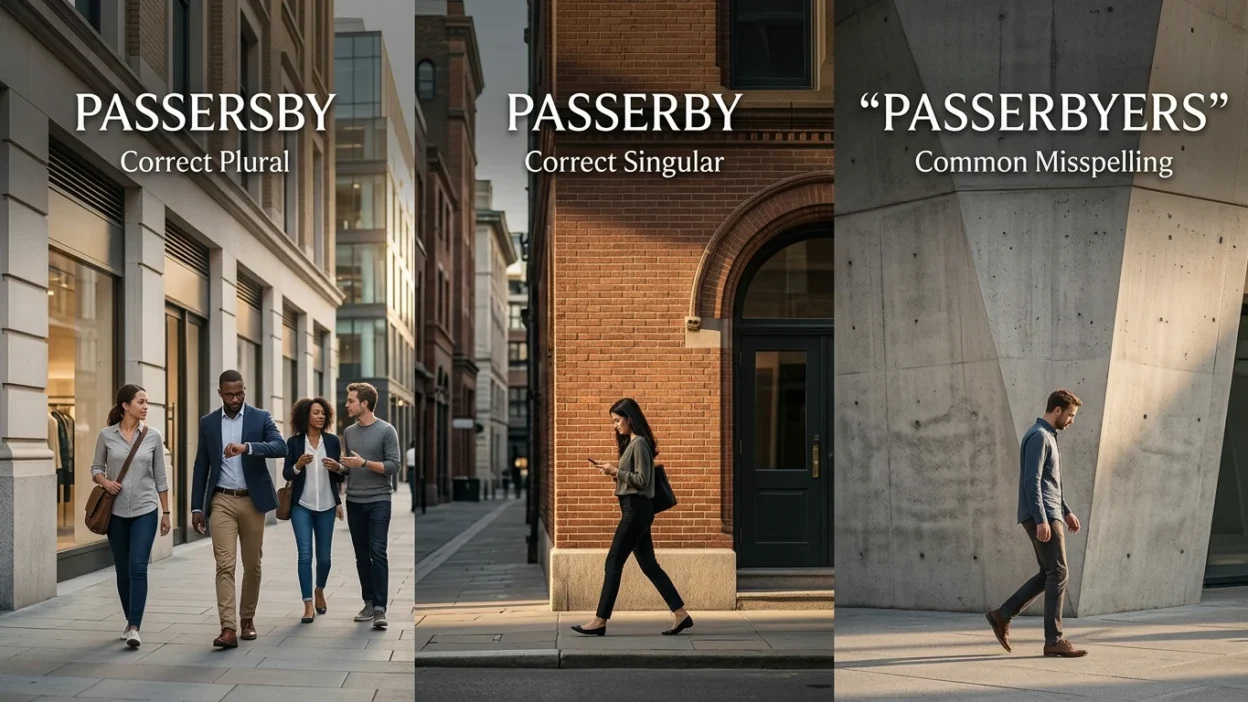
If you are confused about passersby vs passerbyers vs passerby, you are not alone. These words look very similar, but they are not used in the same way. The correct plural form of passerby is passersby, while passerbyers is not a standard English word. Passerby is the singular form, meaning a person who happens to walk past a particular place or person.
Understanding this small difference can help you avoid common grammar mistakes in writing and everyday conversation. The important point is that passerby is already a compound noun, so its plural is normally formed by changing passer to passers, giving us passersby. In this guide, you will learn the meaning, correct usage, examples, common mistakes, and the difference between passerby, passersby, and the incorrect form passerbyers.
Quick Answer
Passerby is the singular form, while passersby is the correct plural form. Passerbyers is not standard English and should generally be avoided. For one person, write “a passerby.” For two or more people, write “passersby.” For example: “A passerby helped me” and “Several passersby stopped to watch.”
Why People Confuse It
The confusion comes from the unusual structure of the word passerby.
Normally, English nouns form plurals by adding -s or -es to the end:
- student → students
- teacher → teachers
- player → players
- visitor → visitors
Because passerby ends in by, some people naturally assume that its plural should be passerbys or passerbyers.
However, passerby is a compound noun made from passer + by. In the traditional plural form, the main noun changes:
passerby → passersby
This is similar to other compound nouns such as:
- mother-in-law → mothers-in-law
- attorney general → attorneys general
- passerby → passersby
First Word: Passerby
Passerby is the correct singular noun.
It refers to one person who is walking or traveling past a particular place or person.
Examples
- A passerby called the police.
- A passerby noticed the lost wallet.
- One passerby stopped to help.
- I asked a passerby for directions.
You can usually use a or one before passerby because it refers to one person.
Correct: A passerby helped the injured man.
Incorrect: A passersby helped the injured man.
Second Word: Passerbyers
Passerbyers is not a standard English plural of passerby.
Although someone might create this form by adding -ers to passerby, native English usage does not normally use passerbyers.
Instead, use passersby when referring to more than one person.
Incorrect: Several passerbyers watched the performance.
Correct: Several passersby watched the performance.
If you are writing an essay, article, school assignment, formal message, or professional content, avoid passerbyers.
Third Word: Passersby
Passersby is the standard plural form of passerby.
It means two or more people who are walking or traveling past a place or person.
Examples
- Several passersby stopped to watch.
- The passersby helped the driver.
- A group of passersby gathered around the street performer.
- Some passersby ignored the noise.
Notice that passersby does not need an additional -s.
Correct: passersby
Incorrect: passersbys
Incorrect: passerbyers
Passersby vs Passerbyers vs Passerby: Comparison Table
| Word | Correct? | Number | Meaning |
| passerby | Yes | Singular | One person passing by |
| passersby | Yes | Plural | Two or more people passing by |
| passerbyers | No | — | Nonstandard/incorrect form |
| passerbys | Generally no | — | Not the standard plural |
When to Use Each
Use “passerby” for one person
Use passerby when you are talking about a single person.
Example:
A passerby found my phone.
Use “passersby” for multiple people
Use passersby when you are talking about two or more people.
Example:
Several passersby saw the accident.
Do not use “passerbyers”
Use passersby instead.
Incorrect: Many passerbyers gathered outside.
Correct: Many passersby gathered outside.
Do not normally use “passerbys”
The standard plural is passersby, not passerbys.
Correct: The passersby continued walking.
10+ Examples of Passerby and Passersby
- A passerby helped the harmful woman cross the street.
- A passerby found a wallet on the sidewalk.
- One passerby called for emergency assistance.
- The police questioned a passerby who witnessed the incident.
- Several passersby stopped to watch the street performance.
- The loud noise attracted many passersby.
- Passersby gathered around the unusual display.
- A few passersby offered directions to the tourists.
- The shopkeeper asked nearby passersby if they had seen the missing bag.
- Several passersby noticed smoke coming from the building.
- The street musician entertained passersby throughout the afternoon.
- A kind passerby returned the child’s lost toy.
Common Mistakes
Mistake 1: Using “passerbyers”
Wrong: Passerbyers stopped to watch.
Right: Passersby stopped to watch.
Mistake 2: Adding “-s” to the end
Wrong: Passerbys
Right: Passersby
The word does not form its standard plural simply by adding -s to the end.
Mistake 3: Using “passersby” for one person
Wrong: A passersby helped me.
Right: A passerby helped me.
Mistake 4: Using “passerby” for several people
Wrong: Several passerby stopped.
Right: Several passersby stopped.
Mistake 5: Treating “passersby” as singular
Wrong: A passersby is standing outside.
Right: A passerby is standing outside.
Memory Trick
Remember this simple rule:
One passerby → Two or more passersby
Think of the word as:
passer + by
The word passer becomes plural:
passer → passers
So:
passerby → passersby
A useful sentence to remember is:
One passerby, several passersby.
If you remember this pattern, you will also know why passerbyers is unnecessary.
American vs British English
There is no major American-versus-British difference in the standard forms of this word.
Both American English and British English commonly use:
- passerby for one person
- passersby for more than one person
The nonstandard form passerbyers should not be used simply because of a regional English difference.
For example:
American English: A passerby helped him.
British English: A passerby helped him.
American English: Several passersby stopped.
British English: Several passersby stopped.
The grammar remains essentially the same.
Similar Words
Several English words have meanings related to passerby.
Pedestrian
A pedestrian is a person traveling on foot, especially in relation to roads and traffic.
Example: Pedestrians should use the crosswalk.
Bystander
A bystander is someone who is present at an event but is not directly involved in it.
Example: A bystander called the police.
Onlooker
An onlooker is someone who watches an event or activity.
Example: Several onlookers watched the match.
Walker
A walker is simply a person who is walking.
Example: The walkers continued along the path.
These words can overlap in meaning, but they are not always interchangeable.
Final Verdict
The standard forms are simple:
- Passerby = one person passing by
- Passersby = two or more people passing by
- Passerbyers = not a standard English word
When you need the plural, choose passersby. When you mean one person, choose passerby.
FAQs
Is “passerbyers” a correct word?
No. Passerbyers is not the standard plural form of passerby. The correct plural is passersby.
What is the plural of passerby?
The standard plural of passerby is passersby.
Example: Several passersby stopped to help.
Is it “passersby” or “passerbys”?
The standard form is passersby. “Passerbys” is not the usual standard plural form.
Is passerby one word or two?
Passerby is normally written as one word.
Example: A passerby helped me find the station.
Can I say “a passersby”?
No. For one person, use a passerby.
Correct: A passerby called the police.
Can I use “passersby” for one person?
No. Passersby is plural, so it refers to more than one person.
Is “passerby” formal English?
Yes. Passerby is a standard English noun and can be used in everyday, academic, journalistic, and professional writing.
What is the difference between a passerby and a bystander?
A passerby is someone passing a place or person, while a bystander is someone present at an event without necessarily being involved in it.
Remember This
Passerby = one
Passersby = more than one
Passerbyers = avoid it
The easiest sentence to remember is: “One passerby walked past, while several passersby stopped.”
Conclusion
The difference between passerby, passersby, and passerbyers is mainly a matter of singular and plural form. Passerby refers to one person who is passing by, while passersby refers to two or more people. The form passerbyers is not standard English and should be avoided in careful writing.
If you are ever unsure, remember that the plural changes passer rather than adding a new ending to by. Therefore, the correct pair is passerby → passersby. Using these forms correctly will make your English clearer and help you avoid one of the more confusing compound-noun plural mistakes.