
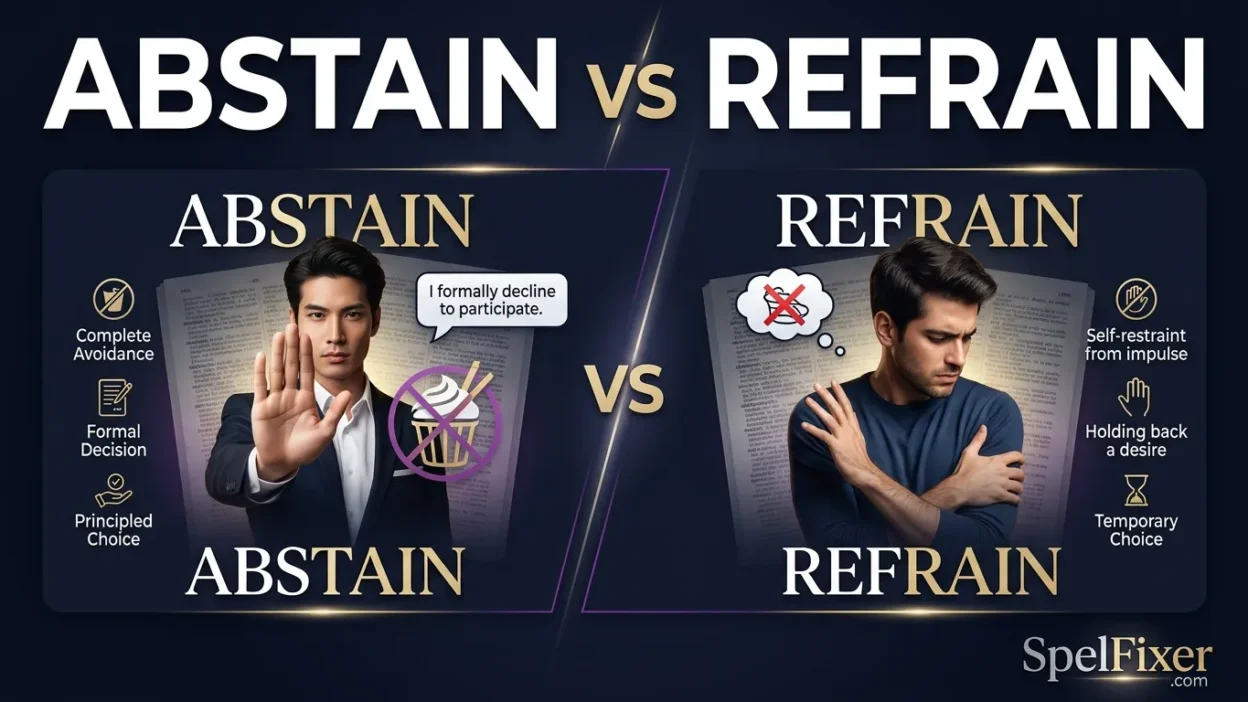
If you have ever wondered whether to say “abstain from” or “refrain from,” you are not alone. Both words describe choosing not to do something, which makes them easy to confuse. However, they are not always interchangeable.
The main difference is usually context and emphasis. Abstain often suggests deliberately choosing not to participate, consume, or indulge in something, while refrain usually means holding yourself back from an action, especially when you could otherwise do it. Let’s look at the difference with clear meanings and practical examples.
Quick Answer:
Abstain means to deliberately avoid or choose not to take part in something, especially something you might normally participate in or consume.
Refrain means to stop yourself from doing something or to deliberately hold back from an action.
Simple rule:
- Abstain = choose not to participate, consume, or engage
- Refrain = hold yourself back from doing something
For example:
- He decided to abstain from alcohol.
- Please refrain from talking during the presentation.
Both words can be followed by from + -ing, but the situations in which they sound natural can be different.
Abstain Meaning
Abstain is a verb meaning to deliberately choose not to do, consume, or participate in something.
It often suggests a conscious decision to avoid something. The word is somewhat formal and is commonly used when discussing food, alcohol, certain activities, voting, or participation.
Examples of abstain
- She decided to abstain from eating sugar for a month.
- He chose to abstain from alcohol.
- Several members abstained from voting.
- I am trying to abstain from unnecessary spending.
- They agreed to abstain from participating in the discussion.
Notice that abstain often involves a deliberate choice.
For example, if someone says, “I abstained from voting,” it means they intentionally did not vote rather than simply forgetting to vote.
Refrain Meaning
Refrain means to deliberately stop yourself from doing something or to hold yourself back.
It is frequently used when someone has the ability or temptation to do something but decides not to.
Examples include:
- Please refrain from using your phone during the exam.
- She refrained from commenting on the issue.
- He tried to refrain from laughing.
- Please refrain from touching the equipment.
- I had to refrain from responding immediately.
The word often appears in polite instructions, warnings, formal writing, and situations where someone is expected to control an action.
Abstain vs Refrain: Key Difference
The easiest way to understand abstain vs refrain is to focus on the type of choice being described.
Abstain emphasizes deliberately avoiding participation, consumption, or involvement.
Refrain emphasizes controlling yourself and holding back from an action.
Compare these examples:
He abstained from alcohol.
This suggests that he deliberately chose not to drink alcohol.
He refrained from making a comment.
This suggests that he wanted or could have made a comment but chose to hold back.
Both words involve self-control, but refrain often focuses more directly on the action being prevented.
Abstain vs Refrain Comparison Table
| Feature | Abstain | Refrain |
| Basic meaning | Choose not to participate or consume | Hold yourself back from an action |
| Common structure | Abstain from + noun/gerund | Refrain from + noun/gerund |
| Common contexts | Voting, food, alcohol, participation | Speaking, commenting, laughing, acting |
| Tone | Formal | Neutral to formal |
| Emphasis | Deliberate avoidance | Self-control or restraint |
| Example | Abstain from voting | Refrain from commenting |
Both are correct in many situations, but the most natural choice depends on the context.
When to Use “Abstain From”
Use abstain from when you want to emphasize deliberately avoiding something, particularly participation or consumption.
1. Abstain from voting
One of the most common formal uses is voting.
- Three members abstained from voting.
- She decided to abstain from the vote.
Here, abstain has a specific meaning: the person chooses not to vote.
2. Abstain from alcohol
This is another familiar expression.
- He decided to abstain from alcohol.
- She has chosen to abstain from drinking.
3. Abstain from certain activities
The word can also describe avoiding an activity.
- The athlete decided to abstain from strenuous activities.
- Participants were asked to abstain from certain activities.
In these contexts, abstain sounds natural because it emphasizes deliberate avoidance.
When to Use “Refrain From”
Use refrain from when you are talking about stopping yourself from performing an action.
1. Refrain from speaking
- Please refrain from speaking while the teacher is explaining.
- He refrained from speaking about the disagreement.
2. Refrain from commenting
- She decided to refrain from commenting.
- The company refrained from commenting on the situation.
This is particularly common in formal statements and news-style writing.
3. Refrain from laughing
- I tried to refrain from laughing.
- He could barely refrain from laughing.
Here, refrain clearly expresses the idea of controlling an immediate reaction.
Can “Abstain” and “Refrain” Be Interchanged?
Sometimes, but not always.
Consider:
- Please refrain from talking.
- Please abstain from talking.
The second sentence is grammatically possible, but refrain from talking sounds much more natural in ordinary English.
Likewise:
- He abstained from voting.
This is much more natural than:
- He refrained from voting.
Although the second sentence can work, abstained from voting is the standard expression when someone intentionally chooses not to cast a vote.
The important point is that synonyms are not always interchangeable in every context. Natural English depends on collocation, meaning the words that commonly appear together.
Abstain vs Refrain: Common Collocations
Learning common word combinations can make the distinction much easier.
Common with “abstain”
- abstain from alcohol
- abstain from drinking
- abstain from voting
- abstain from food
- abstain from participation
- abstain from certain activities
- abstain from something
Common with “refrain”
- refrain from speaking
- refrain from commenting
- refrain from laughing
- refrain from arguing
- refrain from using something
- refrain from making a decision
- refrain from taking action
- refrain from doing something
These patterns are not absolute rules, but they reflect common usage.
Common Mistakes With Abstain and Refrain
Mistake 1: Using “abstain to”
A common error is:
❌ He abstained to drink alcohol.
The normal construction is:
✅ He abstained from drinking alcohol.
Use abstain from, not abstain to.
Mistake 2: Using “refrain to”
Similarly:
❌ Please refrain to speak.
Correct:
✅ Please refrain from speaking.
The standard structure is refrain from + noun/gerund.
Mistake 3: Confusing “refrain” with “remain silent”
Refrain does not specifically mean “be silent.” It means to hold yourself back from an action.
For example:
- She refrained from answering.
This means she deliberately did not answer. It does not necessarily mean she remained silent for the entire situation.
Mistake 4: Assuming they always mean exactly the same thing
Although both words can mean “avoid,” their natural contexts differ.
- Abstain often relates to deliberate non-participation or avoidance.
- Refrain often relates to controlling an action or response.
Abstain vs Refrain in Everyday English
In everyday conversation, refrain from is often more natural when asking someone not to do something.
For example:
Please refrain from touching the display.
This sounds polite and appropriate for a public notice.
Abstain tends to sound more formal or deliberate:
He chose to abstain from alcohol.
You may also hear abstain in political, legal, medical, religious, academic, and organizational contexts.
The choice is therefore not only about dictionary meaning. Tone and context matter.
American vs British English
There is no major difference in meaning between American and British English when it comes to abstain and refrain. Both varieties use the words in essentially the same ways.
For example, these sentences are natural in both forms of English:
- She abstained from voting.
- He abstained from alcohol.
- Please refrain from using your phone.
- They refrained from commenting.
The main differences you may notice are related to individual writing style, formality, or preferred vocabulary rather than a different definition.
Abstain vs Refrain vs Avoid
Because avoid is another common word with a similar meaning, it is useful to compare all three.
- Avoid = stay away from something or prevent something from happening.
- Abstain = deliberately choose not to participate in or consume something.
- Refrain = deliberately hold yourself back from an action.
Examples:
- I avoid junk food.
- I abstain from alcohol.
- I refrain from eating during meetings.
The differences can be subtle, but choosing the right word makes your English sound more natural and precise.
How to Remember the Difference
Here is an easy memory trick:
Abstain = “I choose not to take part.”
Think about voting:
I abstain from voting.
Refrain = “I hold myself back.”
Think about speaking:
I refrain from commenting.
If you remember abstain = deliberate non-participation and refrain = holding back an action, you will usually make the right choice.
Frequently Asked Questions
Is “abstain from” grammatically correct?
Yes. Abstain from is the standard grammatical construction. It is normally followed by a noun or an -ing form.
Example: She abstained from eating dessert.
Is “refrain from” grammatically correct?
Yes. Refrain from is also a standard construction and is commonly followed by a noun or gerund.
Example: Please refrain from making noise.
What is the difference between abstain and refrain?
Abstain usually emphasizes deliberately choosing not to participate, consume, or engage in something. Refrain usually emphasizes holding yourself back from performing an action.
Is abstain more formal than refrain?
Generally, abstain can sound more formal, particularly when discussing voting, participation, or deliberate avoidance. Refrain is also somewhat formal but is common in everyday instructions such as “Please refrain from talking.”
Can I say “refrain from drinking”?
Yes. Refrain from drinking is grammatically correct and means to hold yourself back from drinking.
Can I say “abstain from voting”?
Yes. Abstain from voting is one of the most common uses of abstain. It means intentionally choosing not to vote.
Are abstain and refrain synonyms?
They are related synonyms, but they are not perfect substitutes in every sentence. Their meanings overlap, while their common contexts and collocations differ.
Which is better: “abstain from” or “refrain from”?
Neither is universally better. Choose abstain from when emphasizing deliberate non-participation or avoidance, and refrain from when emphasizing holding yourself back from an action.
Summary
The difference between abstain vs refrain is small but important. Abstain generally means to deliberately choose not to participate in, consume, or engage with something.
It is especially common with expressions such as abstain from voting and abstain from alcohol. Refrain, on the other hand, usually means to hold yourself back from doing something, as in refrain from commenting or refrain from laughing.
Both words are used in American and British English with essentially the same meanings. The best way to use them naturally is to learn their common patterns rather than treating them as completely interchangeable synonyms.
Actionable Takeaway
When you’re unsure which word to choose, ask yourself:
- Am I deliberately choosing not to participate or consume something? → Use abstain.
- Am I holding myself back from an action or response? → Use refrain.
- Am I talking about voting? → Abstain is usually the natural choice.
- Am I giving an instruction not to do something? → Refrain from is often the better choice.
Once you recognize these patterns, choosing between abstain and refrain becomes much easier.