
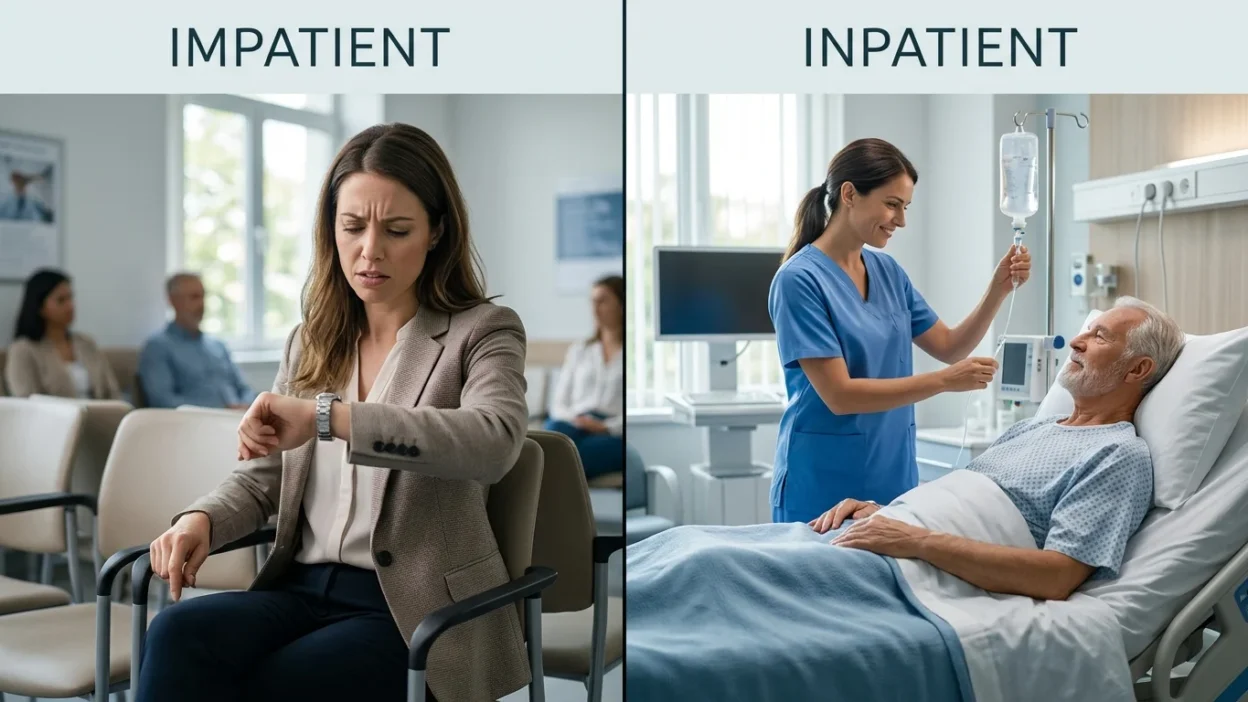
Impatient and inpatient look and sound very similar, but they have completely different meanings. One describes a person’s lack of patience, while the other refers to someone receiving medical care while staying in a hospital or healthcare facility. Because the words differ by only one letter, they are easy to mix up, especially for English learners and beginners.
The key difference is simple: impatient is about waiting or becoming annoyed by delays, while inpatient is a medical term for a person who stays in a hospital for treatment.
Understanding this distinction can help you avoid common spelling and vocabulary mistakes in everyday English. In this guide, you will learn the meanings of both words, see clear examples, compare their usage, and discover an easy memory trick.
Quick Answer
Impatient means unable or unwilling to wait calmly, often because you are annoyed by delay. Inpatient means a person who stays in a hospital or healthcare facility while receiving medical treatment. Remember: impatient = cannot wait; inpatient = stays in for medical care.
Why Do People Confuse “Impatient” and “Inpatient”?
People often confuse these words because they:
- Look almost identical.
- Have similar pronunciation.
- Both begin with im- / in-.
- Are commonly used as adjectives.
- Differ by only one letter.
However, their meanings are completely different.
Impatient is related to patience and waiting.
Inpatient is related to medical treatment and staying inside a hospital.
First Word: Impatient
Impatient is an adjective that describes someone who cannot wait calmly or who becomes annoyed when something takes too long.
Meaning of Impatient
Impatient = not willing to wait or tolerate delay calmly.
For example:
- She became impatient while waiting for the bus.
- He is impatient to see the results.
- The children were impatient for their gifts.
- Don’t be impatient; your turn will come soon.
The word impatient is formed from patient, meaning able to wait calmly, with the prefix im-, which gives it a negative meaning.
Patient → Impatient
Second Word: Inpatient
Inpatient is mainly a medical term. It refers to a person who stays in a hospital or healthcare facility for treatment rather than simply visiting for an appointment.
Meaning of Inpatient
Inpatient = a person who stays in a hospital or healthcare facility while receiving medical treatment.
For example:
- The hospital has 200 inpatient beds.
- The doctor examined the inpatient this morning.
- She was admitted as an inpatient for further treatment.
- The hospital provides care for both inpatients and outpatients.
The opposite term is usually outpatient, which refers to someone who receives medical care without staying overnight or being admitted as a hospital patient.
Impatient vs Inpatient: Comparison Table
| Word | Meaning | Part of Speech | Common Context | Example |
| Impatient | Unable or unwilling to wait calmly | Adjective | Waiting, delays, frustration | He became impatient. |
| Inpatient | A person receiving treatment while staying in a healthcare facility | Noun / Adjective | Hospitals and medical care | The inpatient received treatment. |
When Should You Use “Impatient” and “Inpatient”?
Use “Impatient” When Talking About Waiting
Use impatient when someone is frustrated because something is taking too long.
Example:
The customer became impatient after waiting for an hour.
Here, the person is frustrated about waiting.
Use “Inpatient” When Talking About Medical Care
Use inpatient when referring to someone who has been admitted to a hospital or healthcare facility for treatment.
Example:
The hospital admitted the patient as an inpatient.
Here, inpatient refers to the person’s medical-care status.
12 Examples of “Impatient”
- I became impatient after waiting for 30 minutes.
- The children were impatient to open their presents.
- She is impatient with slow internet.
- Don’t be impatient; the food will be ready soon.
- He grew impatient during the long meeting.
- The students were impatient to hear their exam results.
- My brother gets impatient when traffic is heavy.
- She was impatient for the movie to begin.
- The customer became impatient after receiving no response.
- He is too impatient to wait for the next bus.
- The team was impatient to start the game.
- Try not to be impatient with beginners.
5 Examples of “Inpatient”
- The hospital has several inpatient wards.
- She was admitted as an inpatient for treatment.
- The doctor reviewed the inpatient’s medical records.
- The facility provides both inpatient and outpatient services.
- The inpatient remained in the hospital overnight.
Common Mistakes
Mistake 1: Using “Inpatient” for Someone Who Cannot Wait
Incorrect:
He is very inpatient because the bus is late.
Correct:
He is very impatient because the bus is late.
The situation involves waiting, so impatient is correct.
Mistake 2: Using “Impatient” for a Hospital Patient
Incorrect:
The hospital treated several impatient patients.
If you mean patients who are staying in the hospital for treatment, use inpatient.
Correct:
The hospital treated several inpatients.
Mistake 3: Thinking “Inpatient” Means “Not Patient”
Inpatient does not mean the opposite of patient.
The opposite of patient in the sense of waiting calmly is impatient.
Inpatient is a separate medical term.
Easy Memory Trick
Use this simple trick:
Impatient = I can’t wait.
The word impatient contains patient, which reminds you of patience and waiting.
Inpatient = In the hospital.
Think of in as being in a healthcare facility.
So remember:
Impatient = can’t wait.
Inpatient = stays in for medical care.
American vs British English
The meanings of impatient and inpatient are essentially the same in American and British English.
Impatient is commonly used in both varieties to describe someone who is unwilling or unable to wait calmly.
Inpatient is also used in both varieties as a medical term for someone admitted to a hospital or healthcare facility for treatment.
The exact healthcare system and terminology surrounding hospital admission can vary by country, but the basic distinction between inpatient and outpatient remains familiar in both forms of English.
Similar Words
Understanding related words can make the difference easier to remember.
Patient
Patient can describe someone who can wait calmly.
She was patient while waiting for the doctor.
It can also mean a person receiving medical treatment.
The patient is resting in the hospital.
Impatient
Impatient means not willing to wait calmly.
He became impatient in the long queue.
Inpatient
Inpatient refers to someone receiving medical care while admitted to a healthcare facility.
The hospital has many inpatient rooms.
Outpatient
Outpatient refers to someone who receives medical treatment without being admitted as an inpatient.
The clinic treats many outpatients every day.
Final Verdict
The difference is easy once you connect each word with its context.
Impatient is about waiting and frustration.
Inpatient is about medical care and staying in a healthcare facility.
If someone cannot wait calmly, use impatient. If someone is admitted to a hospital for treatment, use inpatient.
Frequently Asked Questions
Is it “impatient” or “inpatient”?
It depends on the meaning. Use impatient for someone who cannot wait calmly. Use inpatient for someone receiving medical care while staying in a healthcare facility.
What is the difference between impatient and inpatient?
Impatient describes a person’s attitude toward waiting. Inpatient is a medical term describing someone admitted to a hospital or healthcare facility for treatment.
Does impatient mean not patient?
Yes. In the context of waiting calmly, impatient means not patient or unwilling to wait.
Does inpatient mean a hospital patient?
Yes. An inpatient is generally someone who has been admitted to a healthcare facility and stays there while receiving treatment.
What is the opposite of inpatient?
The commonly used contrasting term is outpatient, referring to someone who receives medical care without being admitted as an inpatient.
What is the opposite of impatient?
The opposite of impatient is generally patient, meaning able or willing to wait calmly.
How can I remember impatient vs inpatient?
Remember: impatient = can’t wait, while inpatient = in a hospital or healthcare facility.
Is inpatient an adjective or noun?
Inpatient can function as both a noun and an adjective. For example, “The inpatient received treatment” uses it as a noun, while “inpatient care” uses it as an adjective.
Remember This
Impatient → waiting → cannot wait calmly.
Inpatient → medical care → stays in a healthcare facility.
One extra letter can completely change the meaning, so always look at the context before choosing the word.
Conclusion
Although impatient and inpatient look almost the same, they describe very different ideas. Impatient relates to waiting, delays, and frustration, while inpatient is a medical term for someone who stays in a healthcare facility while receiving treatment.
The easiest way to remember the difference is to connect impatient with “I can’t wait” and inpatient with “in a hospital.” Once you learn this simple connection, choosing the correct word becomes much easier in everyday writing and conversation.