The confusion between inpatient vs impatient is surprisingly common because the two words look and sound very similar. However, their meanings are completely different. One is a medical term related to hospital care, while the other describes a feeling of frustration or restlessness. Using the wrong word can create awkward sentences and misunderstandings, especially in professional or healthcare-related writing.
If you have ever paused while typing “impatient patient” or wondered whether someone was an “inpatient” at a hospital, you are not alone. These words often appear in medical communication, everyday conversations, business writing, and academic English. Learning the difference will improve your grammar, clarity, and confidence in writing.
In this guide, you will learn the meanings of “inpatient” and “impatient,” pronunciation tips, grammar rules, practical examples, common mistakes, memory tricks, and regional usage differences so you can use both words correctly every time.
Quick Answer
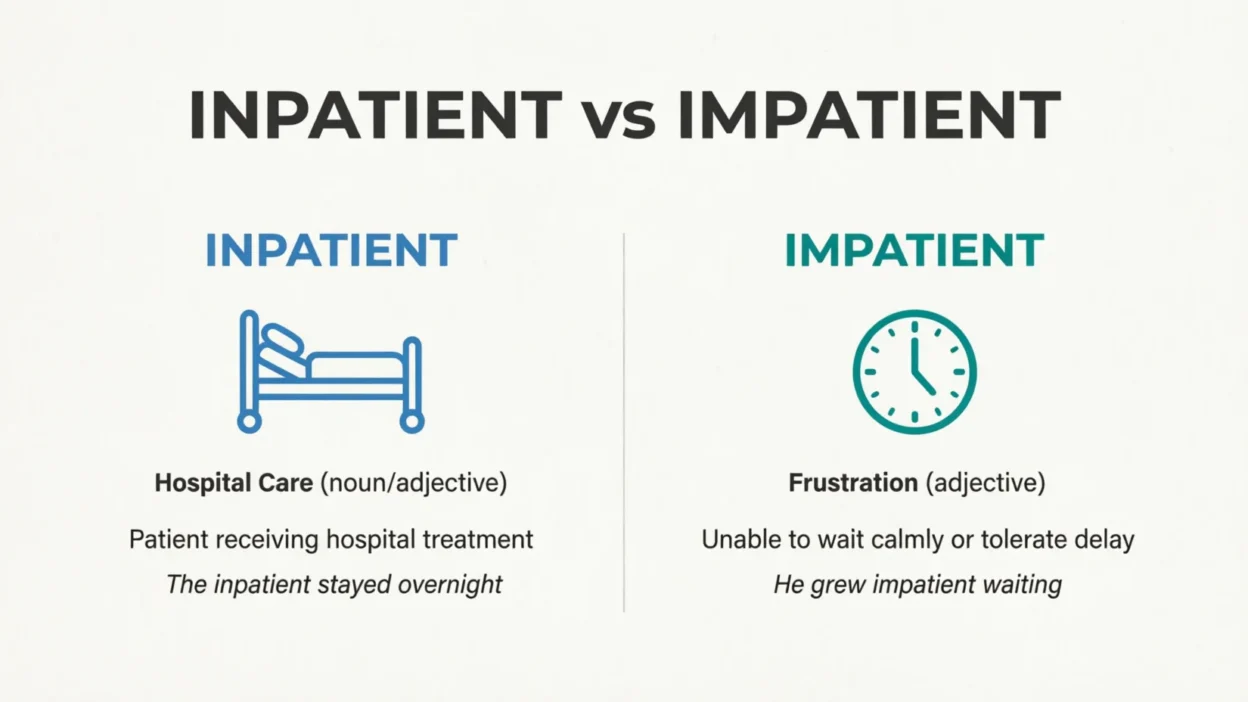
Use “inpatient” when referring to someone admitted to a hospital or healthcare facility for treatment.
Use “impatient” when describing someone who becomes irritated, restless, or unwilling to wait.
Examples:
- The inpatient stayed overnight for observation. ✅
- She became impatient waiting in line. ✅
What Does “Inpatient” Mean?
“Inpatient” is a medical noun or adjective used for:
- a person admitted to a hospital
- someone receiving treatment while staying overnight in a healthcare facility
Examples of Inpatient
- The inpatient received specialized care.
- She remained an inpatient for three days.
- The hospital expanded its inpatient services.
- Inpatient treatment helped him recover fully.
Common Medical Contexts
“Inpatient” frequently appears in:
- hospitals
- healthcare systems
- insurance paperwork
- medical reports
- rehabilitation centers
What Does “Impatient” Mean?
“Impatient” is an adjective meaning:
- unable to wait calmly
- easily irritated by delays
- restless or eager for something to happen
Examples of Impatient
- The children became impatient during the long trip.
- He sounded impatient on the phone.
- Waiting for results made her impatient.
- Customers grew impatient after the delay.
Emotional Contexts for Impatient
“Impatient” often relates to:
- frustration
- urgency
- annoyance
- excitement
- restlessness
Inpatient vs Impatient Comparison Table
| Word | Meaning | Part of Speech | Example |
|---|---|---|---|
| Inpatient | Hospital patient staying overnight | Noun/Adjective | The inpatient needed surgery |
| Impatient | Unable to wait calmly | Adjective | She became impatient quickly |
How to Use “Inpatient” Correctly
Use “inpatient” when discussing:
- hospital admission
- overnight medical care
- healthcare treatment programs
Examples
- The inpatient unit was full.
- Doctors monitored the inpatient closely.
- He entered an inpatient rehabilitation program.
- Inpatient care costs may vary.
Grammar Tip
“Inpatient” can function as:
- a noun
- an adjective
Examples:
- She is an inpatient. ✅
- Inpatient care is expensive. ✅
How to Use “Impatient” Correctly
Use “impatient” when describing emotions or behavior related to waiting.
Examples
- She became impatient with slow service.
- The audience grew impatient during the delay.
- I’m impatient to hear the news.
- Drivers became impatient in traffic.
Grammar Tip
“Impatient” often appears:
- before nouns
- after linking verbs
Examples:
- an impatient customer
- he became impatient
Common Mistakes With Inpatient vs Impatient
These words differ by only one letter, making confusion easy.
Mistake 1: Using Inpatient for Emotions
Incorrect:
- I felt inpatient waiting for the bus. ❌
Correct:
- I felt impatient waiting for the bus. ✅
Mistake 2: Using Impatient in Medical Contexts
Incorrect:
- The impatient stayed overnight at the hospital. ❌
Correct:
- The inpatient stayed overnight at the hospital. ✅
Mistake 3: Spelling Errors
Many writers accidentally type:
- inpatient instead of impatient
- impatient instead of inpatient
Reading the sentence context carefully usually fixes the issue.
Practical Example Paragraphs
Real examples make the distinction much easier to understand.
Example Using Inpatient
After surgery, Daniel remained an inpatient at the hospital for several days while doctors monitored his recovery and adjusted his treatment plan carefully.
Example Using Impatient
Emma became impatient during the delayed flight announcement. After waiting for hours at the airport, she struggled to remain calm and positive.
Placement and Grammar Rules Table
| Word | Sentence Placement | Tone | Example Sentence |
|---|---|---|---|
| Inpatient | Medical noun/adjective | Professional/Clinical | The inpatient required monitoring |
| Impatient | Emotional adjective | Neutral/Conversational | He became impatient quickly |
| Inpatient care | Healthcare phrase | Formal/Medical | Inpatient care improves recovery |
| Impatient with | Emotional phrase | Casual/Professional | She grew impatient with delays |
Pronunciation Difference
Although similar, the stress pattern differs slightly.
Inpatient
Pronounced:
- IN-pay-shunt
The stress falls on:
- “IN”
Impatient
Pronounced:
- im-PAY-shunt
The stress falls on:
- “PAY”
American vs British English Differences
There are very few differences between American and British English for these terms.
American English
Both “inpatient” and “impatient” are widely used with the same meanings.
British English
British English follows the same grammar and spelling rules for both words.
Why This Difference Matters
Using the correct word improves:
- clarity
- professionalism
- medical accuracy
- communication quality
Confusing these words may completely change sentence meaning.
For example:
- “The inpatient waited calmly.” ✅
- “The impatient waited calmly.” ⚠️
The second sentence sounds contradictory because impatience suggests difficulty waiting calmly.
Synonyms and Related Terms
Understanding related vocabulary improves fluency naturally.
Synonyms for Inpatient
- hospital patient
- admitted patient
- resident patient
Synonyms for Impatient
- restless
- irritated
- frustrated
- anxious
- eager
Related Grammar Searches
People searching for “inpatient vs impatient” also search for:
- affect vs effect
- ensure vs insure
- advice vs advise
- stationary vs stationery
- complement vs compliment
Helpful Memory Trick
Simple associations make the difference easier to remember.
Inpatient = Inside Hospital
Think:
- INpatient → IN the hospital
Impatient = Irritated Waiting
Think:
- IMPatient → irritated and impatient
The “im-” beginning connects naturally to emotional frustration.
Inpatient vs Outpatient
“Inpatient” is commonly compared with “outpatient.”
Inpatient
- stays overnight
- receives hospital-based care
Outpatient
- receives treatment without overnight stay
Examples:
- inpatient surgery
- outpatient procedure
Impatient in Everyday Life
“Impatient” appears frequently in daily communication.
Common Situations
People become impatient:
- in traffic
- during delays
- while waiting for replies
- during long meetings
- when technology loads slowly
Example Sentences
- Customers became impatient after waiting.
- He was impatient to begin the project.
- Children often grow impatient quickly.
FAQs About Inpatient vs Impatient
What is the difference between inpatient and impatient?
“Inpatient” refers to a hospitalized patient, while “impatient” describes someone unable to wait calmly.
Is inpatient one word or two?
“Inpatient” is usually written as one word in modern English.
What does impatient mean?
It means restless, irritated, or unwilling to wait.
Can inpatient be used as an adjective?
Yes. Example: inpatient treatment.
Is impatient a negative word?
Usually yes, though it can sometimes describe excitement or eagerness.
What is inpatient care?
It is medical treatment requiring a hospital stay.
How can I remember the difference?
“Inpatient” relates to being inside a hospital. “Impatient” relates to frustration while waiting.
Final Thoughts
The difference between inpatient vs impatient becomes simple once you focus on context. “Inpatient” belongs to healthcare and hospital treatment, while “impatient” describes emotions related to waiting, frustration, or restlessness.
Mastering this distinction improves your grammar, strengthens professional communication, and prevents embarrassing writing mistakes. Whether you are discussing healthcare, emotions, or everyday situations, choosing the correct word helps your message sound clear and polished.
Actionable Takeaway
Remember this quick shortcut:
- inpatient = inside the hospital
- impatient = irritated from waiting
Quick test:
- If healthcare or hospital care is involved → use inpatient
- If emotions or waiting are involved → use impatient
This simple memory trick will help you use both words correctly and confidently in everyday English.