
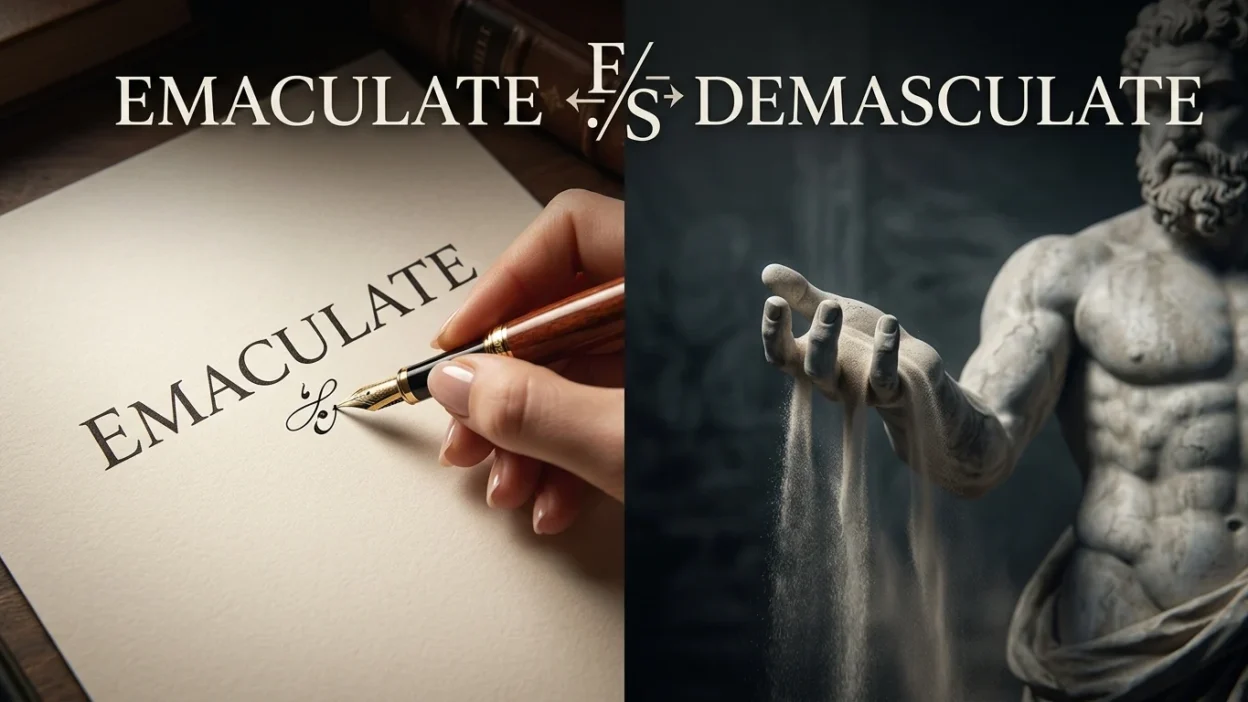
People sometimes confuse “emasculate” and “demasculate” because both words appear to describe the loss or removal of masculine qualities. However, they are not equally standard in modern English. Emasculate is the established English word, while demasculate is extremely rare and is generally not the word you should use in ordinary writing. Understanding this difference can help students, ESL learners, writers, and anyone checking the correct spelling choose the natural term.
In most contexts, emasculate means to make someone or something less masculine, weak, or lacking in strength or authority. It can also have a literal biological meaning related to removing the male reproductive organs. Demasculate, although occasionally encountered, is not a common standard alternative to emasculate. If you are looking for the normal English word, emasculate is the safer and more widely recognized choice.
Quick Answer
Emasculate is the standard English word. It can mean to deprive a male of his reproductive organs or, figuratively, to make someone feel less masculine, powerful, or confident. Demasculate is extremely uncommon and is generally not used in standard everyday English. In normal writing, choose emasculate.
Why Do People Confuse It?
The confusion usually comes from the prefix de-, which often means “remove,” “reverse,” or “reduce.” Because emasculate can mean “remove masculine qualities,” some people naturally assume that demasculate must be an alternative spelling or formation.
However, English does not always form words according to a simple prefix rule. A word may look logical but still be uncommon, nonstandard, or unnecessary.
The established word is emasculate.
What Does “Emasculate” Mean?
Emasculate is a verb meaning to make someone or something less masculine, powerful, confident, or effective.
It can also have a literal meaning: to castrate or remove the male reproductive organs.
Examples
- The criticism made him feel emasculated.
- He worried that accepting help would make him appear emasculated.
- The injury left him feeling physically emasculated.
- The policy was criticized for emasculating the authority of the organization.
The figurative use does not necessarily refer to physical changes. It can describe a feeling of lost confidence, authority, independence, or traditionally masculine identity.
What Does “Demasculate” Mean?
Demasculate is a very rare word and is not normally used in standard modern English.
You may encounter it in specialized, historical, or unusual writing, but it is not the ordinary equivalent of “emasculate.”
For general writing, conversation, academic work, and ESL learning, emasculate is the appropriate choice.
Example
Instead of writing:
The experience demasculated him.
Write:
The experience emasculated him.
The second sentence uses the established English verb.
Emaculate vs. Demasculate: Comparison Table
| Word | Standard English? | Meaning | Commonness | Recommended? |
| Emasculate | Yes | To deprive of masculine qualities, strength, authority, or male reproductive organs | Commonly recognized | Yes |
| Demasculate | Very rare | An uncommon formation suggesting removal of masculine qualities | Extremely uncommon | Generally no |
Important spelling note: If you were thinking of “emaculate” rather than “emasculate,” emaculate is a different and uncommon word. The standard word for the meaning discussed here is emasculate.
When Should You Use Each?
Use “emasculate” in normal English
Use emasculate when you mean:
- to make someone feel less masculine
- to reduce someone’s sense of masculine identity
- to weaken someone’s authority or power
- to deprive a male of reproductive organs
- to make something less powerful or effective
Example:
The public criticism seemed to emasculate the leader.
What About “demasculate”?
Avoid demasculate in ordinary English unless you have a specific reason to reproduce a rare or specialized usage.
For most readers, emasculate will be clearer and more natural.
10+ Examples of “Emasculate”
- The constant criticism emasculated his confidence.
- He felt emasculated after being publicly humiliated.
- The injury left him feeling physically emasculated.
- The decision emasculated the department by removing much of its authority.
- He did not want to appear emasculated in front of his colleagues.
- The character feels emasculated by his inability to protect his family.
- The new restrictions were accused of emasculating the organization.
- Losing his position made him feel emasculated.
- The novel explores how social pressure can emasculate men.
- He believed that asking for assistance would make him seem emasculated.
- The reforms significantly emasculated the institution’s traditional powers.
- The soldier described the defeat as deeply emasculating.
A useful distinction
Emasculate can describe either a person or, figuratively, an organization, system, or institution whose power has been significantly weakened.
Common Mistakes
Mistake 1: Using “demasculate” as the normal spelling
❌ The experience demasculated him.
✅ The experience emasculated him.
Mistake 2: Confusing “emasculate” with “emaculate”
Emasculate relates to masculinity, male reproductive organs, or figurative loss of power.
Emaculate is a different, uncommon word and should not be used as a spelling variant of emasculate.
Mistake 3: Assuming every “de-” word has an “emasculate” equivalent
English vocabulary does not always work by simply adding prefixes. The existence of words such as devalue, defrost, or deactivate does not mean that every corresponding “de-” formation is standard English.
Mistake 4: Using “emasculate” when you only mean “embarrass”
These words are not exact synonyms.
The joke embarrassed him.
does not necessarily mean:
The joke emasculated him.
Emasculate carries an additional sense involving masculinity, power, authority, or traditionally masculine identity.
Memory Trick
Remember:
EMASculate → MASculine
The middle of emasculate contains “mascul-”, which connects it with masculine.
So:
EMASculate → MASculine
If you mean “make someone less masculine or less powerful,” think emasculate.
American vs. British English
There is no major American-versus-British spelling difference between emasculate and demasculate.
Emasculate is the established word in both American and British English.
The main issue is not regional spelling. It is standard usage versus extremely rare usage. Whether you are writing for an American, British, or international audience, emasculate is the natural choice.
Similar Words
Depending on the context, several words can be related to emasculate, but they are not always interchangeable.
- Castrate — to remove or destroy the function of the male reproductive organs; often literal.
- Weaken — to make something less strong or effective.
- Humiliate — to cause someone to feel deeply embarrassed or degraded.
- Disempower — to take away someone’s power or authority.
- Undermine — to weaken someone’s position, confidence, or authority.
- Deprive — to prevent someone from having something.
- Feminize — to make something more feminine; this has a different meaning and should not automatically be treated as a synonym.
- Demoralize — to reduce someone’s confidence or morale.
The best choice depends on exactly what you want to say.
Final Verdict
If you are choosing between emasculate and demasculate, use emasculate in standard modern English.
Emasculate is the established and widely recognized word. It can refer literally to removing male reproductive organs or figuratively to reducing someone’s masculine identity, confidence, authority, or power.
Demasculate is extremely rare and is not normally needed in everyday, academic, or professional writing.
The safest choice:
Emasculate ✅
Demasculate ⚠️ Very rare; generally avoid
FAQs:
Is “demasculate” a real word?
It can be found in rare usage, but it is extremely uncommon. It is not the normal modern English alternative to emasculate.
Is “emasculate” the correct word?
Yes. Emasculate is the established English word for making someone less masculine or, in a literal sense, removing the male reproductive organs.
What is the difference between emasculate and demasculate?
Emasculate is the standard and widely recognized word. Demasculate is an extremely rare formation and is generally unnecessary in ordinary English.
Is “emasculate” an insult?
Not necessarily. The word itself is descriptive, but saying that someone was emasculated can be sensitive because it may imply that their masculinity, confidence, or authority was diminished.
What is the noun form of emasculate?
The noun is emasculation.
Example:
The character experiences a sense of emasculation after losing his position.
What is the adjective form?
Common related forms include emasculated and emasculating.
Example:
He felt emasculated by the situation.
Is emasculate the same as castrate?
Not always. Castrate generally refers specifically to removing or disabling the male reproductive organs. Emasculate can have that literal meaning but is also widely used figuratively to describe loss of masculine confidence, power, or authority.
How do you pronounce emasculate?
It is commonly pronounced approximately:
ih-MASS-kyuh-layt
The exact pronunciation can vary slightly by accent.
Remember This
Emasculate = the standard word.
Think:
EMASculate → MASculine
If you’re writing a sentence about becoming less masculine, losing masculine confidence, or having power or authority weakened, emasculate is the word to choose.
Demasculate is so uncommon that using it may make your sentence sound unnatural or confusing.
Conclusion:
The difference between emasculate and demasculate is mainly one of standard usage. Emasculate is the established English verb and can describe literal castration or the figurative loss of masculinity, confidence, strength, power, or authority. Demasculate is extremely rare and is not normally used as its replacement.
For students, ESL learners, and general writers, the practical rule is simple: choose “emasculate.” Remember the connection between emasculate and masculine, and you will have an easy way to remember both its spelling and meaning.