
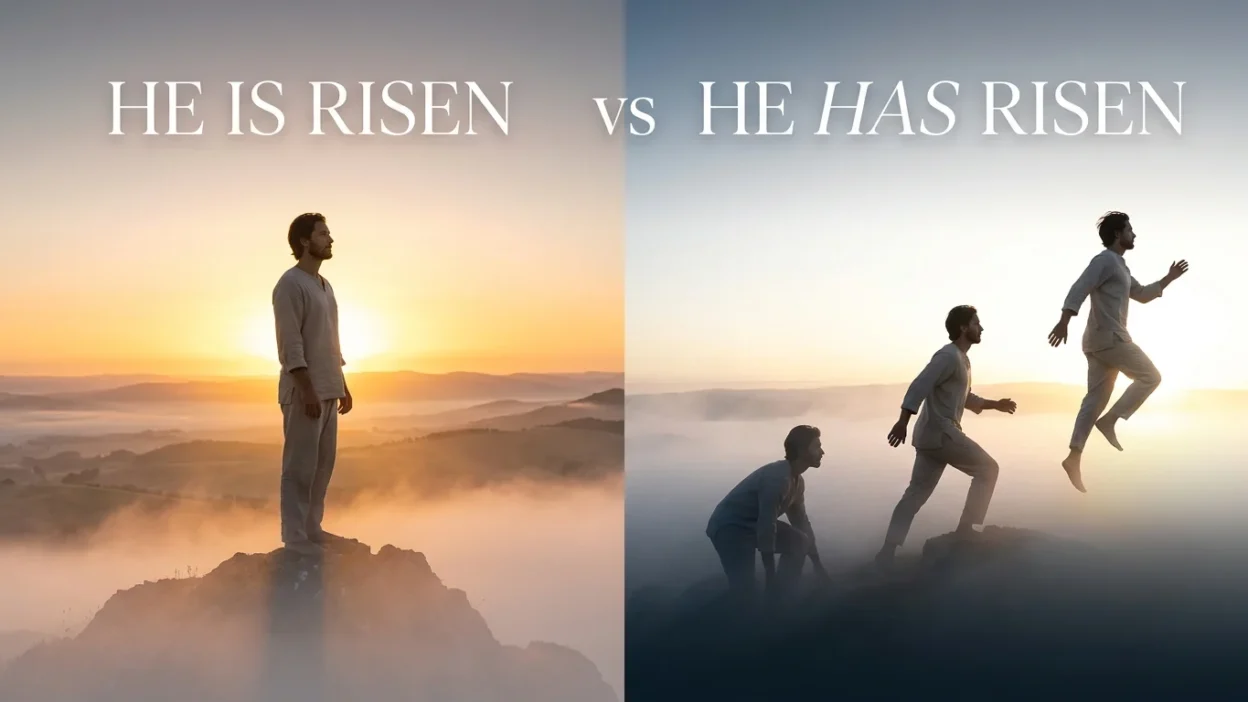
When should you use “he is risen” and when should you use “he has risen”? Both expressions are grammatically meaningful, but they are used differently and have different tones. The main difference comes from the verb rise and the grammatical structure of each phrase. “He has risen” is the normal modern-English form for saying that someone has risen or gotten up. “He is risen” is an older or literary construction that is especially familiar from Christian religious language, where it means that Jesus has risen from the dead.
Understanding this difference helps English learners recognize why both phrases appear in books, religious texts, songs, and everyday conversation. Although they may seem interchangeable, their grammar, context, and style are not exactly the same. This guide explains the difference between he is risen vs he has risen, with simple definitions, examples, common mistakes, and useful comparisons.
Quick Answer
“He has risen” is the standard modern English expression meaning that he has risen or gotten up. “He is risen” is an older, formal, or religious expression, most famously associated with the Christian statement that Jesus has risen from the dead. Both can refer to a completed rising, but their grammatical structures and contexts differ.
Why Do People Confuse “He Is Risen” and “He Has Risen”?
The confusion happens because risen is the past participle of rise, and both is and has can appear before a past participle.
Compare:
- He has risen. → present perfect
- He is risen. → older/literary passive-like or adjectival construction
In modern English, has risen is much more common when describing the action of rising.
The phrase he is risen has a distinctive historical and religious character. It is particularly well known in Christian contexts, such as “He is risen!”, referring to the resurrection of Jesus.
What Does “He” Mean?
He is a third-person singular pronoun used for a male person or, in some contexts, a male animal.
Examples:
- He is my brother.
- He has arrived.
- He is sleeping.
- He has risen.
In the expressions “he is risen” and “he has risen,” the subject is the person who has risen.
What Does “Risen” Mean?
Risen is the past participle of the irregular verb rise.
The basic forms are:
| Verb Form | Example |
| Base form | rise |
| Past tense | rose |
| Past participle | risen |
| -ing form | rising |
Examples:
- I rise early.
- I rose early yesterday.
- I have risen early every day this week.
- The sun is rising.
Importantly, rise normally does not take a direct object. We say “He rose”, not “He rose the book.”
What Does “He Is Risen” Mean?
“He is risen” is an older or literary English expression. Today, it is strongly associated with Christian religious language.
In the famous Christian context:
He is risen.
means that Jesus has risen from the dead.
The expression emphasizes a present state or condition resulting from the rising. It is not normally the phrase you would choose for ordinary modern conversation.
For example, in everyday English, you would normally say:
- He has risen from his chair.
- He has gotten up.
- He has risen early.
Rather than:
- He is risen from his chair.
What Does “He Has Risen” Mean?
“He has risen” is the standard modern present-perfect construction.
It is formed with:
has + risen
The phrase means that he rose at some point before now, with the result or relevance connected to the present.
Examples:
- He has risen from his seat.
- The king has risen early.
- He has risen to speak.
- He has risen from the dead.
The final example can also be used in Christian writing, but “He is risen” remains a traditional religious expression.
He Is Risen vs He Has Risen: Comparison Table
| Expression | Grammar/Structure | Meaning | Typical Context |
| He is risen | Older/literary construction | He has risen; he is in a risen state | Religious, biblical, formal, literary |
| He has risen | Present perfect | He has risen or gotten up | Modern everyday English and formal writing |
| He rose | Simple past | He rose at a past time | Narrative and ordinary past events |
| He is rising | Present continuous | He is rising now | An action happening currently |
When Should You Use “He Is Risen”?
Use “he is risen” mainly when you want a traditional, religious, biblical, or literary tone.
Common context:
- Christian Easter messages
- Religious sermons
- Biblical-style writing
- Hymns and religious literature
- Formal references to the resurrection of Jesus
Example:
“He is risen! He is risen indeed!”
This is a traditional Christian Easter expression.
For ordinary situations, however, modern English generally prefers “he has risen.”
When Should You Use “He Has Risen”?
Use “he has risen” when you are speaking or writing in normal modern English.
Examples:
- He has risen from his chair.
- He has risen early today.
- He has risen to address the audience.
- He has risen above his difficulties.
It can also be used in religious writing:
“Christ has risen from the dead.”
This sentence is grammatically standard modern English.
10+ Examples of “He Is Risen” and “He Has Risen”
Examples of “He Is Risen”
- He is risen from the dead.
- He is risen, as the Scriptures foretold.
- The message says, “He is risen.”
- On Easter morning, Christians proclaim, “He is risen!”
- The preacher announced that He is risen.
These examples have a religious or deliberately traditional tone.
Examples of “He Has Risen”
- He has risen from his chair.
- He has risen early this morning.
- He has risen to speak to the crowd.
- He has risen from the bed.
- He has risen above his difficult circumstances.
- The leader has risen to address the nation.
- He has risen in popularity over the past year.
Notice that rise can have several meanings beyond physically standing up.
Common Mistakes
Mistake 1: Using “risen” as the simple past
Incorrect:
He risen yesterday.
Correct:
He rose yesterday.
Remember:
- Present → rise
- Past → rose
- Past participle → risen
Mistake 2: Saying “He has rose”
Incorrect:
He has rose from his chair.
Correct:
He has risen from his chair.
After has/have/had, use the past participle risen.
Mistake 3: Assuming “He is risen” is always the modern equivalent
Although “he is risen” is grammatically meaningful and traditional, it sounds unusual in ordinary modern conversation.
For everyday English, prefer:
He has risen.
Mistake 4: Confusing “rise” with “raise”
Rise means to move upward by yourself.
Raise means to lift something or cause something to move upward.
Examples:
- He rose from his chair.
- He raised his hand.
Not:
- He raised from his chair.
Memory Trick
A simple way to remember the difference is:
Has risen = modern action
Is risen = traditional/religious expression
And remember the verb forms:
rise → rose → risen
Think:
Today he rises. Yesterday he rose. He has risen.
American vs British English
There is no major American-versus-British difference in the basic forms rise, rose, and risen.
Both American and British English use:
- rise
- rose
- risen
The main difference with “he is risen” is not geographical. Its unusual modern usage is mainly related to historical, literary, and religious language.
For everyday communication in both varieties of English, “he has risen” is generally the natural choice when using the present perfect.
Similar Words and Expressions
Several expressions are related to he is risen and he has risen.
He Rose
“He rose” is simple past.
Example:
He rose from his chair and walked away.
He Has Gotten Up
This is a common everyday expression, especially in American English.
Example:
He has gotten up already.
He Has Got Up
This is also common, particularly in British English.
Example:
He has got up and gone outside.
He Is Rising
This describes an action that is happening or developing.
Example:
He is rising from his chair.
He Has Risen From the Dead
This is a modern grammatical construction often used in Christian contexts.
He Is Risen From the Dead
This is a traditional religious expression, strongly associated with Christian resurrection language.
Final Verdict
The key difference is grammar, style, and context.
“He has risen” is the normal modern English present-perfect construction. Use it when you simply want to say that someone has risen.
“He is risen” is a traditional, older, literary, and especially religious expression. It is most familiar in Christianity, particularly in statements about Jesus’ resurrection.
Therefore, choose the expression according to the context rather than treating the two phrases as completely interchangeable.
FAQs:
Is “He is risen” grammatically correct?
Yes. “He is risen” is a traditional English construction and is especially familiar in religious language. It is less common in ordinary modern conversation.
Is “He has risen” grammatically correct?
Yes. “He has risen” is standard modern English. It uses the present perfect: has + risen.
Which is more common in modern English: “he is risen” or “he has risen”?
“He has risen” is the ordinary modern construction. “He is risen” is much more associated with religious, historical, or literary language.
Why do Christians say “He is risen”?
“He is risen” is a traditional Christian expression referring to the resurrection of Jesus. It has been preserved in religious language and Easter traditions.
Is “He has risen from the dead” correct?
Yes. “He has risen from the dead” is grammatically correct modern English and is commonly understandable in religious contexts.
What is the past tense of “rise”?
The simple past of rise is rose.
Example:
He rose from his chair.
The past participle is risen:
He has risen from his chair.
Can I use “he is risen” in everyday conversation?
You can, but it may sound old-fashioned, literary, or religious. In ordinary conversation, “he has risen” or “he has gotten up” is usually more natural.
Remember This
Rise → Rose → Risen
- He rises = present
- He rose = past
- He has risen = present perfect
- He is risen = traditional/literary/religious expression
If you are talking about ordinary modern English, “he has risen” is usually the form to choose. If you are referring to traditional Christian language, “He is risen” is a familiar and meaningful expression.
Conclusion
“He is risen” and “he has risen” both communicate the idea of rising, but they belong to different grammatical and stylistic contexts. “He has risen” follows the standard present-perfect pattern and works naturally in modern English. “He is risen” has an older, formal, and strongly religious character.
For English learners, the most important thing is to remember the verb forms rise, rose, risen and to recognize the special context of “He is risen.” Use “he has risen” for ordinary modern usage, while recognizing “He is risen” as a traditional expression, especially in Christian language.