Traveling internationally can be confusing, especially when you see signs for passport control and customs at an airport. Although both are part of border control, they serve different purposes. Knowing the difference can help you move through an airport more confidently and avoid unnecessary delays.
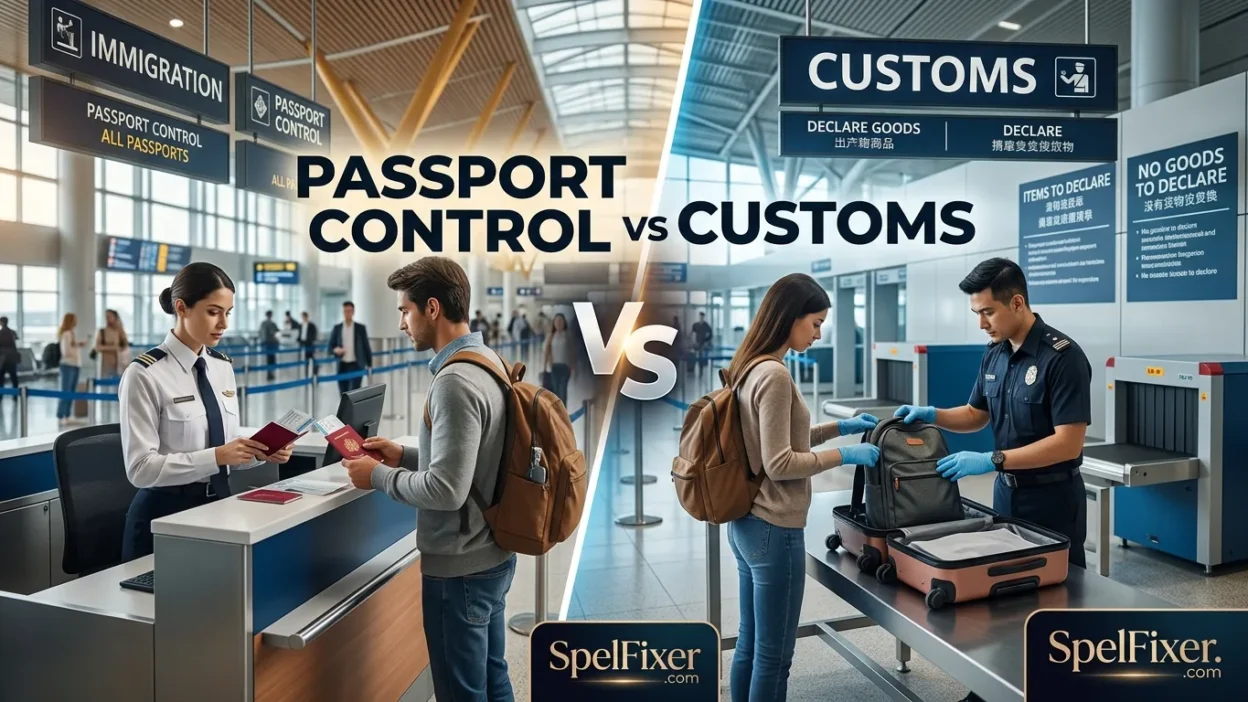
In simple terms, passport control checks you and your right to enter or leave a country, while customs checks the goods and belongings you are bringing into the country. They may be located close together, but they are handled for completely different reasons.
Quick Answer:
Passport control verifies your identity, passport, visa or immigration status, and permission to enter or leave a country.
Customs checks what you are bringing across the border, including goods, food, currency in some circumstances, and other restricted or taxable items.
A simple way to remember it is:
- Passport control = Who are you, and can you enter?
- Customs = What are you bringing with you?
For example, when you arrive in another country, an immigration officer may examine your passport and ask questions about your trip. After collecting your luggage, you may then pass through customs, where officials may check your bags or ask whether you have anything to declare.
What Does Passport Control Mean?
Passport control is the process of checking travelers when they cross an international border. It is usually handled by immigration or border-control officers.
The main purpose is to confirm your identity and determine whether you have permission to enter or leave the country.
An officer may check:
- Your passport or travel document
- Your visa, if one is required
- Your immigration status
- Your travel history
- Your reason for visiting
- How long you intend to stay
- Whether you meet the country’s entry requirements
You may also be asked questions such as:
“Why are you visiting?”
“How long will you stay?”
“Where are you staying?”
The exact questions depend on the country, your circumstances, and the border officer.
Example of Passport Control
Imagine you fly from Pakistan to the United Kingdom for a holiday.
After arriving, you may go through immigration or passport control. The officer checks your passport and confirms that you have the appropriate permission to enter.
The officer is primarily concerned with you as a traveler, rather than the contents of your suitcase.
What Does Customs Mean?
Customs is concerned with goods and items crossing an international border.
Customs authorities enforce rules concerning what travelers can bring into a country. Depending on the destination, this can include restrictions or requirements involving:
- Food and agricultural products
- Commercial goods
- Certain medicines
- Large quantities of particular items
- Alcohol and tobacco
- Valuable goods
- Restricted or prohibited items
- Goods that may require taxes or duties
Customs rules vary significantly from country to country, so travelers should check the requirements for their destination before flying.
Example of Customs
Suppose you return home after buying several expensive items overseas.
At customs, authorities may want to know what you purchased and whether any items need to be declared or are subject to duty.
The focus is therefore on your belongings and goods, rather than primarily on your immigration status.
Passport Control vs Customs: Key Differences
| Feature | Passport Control | Customs |
| Main purpose | Checks travelers | Checks goods and belongings |
| Main concern | Identity and immigration status | Items entering or leaving the country |
| Usually handled by | Immigration/border-control officers | Customs officers |
| Checks passport? | Yes | Usually not the main purpose |
| Checks luggage? | Not normally the main focus | Yes, when necessary |
| Checks visa/entry permission? | Yes | No, this is generally immigration’s role |
| Deals with duties/taxes on goods? | No | Yes |
| May ask about your trip? | Yes | Sometimes, but mainly about goods |
The easiest distinction is person versus possessions.
Passport control asks, essentially, “Who are you, and are you allowed to cross this border?”
Customs asks, “What are you bringing across this border, and is it permitted?”
Do You Go Through Passport Control or Customs First?
The order can vary depending on the airport, country, and whether you are arriving, departing, or connecting.
For an international arrival, a common process is:
Arrival → Passport control/immigration → Baggage claim → Customs → Exit
However, this is not universal.
Some airports combine or rearrange parts of the process, and connecting passengers may follow different procedures. You should always follow airport signs and instructions from staff.
What About Departing a Country?
When leaving a country, you may encounter passport control or exit immigration. Customs procedures can also apply when taking goods out of a country, although the process may be less noticeable to ordinary travelers.
This is why it is better not to assume that every airport follows exactly the same sequence.
Immigration vs Passport Control
You may also see the terms immigration and passport control used almost interchangeably.
There is a slight distinction in how the terms are used.
Immigration is the broader process of managing people’s entry, stay, and departure from a country.
Passport control commonly refers to the point where an officer or automated system checks your passport and immigration status.
For travelers, however, the practical meaning is usually very similar: this is the part of border processing concerned with you and your permission to cross the border.
Customs vs Immigration
The difference between customs and immigration is particularly important.
Immigration deals with people.
Customs deals with goods.
For example:
- Immigration may check whether your visa is valid.
- Customs may check whether food in your luggage is allowed.
- Immigration may ask where you will stay.
- Customs may ask whether you have anything to declare.
- Immigration decides whether you meet entry requirements.
- Customs enforces rules concerning imported goods and applicable duties.
Both are important parts of international border security, but they have separate responsibilities.
American vs British English: Is the Terminology Different?
The basic concepts are the same in American and British English, but travelers may notice differences in terminology and airport signage.
In American English, you will commonly hear terms such as immigration, passport control, border control, and customs.
In British English, passport control is also very common, particularly in airport contexts. You may see signs referring to UK Border Force or passport control rather than simply “immigration.”
The word customs is used in both varieties of English.
There is also an important difference between customs and border control. “Border control” can be a broader term covering controls applied to people and goods, whereas customs specifically concerns goods crossing the border.
So, although terminology may vary, the underlying distinction remains straightforward.
Common Mistakes Travelers Make
Understanding passport control vs customs can prevent several common travel mistakes.
1. Thinking Customs Checks Your Visa
Customs is not primarily responsible for determining whether you have immigration permission.
Your passport, visa, and entry status are generally handled through immigration or passport control.
2. Assuming Customs Means Your Bags Will Definitely Be Searched
Passing through customs does not necessarily mean an officer will open your suitcase.
Depending on the airport and country, you may simply follow the appropriate customs channel or declaration process. Customs authorities can conduct inspections when necessary.
3. Forgetting About Declaration Requirements
One of the biggest mistakes is assuming that something is automatically permitted because you legally purchased it somewhere else.
A product can be legal to buy in one country but subject to restrictions when you bring it into another.
Always check the destination country’s current customs requirements.
4. Confusing Customs With Security
Airport security and customs are also different.
Security screening is primarily concerned with aviation safety and prohibited items entering secure airport areas.
Customs is concerned with goods crossing an international border.
These processes may all happen during one journey, but they serve different purposes.
5. Assuming Every Airport Has the Same Process
Airport procedures differ.
Your experience may depend on:
- Your destination
- Your nationality
- Your visa status
- Whether you are connecting
- The airport
- Your baggage
- The country you are entering
Following official airport and government instructions is always safer than relying on another traveler’s experience.
A Simple Real-Life Example
Imagine you fly from the United States to France for a two-week vacation.
When you arrive, passport control may check your travel document and determine whether you meet the requirements to enter France.
After collecting your luggage, you may proceed through customs.
If you have nothing requiring declaration, you may be able to use the appropriate customs channel without speaking to an officer.
Notice how the two stages have different purposes:
Passport control: “Can this traveler enter?”
Customs: “Can these goods enter?”
That one distinction makes the entire process much easier to understand.
What Should You Prepare Before International Travel?
A little preparation can make border procedures much smoother.
Before your trip:
- Make sure your passport is valid for your destination.
- Check whether you need a visa or travel authorization.
- Know where you are staying.
- Keep important travel documents accessible.
- Check the destination’s customs restrictions.
- Find out whether you need to declare particular goods.
- Check rules concerning food, medicines, and other regulated items.
- Follow official airport and government instructions.
Keep your answers at passport control truthful and straightforward. If an officer asks about your trip, provide the information requested rather than guessing.
FAQs
1. Is passport control the same as customs?
No. Passport control focuses mainly on the traveler, identity, and immigration permission. Customs focuses mainly on goods and belongings crossing the border.
2. Do you go through passport control before customs?
For many international arrivals, passport control comes before baggage collection and customs. However, the exact process varies by airport and country.
3. Does customs check your passport?
Customs officials may have access to travel information or identification documents when necessary, but checking immigration permission is primarily the role of passport control or immigration.
4. What happens at passport control?
An officer or automated system checks your travel document and may verify your identity, visa or immigration status, and eligibility to enter or leave the country.
5. What happens at customs?
Customs authorities enforce rules concerning goods entering or leaving a country. You may need to make a declaration, pay applicable duties, or have your luggage inspected.
6. Is immigration the same as passport control?
They are closely related terms. Immigration refers more broadly to the process governing people’s entry and stay, while passport control commonly describes the passport-checking stage of that process.
7. Is airport security the same as customs?
No. Airport security primarily focuses on aviation and passenger safety, while customs deals with goods crossing an international border.
8. What is the easiest way to remember the difference?
Remember: passport control checks you; customs checks what you bring.
Summary
The difference between passport control vs customs is simple once you understand what each authority is looking for. Passport control, often associated with immigration, checks your identity and whether you have permission to cross the border. Customs focuses on goods, luggage, declarations, restrictions, and applicable duties.
The two processes can happen close together, but they are not the same. Airport procedures also vary by country and location, so always follow the signs and check the official requirements for your specific journey. Understanding the difference before you travel can make international airport procedures feel much less confusing.
Actionable Takeaway
Before your next international trip, remember this rule: Passport control = you; customs = your stuff. Prepare your passport and immigration documents for passport control, and check the customs rules for everything you plan to bring across the border.

Fenwick Quentin is a creative blogging author known for his analytical yet engaging writing style.
He explores topics such as innovation, digital culture, and personal development with depth and clarity.
Through his articles, Fenwick encourages readers to think critically and embrace continuous growth.