
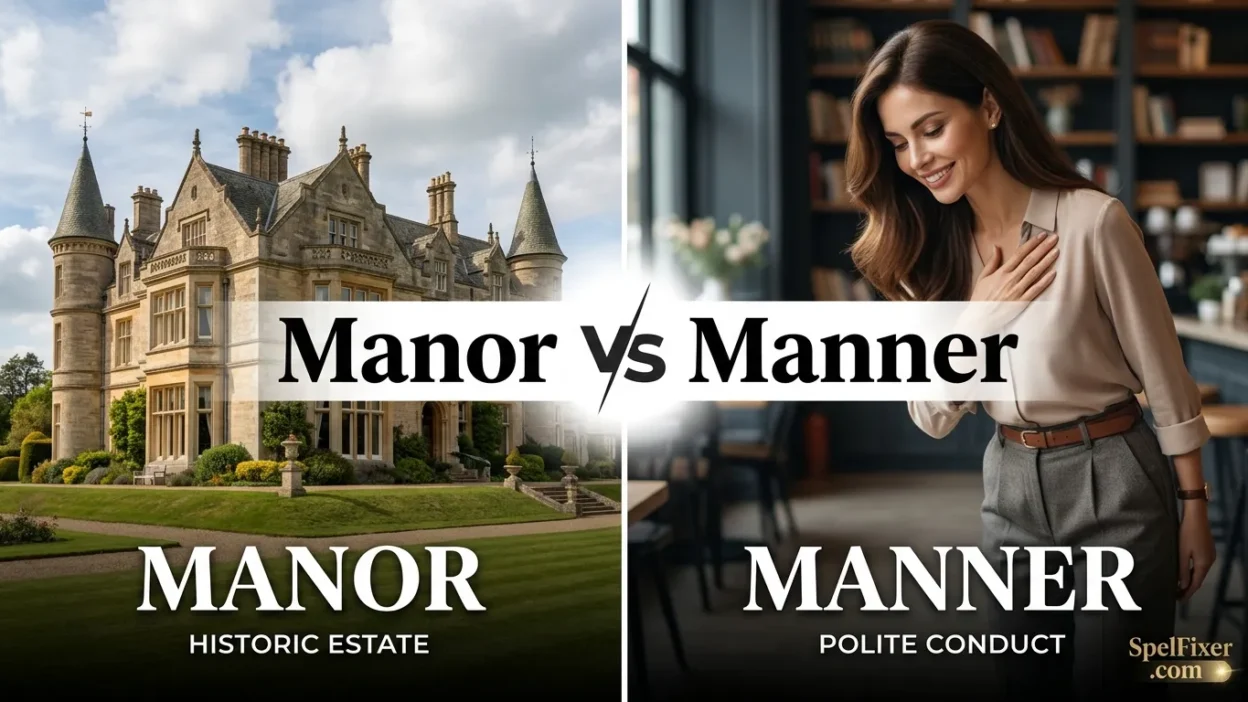
Have you ever written “manor” when you actually meant “manner”? These two words sound very similar, but they have completely different meanings. Understanding the difference can help you avoid confusing spelling and grammar mistakes in essays, emails, articles, and everyday writing.
Manor vs manner is a common word confusion because both words are pronounced similarly. However, manor is a noun connected with a large country house or historical estate, while manner usually refers to the way something is done or a person’s behavior. Let’s make the difference simple with clear definitions, examples, and practical tips.
Quick Answer:
The easiest way to remember the difference is:
- Manor = a large house or estate, especially one associated with historical land ownership.
- Manner = the way something is done, said, or expressed; it can also mean a person’s behavior.
Example:
The family lived in a beautiful manor in the countryside.
She spoke to everyone in a polite manner.
So, if you are talking about a building or estate, use manor. If you are talking about how something happens or someone behaves, use manner.
What Does Manor Mean?
Manor is a noun that traditionally refers to a large country house or an estate. Historically, a manor was a landed estate belonging to a wealthy landowner or lord.
The word is especially associated with British history and medieval or early modern England. A manor could include a large residence, farmland, and surrounding property.
Today, manor is often used to describe a large, impressive, or historically significant house.
Examples of Manor
- The old manor has stood there for hundreds of years.
- They visited a beautiful country manor during their vacation.
- The historic manor attracts thousands of visitors each year.
- The family restored the abandoned manor to its original condition.
- A stone wall surrounded the ancient manor.
In modern English, you may see manor house used to describe a large country residence.
Manor in a Sentence
The wealthy family purchased an enormous manor surrounded by gardens.
Here, manor refers to the large property or residence, so the spelling is correct.
What Does Manner Mean?
Manner has several related meanings, but the most common one is the way in which something is done, said, or experienced.
It can also refer to someone’s behavior, attitude, or way of interacting with other people.
Examples of Manner
- He answered the question in a polite manner.
- She completed the task in an efficient manner.
- His friendly manner made everyone feel comfortable.
- The teacher explained the lesson in a clear manner.
- Please speak in a respectful manner.
You will often see manner in expressions such as:
- in a polite manner
- in a professional manner
- in a similar manner
- in this manner
- in a different manner
- in a respectful manner
Manner in a Sentence
She handled the difficult situation in a calm manner.
Here, manner means the way she handled the situation.
Manor vs Manner: Key Differences
Although manor and manner look and sound similar, their meanings are very different.
| Word | Part of Speech | Meaning | Example |
| Manor | Noun | A large country house or estate | The historic manor was surrounded by trees. |
| Manner | Noun | The way something is done or someone’s behavior | He spoke in a polite manner. |
A simple distinction is:
Manor = place/property
Manner = way/behavior
Remembering these two ideas will help you choose the correct word quickly.
Manor vs Manner Pronunciation
Pronunciation is one reason these words are frequently confused.
In many varieties of English, manor and manner are pronounced very similarly, and in some accents they may sound almost identical.
However, their spelling and meanings remain different.
This is a good example of why relying only on pronunciation can cause spelling mistakes. When writing, think about the meaning of the word rather than how it sounds.
If you mean a large house or estate, choose manor.
If you mean the way something is done or someone’s behavior, choose manner.
Common Mistakes With Manor and Manner
Because these words are similar in pronunciation, writers sometimes use one in place of the other.
Mistake 1: Using “Manor” for Behavior
Incorrect:
He spoke in a polite manor.
Correct:
He spoke in a polite manner.
Why? Because the sentence describes how he spoke, not a house or estate.
Mistake 2: Using “Manner” for a House
Incorrect:
They bought an old manner in the countryside.
Correct:
They bought an old manor in the countryside.
Why? The sentence refers to a large country house, so manor is correct.
Mistake 3: Confusing “Manner” With “Manor” in Formal Writing
Incorrect:
The employee handled the complaint in a professional manor.
Correct:
The employee handled the complaint in a professional manner.
This mistake is particularly noticeable in professional writing because in a professional manner is a standard expression.
Easy Trick to Remember Manor vs Manner
Here is a simple memory trick:
Manor has one “n” before the “or” and relates to a property.
Think:
Manor → Mansion → Property
The words aren’t synonyms, but this association can help you remember that manor relates to a large house or estate.
For manner, think:
Manner → Method → Way
Both manner and method can relate to how something is done.
For example:
She completed the work in a professional manner.
You could think of this as saying:
She completed the work in a professional way.
Manner Can Also Mean Behavior
One important point is that manner is not limited to the meaning “way.”
It can also describe someone’s behavior or social conduct.
For example:
His cheerful manner made him popular with his coworkers.
Here, manner describes his personality and behavior.
You might also hear expressions such as:
- good manners
- bad manners
- table manners
- polite manners
- friendly manner
- confident manner
For example:
Children are often taught good manners at home.
In this context, manners means socially acceptable or polite behavior.
Is There an American vs British English Difference?
There is no major American vs British English difference in the basic meanings or spellings of manor and manner.
Both American English and British English use:
- manor for a large country house or estate
- manner for a way of doing something or a person’s behavior
The word manor may appear more frequently in British historical or cultural contexts because of Britain’s long history of manorial estates and manor houses.
However, the distinction between the two words remains the same in both varieties of English.
Manor vs Manner: More Examples
Seeing the words in different contexts can make the distinction easier.
Examples With Manor
The historic manor was converted into a museum.
They stayed at a beautiful manor during their trip.
The manor sits on several acres of land.
The old manor house has been carefully preserved.
Examples With Manner
She answered the question in a confident manner.
He treated his guests in a friendly manner.
The issue was resolved in a professional manner.
His calm manner helped everyone relax.
These examples show why replacing one word with the other changes the meaning of the sentence.
When Should You Use Manor?
Use manor when your sentence is talking about:
- A large country house
- A historic estate
- A landed property
- A manor house
- A residence associated with an estate
Example:
The historic manor overlooks the village.
Ask yourself: Am I talking about a place or property?
If yes, manor is probably the word you need.
When Should You Use Manner?
Use manner when you are talking about:
- The way something happens
- The way someone does something
- Someone’s behavior
- Someone’s attitude or conduct
- A particular method or style
Example:
He explained the rules in a simple manner.
Ask yourself: Am I talking about how something is done or how someone behaves?
If yes, use manner.
FAQs
Is manor the same as manner?
No. Manor generally refers to a large country house or estate, while manner refers to the way something is done or someone’s behavior.
What is the difference between manor and manner?
The main difference is their meaning. Manor is associated with a house or estate. Manner describes a way of doing something or a person’s behavior.
Is it “in a polite manor” or “in a polite manner”?
The correct phrase is “in a polite manner.” It means doing or saying something politely.
Is “manor” a noun?
Yes. Manor is a noun that commonly refers to a large country house, estate, or historically important landed property.
Is “manner” a noun?
Yes. Manner is a noun. It can mean the way something is done or someone’s behavior, style, or conduct.
Why are manor and manner confused?
They are often confused because they have similar spellings and pronunciations. Their meanings, however, are completely different.
What is an easy way to remember manor vs manner?
Remember manor = property and manner = way or behavior. This simple association works in most everyday situations.
Does British English use manor differently from American English?
The basic meaning is the same in both varieties of English. Manor may simply appear more often in British historical contexts because of the country’s history of manor houses and estates.
Summary:
The difference between manor vs manner is simple once you connect each word with its meaning. Manor refers to a large country house, estate, or historical property. Manner, on the other hand, describes the way something is done or someone’s behavior. Although the two words can sound very similar, they should never be treated as interchangeable.
The best way to avoid mistakes is to focus on the context. If you’re describing a house, estate, or property, use manor. If you’re describing a way, method, behavior, or attitude, use manner. Remembering “manor = property” and “manner = way” can help you choose the correct spelling every time.
Actionable Takeaway
Before using either word, ask yourself one quick question:
Am I talking about a property? → Manor.
Am I talking about a way of doing something or behavior? → Manner.
For example, “The manor was beautiful” describes a property, while “She spoke in a polite manner” describes how she spoke.