The confusion between “on to” vs “onto” is incredibly common, even among fluent English speakers. At first glance, the two expressions look almost identical, but they serve different grammatical purposes. Using the wrong one can make your writing feel awkward or unclear, especially in professional, academic, or polished communication.
The good news is that the difference is easier to understand than many people think. Once you learn the grammar rule behind these terms, choosing the correct form becomes natural. In this guide, you’ll discover the meanings, usage rules, examples, comparison tables, common mistakes, and practical tips for mastering on to and onto confidently.
Quick Answer
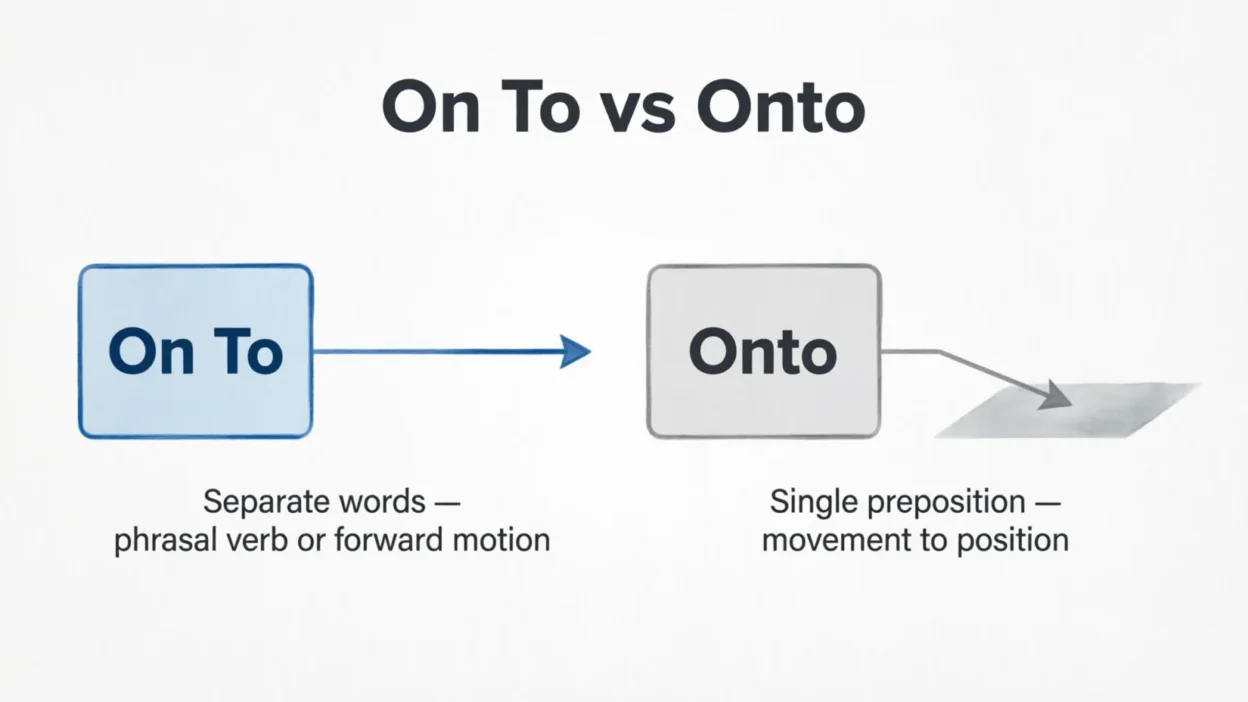
Use “onto” when showing movement toward a surface or position. Use “on to” when “on” belongs to the verb and “to” begins the next phrase or action.
Examples:
- She jumped onto the stage. ✅
- Let’s move on to the next topic. ✅
What Does “Onto” Mean?
“Onto” is a preposition that usually shows movement toward a surface, position, or location.
Meaning of Onto
“Onto” combines the ideas of movement and placement.
Examples:
- The cat climbed onto the roof.
- He stepped onto the train.
- She placed the book onto the shelf.
Usage Rule for Onto
Use “onto” when something physically moves to a higher surface or position.
Correct:
- The child jumped onto the bed.
Incorrect:
- The child jumped on to the bed. ❌
Easy Tip to Remember
If you can replace the phrase with “upon,” then “onto” is usually correct.
Example:
- She climbed onto the horse.
- She climbed upon the horse. ✅
What Does “On To” Mean?
“On to” consists of two separate words working independently.
- “On” belongs to the verb.
- “To” introduces the next action, topic, or destination.
Meaning of On To
“On to” often indicates progression, continuation, or transition.
Examples:
- Let’s move on to the next chapter.
- We went on to discuss marketing.
- She passed the test and went on to become a doctor.
Usage Rule for On To
Use “on to” when “on” connects naturally with the verb before it.
Correct:
- We carried on to the next city.
Incorrect:
- We carried onto the next city. ❌
Quick Grammar Check
Try removing “to.” If the sentence still makes sense with “on,” then “on to” is likely correct.
Example:
- We moved on.
- We moved on to another issue.
On To vs Onto Comparison Table
| Feature | Onto | On To |
|---|---|---|
| Word Type | Single preposition | Two-word phrase |
| Main Meaning | Movement toward a surface | Continuation or transition |
| Common Use | Physical direction | Verbal phrases |
| Example | Jump onto the table | Move on to the next point |
| Replaceable With “Upon”? | Usually yes | Usually no |
| Formality | Standard English | Standard English |
When to Use Onto
Understanding when to use “onto” becomes much easier with examples.
1. Physical Movement
Use “onto” when someone or something moves physically to another surface.
Examples:
- He climbed onto the ladder.
- The dog jumped onto the couch.
2. Direction Toward a Position
“Onto” can describe movement toward a place or object.
Examples:
- She stepped onto the platform.
- The actor walked onto the stage.
3. Figurative Placement
Sometimes “onto” appears in less literal situations.
Examples:
- The company moved onto a better strategy.
- He held onto hope.
4. Common Expressions With Onto
Popular phrases include:
- Hold onto
- Move onto
- Get onto
- Climb onto
5. Tips for Using Onto Correctly
- Think about movement.
- Ask whether a surface or destination exists.
- Test whether “upon” works naturally.
When to Use On To
“On to” usually appears in phrases involving continuation or progression.
1. Transitioning to Another Topic
Examples:
- Let’s move on to the next question.
- We’ll go on to discuss pricing later.
2. Continuing an Action
Examples:
- She worked on to complete the project.
- They carried on to the next level.
3. Verb + Preposition Combinations
Examples:
- Hang on to your ticket.
- Hold on to your dreams.
4. Progression or Advancement
Examples:
- He went on to become famous.
- She moved on to a leadership role.
5. Tips for Using On To
- Look at the verb before “on.”
- See whether “to” begins a new phrase.
- Focus on continuation rather than direction.
Common Mistakes With On To and Onto
Many English learners mix these terms because they sound identical in speech.
Mistake 1: Using Onto for Topic Transitions
Incorrect:
- Let’s move onto the next chapter. ❌
Correct:
- Let’s move on to the next chapter. ✅
Why?
Because “move on” is the phrasal verb.
Mistake 2: Separating Onto Incorrectly
Incorrect:
- The cat jumped on to the fence. ❌
Correct:
- The cat jumped onto the fence. ✅
Why?
The sentence describes physical movement toward a surface.
Mistake 3: Forgetting Context
Always ask:
- Is this about movement?
- Or is this about progression?
That question usually solves the confusion instantly.
Practical Example Paragraphs
Reading full paragraphs helps you understand natural usage.
Example Using Onto
The little boy climbed onto the chair so he could reach the cookies on the kitchen shelf. After balancing carefully, he stepped onto the counter and grabbed the jar before his mother noticed.
Example Using On To
After finishing the introduction, the professor moved on to the main lecture topic. The students listened carefully as she went on to explain the new grammar rules in detail.
Placement and Grammar Rules Table
| Phrase | Sentence Placement | Tone | Example Sentence |
|---|---|---|---|
| Onto | Before destination or surface | Neutral | She stepped onto the balcony. |
| On to | After phrasal verbs | Neutral/Formal | Let’s move on to the next issue. |
| Hold onto | Verb phrase | Conversational | Hold onto the railing tightly. |
| Go on to | Transitional phrase | Professional | He went on to lead the company. |
| Move onto | Sometimes accepted for progression in informal use | Casual | The team moved onto another strategy. |
| Move on to | Preferred standard form | Formal | We moved on to the final section. |
American vs British English Differences
There is very little difference between American and British English regarding “on to” vs “onto.”
However:
- American English sometimes accepts “move onto” in casual writing.
- British English often prefers the stricter grammatical distinction.
In professional and academic writing, both regions usually follow the standard rules explained above.
Related Grammar Terms and LSI Keywords
To better understand this topic, it helps to know related grammar concepts:
- Prepositions
- Phrasal verbs
- English word pairs
- Grammar confusion words
- Common writing mistakes
- English usage rules
- Transition phrases
- Directional prepositions
These related terms improve both writing accuracy and SEO relevance.
FAQs About On To vs Onto
Is “onto” one word or two?
“Onto” is one word when used as a preposition showing movement.
Is “on to” grammatically correct?
Yes. “On to” is correct when “on” belongs to the verb and “to” begins the next phrase.
Which is more formal: onto or on to?
Neither is more formal. Correctness depends on sentence structure.
Can I say “move onto”?
Some informal writers use it, but “move on to” is generally preferred in formal English.
How do I remember the difference?
Use “onto” for movement and “on to” for continuation or transition.
Is “onto” used in British English?
Yes. Both American and British English use “onto.”
Can “onto” replace “on to”?
No. They are not interchangeable in every sentence.
Final Thoughts
The difference between on to vs onto comes down to grammar and meaning. “Onto” usually refers to movement toward a surface or position, while “on to” describes continuation, progression, or transition to another topic or action. Although the words sound identical, their functions in a sentence are different.
Mastering this distinction can instantly improve your writing clarity and confidence. If you pause and ask whether the sentence involves physical movement or verbal progression, you’ll usually choose the correct form naturally. Over time, the difference becomes second nature.
Actionable Takeaway
- Use onto for physical movement or direction
- Use on to for transitions or continuation
- Test whether “upon” works to check for “onto”
- Look at the verb before “on” to identify “on to”
- Stay consistent in formal and professional writing
Small grammar improvements like this make your writing smoother, clearer, and more professional.