
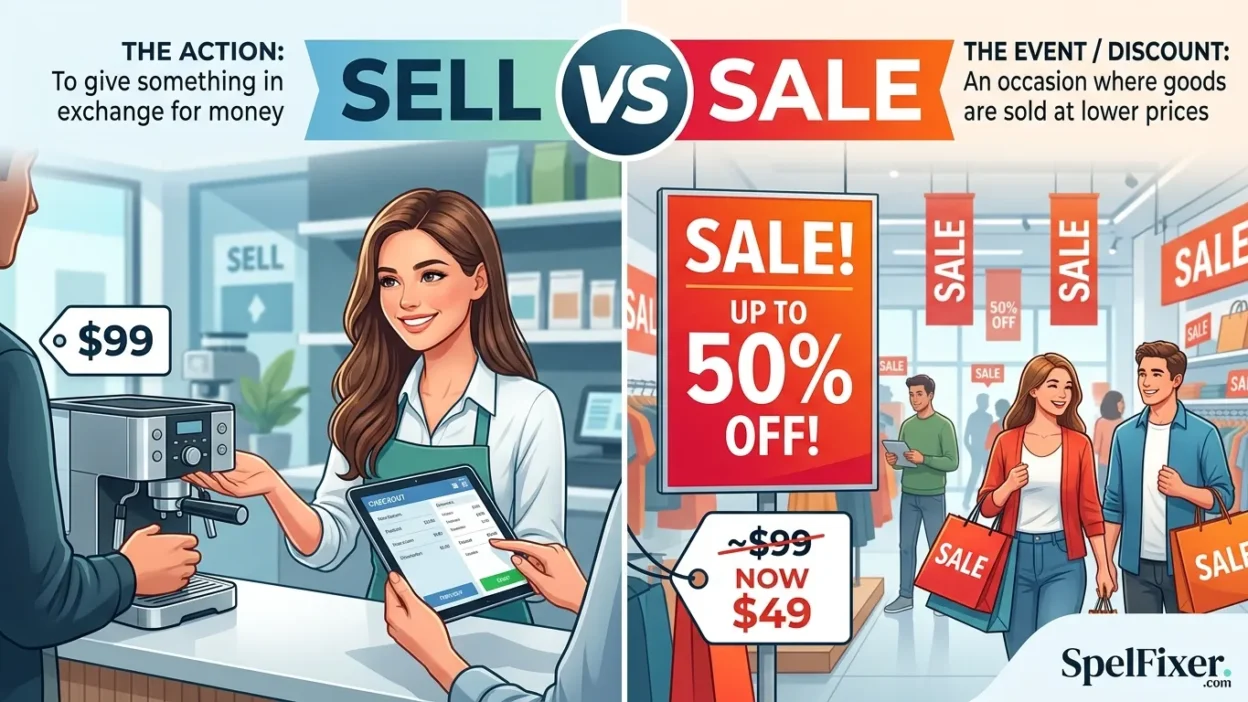
Sell and sale are closely related words, so it is easy to confuse them. The key difference is simple: sell is usually a verb, while sale is a noun. We use sell when talking about the action of giving something to someone in exchange for money. We use sale when talking about the event, process, or occasion of selling something.
For example, you can say, “I want to sell my old phone,” because sell describes an action. But you would say, “The store is having a sale,” because sale refers to an event where products are offered for purchase, often at reduced prices.
Understanding this small grammatical difference will help you choose the correct word in everyday English, school writing, business communication, and online shopping contexts.
Quick Answer:
Sell is mainly a verb meaning to give something to someone in exchange for money. Sale is a noun referring to the act or process of selling, or an event where goods are offered for purchase. For example: “They sell shoes” and “The shoes are on sale.”
Why Do People Confuse Sell and Sale?
People often confuse sell and sale because both words are connected to buying and selling.
They also sound somewhat similar when spoken:
- Sell → describes an action.
- Sale → describes an event, transaction, or instance of selling.
Compare these sentences:
- I want to sell my car.
- My car is for sale.
The meaning is related, but the grammatical role is different.
A useful way to remember the distinction is to ask:
Am I describing an action? → Use sell.
Am I naming an event or transaction? → Use sale.
First Word: Sell
Sell is primarily a verb. It means to give something to another person in exchange for money.
Examples of Sell
- I want to sell my old laptop.
- They sell fresh fruit.
- She plans to sell her house.
- We sell handmade products online.
- He sells books at the local market.
Forms of Sell
The verb has several forms:
- Sell — present
- Sells — present, third person singular
- Sold — past
- Sold — past participle
- Selling — -ing form
For example:
They sell computers.
She sells computers.
They sold the computer yesterday.
He is selling his old computer.
Second Word: Sale
Sale is a noun. It can refer to the act of selling something, a transaction, or a special event where products are offered for purchase, often at a lower price.
Examples of Sale
- The store is having a sale.
- These shoes are on sale.
- The house is for sale.
- The company reported strong sales.
- I bought this jacket during a summer sale.
The word sale commonly appears in phrases such as:
- For sale
- On sale
- Sale price
- Big sale
- Clearance sale
- Annual sale
- Online sale
- Garage sale
Sell vs Sale: Comparison Table
| Feature | Sell | Sale |
| Part of speech | Verb | Noun |
| Main meaning | To exchange something for money | An act, transaction, or event involving selling |
| Describes | An action | A thing, event, or transaction |
| Example | I want to sell my car. | My car is for sale. |
| Common phrase | Sell products | On sale |
| Past form | Sold | Not applicable |
| Related word | Seller | Sale |
When Should You Use Sell or Sale?
Use sell when you need a verb describing the act of selling.
Correct:
They sell clothes online.
Use sale when you need a noun describing a selling event, transaction, or availability.
Correct:
The clothes are on sale.
Use “Sell” for an Action
- I want to sell my phone.
- She sells flowers.
- They sell cars.
- We are selling our furniture.
Use “Sale” for an Event or Transaction
- The store has a sale.
- The property is for sale.
- I bought it during a sale.
- The company had record sales.
10+ Examples of Sell and Sale
Here are practical examples to make the difference easier to understand:
- I want to sell my old bicycle.
- My bicycle is for sale.
- They sell fresh vegetables.
- The supermarket is having a sale.
- She sold her house last year.
- The house was recently put up for sale.
- We sell clothes through our website.
- These clothes are currently on sale.
- He wants to sell his car.
- The dealership is having a weekend sale.
- They sell electronics at competitive prices.
- The store’s annual sale starts tomorrow.
- I decided to sell my old books.
- Those books are not for sale anymore.
Notice the pattern: sell describes what someone does, while sale names the event, transaction, or selling situation.
Common Mistakes With Sell and Sale
Mistake 1: Using Sale as a Verb
❌ I want to sale my car.
✅ I want to sell my car.
Sale is a noun. The verb is sell.
Mistake 2: Using Sell After “For”
❌ My house is for sell.
✅ My house is for sale.
The standard phrase is for sale.
Mistake 3: Saying “On Sell”
❌ These shoes are on sell.
✅ These shoes are on sale.
The standard expression is on sale.
Mistake 4: Confusing “Sold” With “Sale”
❌ I sale my old phone yesterday.
✅ I sold my old phone yesterday.
The past tense of sell is sold.
Memory Trick: Sell = Action, Sale = Thing
A simple memory trick can help:
Sell = Do
Sale = Thing/Event
Think of this sentence:
I sell products during a sale.
The person sells something, while the sale is the event.
Another useful pair is:
Sell your car.
Put your car for sale.
If you remember sell = action and sale = noun, you will usually choose the correct word.
American vs British English
The distinction between sell and sale is essentially the same in American and British English.
In both varieties:
- Sell is a verb.
- Sale is a noun.
- For sale is a standard expression.
- On sale is commonly used.
There can be differences in vocabulary surrounding shopping, stores, and promotions between American and British English, but the basic grammatical distinction between sell and sale remains the same.
Similar Words to Sell and Sale
Several related words can help expand your vocabulary.
Seller
A seller is a person or business that sells something.
The seller offered me a lower price.
Buyer
A buyer is someone who purchases something.
The buyer paid in cash.
Purchase
Purchase means to buy something.
She purchased a new laptop.
Retail
Retail refers to selling products directly to consumers.
He works in retail.
Discount
A discount is a reduction in price.
The store offers a 20% discount.
Sales
Sales can refer to the number or value of products sold.
The company increased its sales this year.
Final Verdict: Sell vs Sale
Sell and sale are related but grammatically different.
Use sell when you are talking about the action of selling:
I want to sell my car.
Use sale when you are talking about a selling event, transaction, or something offered for purchase:
My car is for sale.
The easiest rule is:
Sell = verb/action
Sale = noun/event or transaction
Frequently Asked Questions
Is “sell” a verb or noun?
Sell is primarily a verb. It means to give something to someone in exchange for money.
They sell furniture.
Is “sale” a verb or noun?
Sale is a noun. It can refer to an act or transaction involving selling, or an event where products are offered for purchase.
The store is having a sale.
Is it “for sell” or “for sale”?
The correct expression is for sale.
My car is for sale.
Is it “on sell” or “on sale”?
The standard expression is on sale.
These shoes are on sale.
What is the past tense of sell?
The past tense of sell is sold.
She sold her old laptop.
Can I say “sale my car”?
No. Use sell as the verb.
❌ I want to sale my car.
✅ I want to sell my car.
What is the difference between sell and sales?
Sell is a verb describing the action of selling. Sales is the plural form of the noun sale and can refer to multiple transactions or the amount of products sold.
They sell cars.
Their sales increased this year.
Is “sale” related to “sell”?
Yes. Both words are related to the same general idea of exchanging goods or services for money, but they serve different grammatical functions.
Remember This
Sell = an action
I sell books.
Sale = a noun/event
The books are on sale.
Sold = past tense of sell
I sold the books yesterday.
For sale = available to buy
The books are for sale.
If you remember these four patterns, you can avoid most sell vs sale mistakes.
Conclusion
The difference between sell and sale is straightforward once you understand their grammatical roles. Sell is primarily a verb used for the action of exchanging something for money, while sale is a noun used for a selling event, transaction, or situation. That is why we say “I want to sell my car” but “My car is for sale.”
When writing or speaking, look at the role the word needs to play. If you are describing what someone does, choose sell. If you are naming an event, transaction, or selling situation, choose sale. With regular practice and the simple sell = action / sale = noun memory trick, choosing the correct word becomes much easier.