
English has many words that look or sound alike but do not always have the same meaning. Three terms that often cause confusion are homophone, homograph, and homonym. They describe different relationships between words, and understanding them can make reading, writing, spelling, and vocabulary much easier.
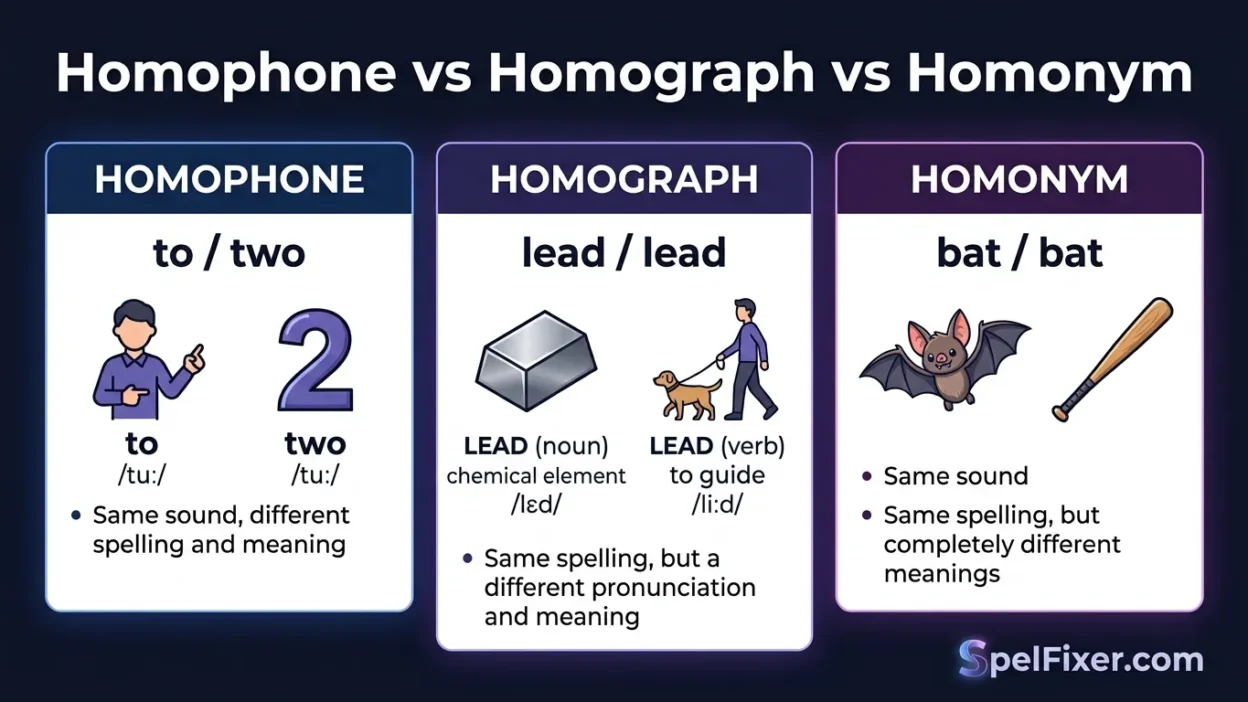
A homophone is a word that sounds the same as another word but has a different meaning or spelling, such as pair and pear. A homograph is a word that is spelled the same as another word but has a different meaning, such as bat (the animal) and bat (used in sports). A homonym is a broader term for words that share the same spelling, pronunciation, or both, depending on the definition being used.
Quick Answer
Homophones sound the same but may be spelled differently. Homographs are spelled the same but may have different meanings or pronunciations. Homonyms are words that share the same form or sound while having different meanings. Some words can belong to more than one category.
Why People Confuse Homophone, Homograph, and Homonym
The confusion comes from the Greek roots behind these words.
- Homo- means same.
- -phone relates to sound.
- -graph relates to writing or spelling.
- -nym relates to name or word.
So, the terms give you a useful clue:
Homophone = same sound
Homograph = same spelling
Homonym = same word form/name
The tricky part is that homonym has slightly different definitions in dictionaries and linguistics textbooks. Some sources use it broadly for words that have the same spelling and pronunciation but different meanings. Others use it as an umbrella term that can include homophones and homographs.
First Word: Homophone
A homophone is a word that has the same pronunciation as another word but a different meaning.
The spelling can be the same or different.
Examples of Homophones
- to / two / too
- there / their / they’re
- right / write
- flower / flour
- sea / see
- pair / pear
- hear / here
For example:
I can see the sea from here.
See and sea sound the same, but they have different meanings and spellings.
Easy Rule
Homophone = same sound.
Think of phone as referring to sound.
Second Word: Homograph
A homograph is a word that has the same spelling as another word but a different meaning.
The pronunciation may be the same or different.
Examples of Homographs
- bat — an animal
- bat — a piece of sports equipment
- bank — a financial institution
- bank — the side of a river
- bark — the sound a dog makes
- bark — the outer covering of a tree
- lead — to guide
- lead — a metal
Some homographs have different pronunciations.
For example:
- lead /liːd/ = to guide
- lead /lɛd/ = a metal
Easy Rule
Homograph = same spelling.
Think of graph as referring to writing.
Homophone vs Homograph vs Homonym
| Term | Same Sound? | Same Spelling? | Different Meaning? | Example |
| Homophone | Yes | Not necessarily | Yes | right / write |
| Homograph | Not necessarily | Yes | Yes | bat / bat |
| Homonym | Often yes | Often yes | Yes | bank / bank |
The exact definition of homonym can vary by linguistic source. In a broad sense, it can describe words that share the same form or pronunciation but have different meanings.
When to Use Each
Use homophone when you are talking about words that sound alike.
Their and there are homophones.
Use homograph when you are talking about words that are spelled alike but have different meanings.
Bat (animal) and bat (sports equipment) are homographs.
Use homonym when discussing words with the same linguistic form but different meanings, particularly when the words are both spelled and pronounced alike.
Bank meaning a financial institution and bank meaning the side of a river are commonly called homonyms.
Remember that terminology can overlap. A pair of words may fit more than one category.
10+ Examples of Homophones, Homographs, and Homonyms
1. Right vs Write
Right can mean correct.
Write means to form words using letters.
Your answer is right.
Please write your name.
They sound the same, so they are homophones.
2. Flower vs Flour
Flower is the colorful part of a plant.
Flour is a powder used in cooking and baking.
She bought a beautiful flower.
We need some flour for the cake.
These are homophones.
3. Bat vs Bat
A bat can be a flying mammal.
A bat can also be equipment used in sports such as baseball or cricket.
A bat flew out of the cave.
He picked up his cricket bat.
These are homographs and are also commonly treated as homonyms because their spelling and pronunciation are the same.
4. Bank vs Bank
A bank can be a financial institution.
A bank can also mean the land beside a river.
She went to the bank.
We sat on the river bank.
These are commonly called homonyms.
5. Sea vs See
Sea means a large body of salt water.
See means to notice something with your eyes.
We swam in the sea.
I can see the mountains.
They are homophones.
6. Bark vs Bark
Bark can mean the sound made by a dog.
Bark can also mean the outer layer of a tree.
The dog began to bark.
The tree has rough bark.
These are homographs and are commonly treated as homonyms.
7. Lead vs Lead
Lead pronounced /liːd/ means to guide.
Lead pronounced /lɛd/ refers to a metal.
She will lead the team.
The pipe contains lead.
These are homographs with different pronunciations.
8. Pair vs Pear
A pair means two things that belong together.
A pear is a type of fruit.
I bought a pair of shoes.
She ate a juicy pear.
They are homophones.
9. Two vs To
Two is the number 2.
To is commonly used to show direction or an infinitive.
I have two books.
I want to read.
These are homophones.
10. Too vs Two
Too can mean also or excessively.
Two is the number 2.
I want to come too.
She has two cats.
These are homophones.
11. Tear vs Tear
Tear /tɪr/ means a drop from the eye.
Tear /ter/ means to pull or rip something.
A tear rolled down her cheek.
Be careful not to tear the paper.
These are homographs with different pronunciations.
Common Mistakes
Mistake 1: Thinking Homophones Must Be Spelled the Same
They do not.
Right and write sound alike but have different spellings.
Mistake 2: Thinking Homographs Always Sound the Same
They do not.
Lead has different pronunciations depending on its meaning.
Mistake 3: Treating Every Similar Word as a Homonym
Words must have a meaningful relationship in form or sound to fit the terminology. Simply having unrelated meanings does not make two words homonyms.
Mistake 4: Ignoring Context
Context usually tells you which meaning is intended.
He sat beside the bank.
The surrounding sentence helps you understand which meaning of bank is being used.
Mistake 5: Assuming Homonym Has One Universal Definition
Different dictionaries and linguistic traditions may use homonym somewhat differently. When precision matters, it is useful to specify whether you mean same sound, same spelling, or both.
Memory Trick
Use this simple three-word trick:
Phone = Sound
Graph = Writing
Nym = Name/Word
Therefore:
- Homophone → same sound
- Homograph → same spelling
- Homonym → same word/name form, depending on definition
If you remember phone = sound and graph = writing, you can usually distinguish the first two immediately.
American vs British English
The concepts of homophones, homographs, and homonyms are used in both American English and British English.
The main difference is that pronunciation can vary between accents. Two words may be homophones in one variety of English but not necessarily in another because their pronunciation can differ.
For example, regional pronunciation can affect whether certain word pairs sound identical. Spelling differences between American and British English can also affect whether two written forms look the same.
The basic concepts remain the same:
- Homophones concern sound.
- Homographs concern spelling.
- Homonyms concern shared word form or sound with different meanings, depending on the terminology being used.
Similar Words
Several related terms are useful when studying these concepts.
Heteronym
A heteronym is a type of homograph whose different meanings have different pronunciations.
Example:
lead — /liːd/ and /lɛd/
Polysemy
Polysemy occurs when one word has several related meanings.
For example, head can refer to a body part, the leader of something, or the top/front part of something. These meanings are related rather than completely separate.
Synonym
A synonym is a word with the same or a similar meaning.
Examples:
- big / large
- begin / start
- quick / fast
Antonym
An antonym has an opposite meaning.
Examples:
- hot / cold
- early / late
- easy / difficult
Final Verdict
The easiest way to distinguish these terms is to focus on what is shared.
Homophones share a sound. Homographs share a spelling. Homonyms are words with different meanings that share a form or pronunciation, with the exact definition varying by linguistic source.
Some words can belong to more than one category. For example, bat has the same spelling and pronunciation for two different meanings, so it can be described as both a homograph and, under the broader common definition, a homonym.
Frequently Asked Questions
Are homophones and homonyms the same?
Not always. Homophones specifically share pronunciation, while homonym is used more broadly or differently depending on the linguistic definition.
What is an example of a homophone?
Right and write are common homophones because they have the same pronunciation but different spellings and meanings.
What is an example of a homograph?
Bat is a common example. It can mean a flying mammal or a piece of sports equipment while keeping the same spelling.
Can a word be both a homophone and a homograph?
Yes. Bat has the same spelling and pronunciation for different meanings, so it can fit both categories.
What is the difference between a homograph and a heteronym?
A heteronym is a type of homograph in which the different meanings have different pronunciations. Lead is a classic example.
Is lead a homophone or homograph?
Lead is a homograph because it has the same spelling but different meanings and pronunciations.
Are homonyms always spelled the same?
Definitions vary. In some linguistic descriptions, homonyms are words that are both spelled and pronounced alike. In broader usage, the term can be applied more generally to words sharing sound or form.
How can I remember homophone and homograph?
Remember phone = sound and graph = writing. Therefore, homophone means same sound, while homograph means same spelling.
Remember This
Homophone = same sound.
Homograph = same spelling.
Homonym = same form or sound with different meanings, depending on the definition being used.
When you are unsure, ask yourself one question: Are the words sharing their sound, their spelling, or both? That will usually point you toward the correct term.
Conclusion
Homophones, homographs, and homonyms describe different ways words can be alike while having different meanings. Right/write shows how two words can sound the same, while bat/bat shows how one spelling can represent different meanings. Lead/lead demonstrates that identical spelling can even come with different pronunciation.
The easiest approach is to remember the key connection: phone relates to sound, graph relates to writing, and nym relates to a name or word. Once you understand these distinctions, examples become much easier to recognize in everyday English.
Instead of memorizing long definitions, focus on what the words share. If they share a sound, think homophone. If they share spelling, think homograph. If they share a form or pronunciation while carrying different meanings, homonym may be the appropriate broader term. Context will help you identify the intended meaning.

Fenwick Quentin is a creative blogging author known for his analytical yet engaging writing style.
He explores topics such as innovation, digital culture, and personal development with depth and clarity.
Through his articles, Fenwick encourages readers to think critically and embrace continuous growth.