Have you ever paused while writing and wondered whether sole or soul is the correct word? You’re not alone. These two words sound exactly alike, making them a classic example of English homophones that often cause confusion.
Although sole and soul share the same pronunciation, their meanings are entirely different. One relates to being the only one or to the bottom of a foot or shoe, while the other refers to a person’s spirit or inner self. Understanding the difference will help you write with greater confidence and accuracy.
Quick Answer
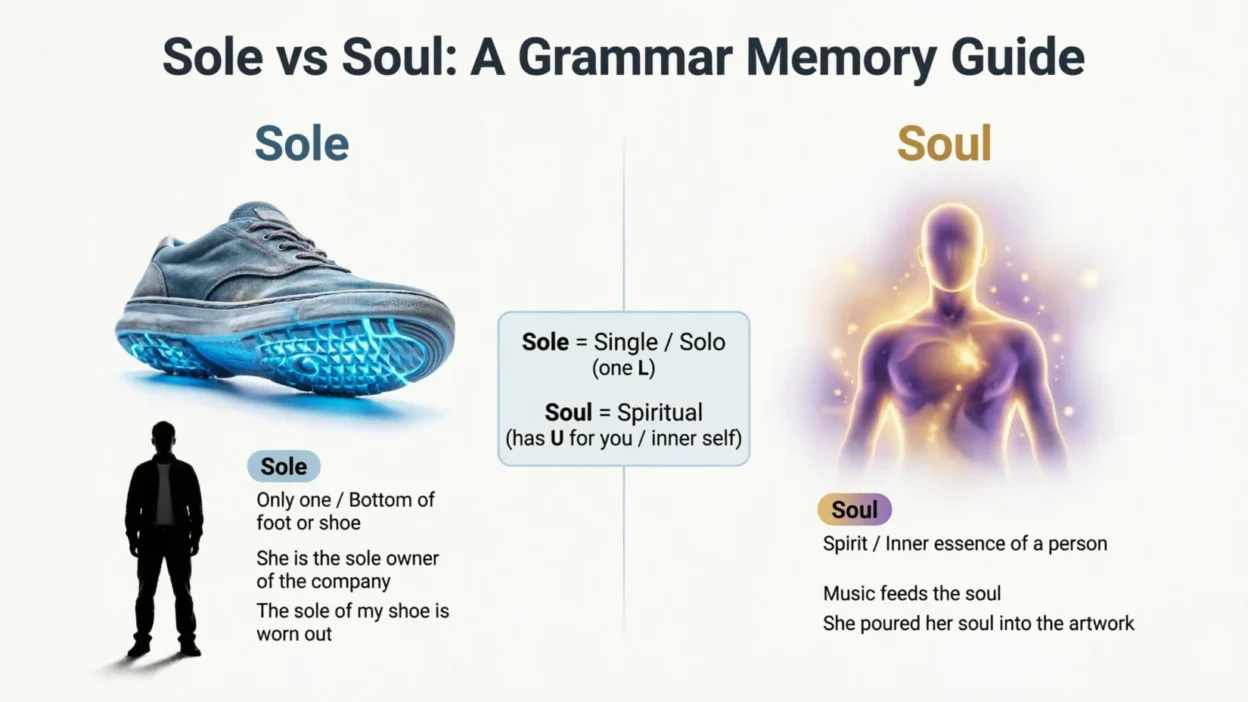
- Sole means only, single, or the bottom of a foot or shoe.
- Soul refers to a person’s spirit, inner self, or emotional essence.
Examples:
- She was the sole survivor of the accident. ✅
- Music nourishes the soul. ✅
A simple rule:
👉 Sole = only one or bottom of a shoe
👉 Soul = spirit or inner being
What Does “Sole” Mean?
Definition of Sole
Sole is a noun, adjective, or sometimes part of an expression that generally means only, single, or exclusive.
It can also refer to the underside of a foot or shoe.
Sole Meaning “Only One”
Examples:
- He was the sole owner of the company.
- She became the sole beneficiary of the estate.
- The sole purpose of the meeting was to discuss safety.
In these examples, sole means one and only.
Sole Meaning “Bottom of a Foot or Shoe”
Examples:
- The sole of my shoe is worn out.
- He stepped on a sharp stone and hurt the sole of his foot.
- The cobbler repaired the shoe’s sole.
Here, sole refers to the bottom surface.
Common Uses of Sole
- Sole survivor
- Sole proprietor
- Sole responsibility
- Sole purpose
- Shoe sole
What Does “Soul” Mean?
Definition of Soul
Soul refers to a person’s spiritual, emotional, or moral essence.
In many religions and philosophies, the soul is considered the immortal part of a human being.
Examples of Soul in Sentences
- She has a kind soul.
- The song touched my soul.
- Many cultures believe the soul lives on after death.
- He poured his heart and soul into the project.
In each example, soul relates to emotions, spirit, or inner character.
Common Uses of Soul
Spiritual Contexts
- Human soul
- Immortal soul
- Saving souls
Examples:
- The sermon focused on the soul’s journey.
- Many religions discuss the nature of the soul.
Emotional Contexts
Examples:
- The novel spoke to my soul.
- Her words lifted my soul.
Figurative Expressions
Examples:
- Heart and soul
- Old soul
- Soul mate
- Soul-searching
Sole vs Soul: Key Differences
| Feature | Sole | Soul |
|---|---|---|
| Meaning | Only one; bottom of foot or shoe | Spirit or inner self |
| Part of Speech | Noun or adjective | Noun |
| Context | Quantity, ownership, footwear | Emotions, spirituality, character |
| Example | The sole survivor | A gentle soul |
| Pronunciation | Same as soul | Same as sole |
Although they sound identical, their meanings are completely unrelated.
Why People Confuse Sole and Soul
They Are Homophones
Both words are pronounced the same way:
- Sole
- Soul
This often leads to spelling mistakes.
Similar Sound, Different Meaning
Writers may choose the wrong spelling when relying only on pronunciation.
For example:
- She was the soul owner of the business. ❌
- She was the sole owner of the business. ✅
Spell-Check Doesn’t Always Help
Since both are valid English words, spell-checkers may not catch the mistake.
When to Use Sole
Talking About One Person or Thing
Examples:
- The sole applicant was hired.
- He was the sole witness.
Talking About Ownership
Examples:
- She became the sole proprietor.
- The company has a sole owner.
Talking About Shoes or Feet
Examples:
- The sole of the boot cracked.
- The sole of his foot was sore.
When to Use Soul
Talking About Spirit
Examples:
- The priest spoke about the soul.
- Many believe the soul survives death.
Talking About Emotions
Examples:
- The performance moved her soul.
- The poem touched my soul deeply.
Talking About Personality
Examples:
- He is a generous soul.
- She has the soul of an artist.
Common Mistakes to Avoid
Mistake 1: Using Soul for “Only One”
Incorrect:
- He was the soul survivor. ❌
Correct:
- He was the sole survivor. ✅
Mistake 2: Using Sole for Spiritual Meaning
Incorrect:
- Music feeds the sole. ❌
Correct:
- Music feeds the soul. ✅
Mistake 3: Confusing Figurative Expressions
Incorrect:
- She put her heart and sole into the project. ❌
Correct:
- She put her heart and soul into the project. ✅
Real-Life Examples
Example 1
Correct:
- The sole purpose of the event was fundraising.
Incorrect:
- The soul purpose of the event was fundraising.
Example 2
Correct:
- The song touched my soul.
Incorrect:
- The song touched my sole.
Example 3
Correct:
- The sole of the shoe needed repair.
Incorrect:
- The soul of the shoe needed repair.
Easy Memory Tricks
Sole Means Single
Think of the word:
- Sole = single
Examples:
- Sole owner
- Sole survivor
- Sole responsibility
Soul Relates to Spirit
The word soul contains ou, which can remind you of emotions, heart, and spirituality.
Think:
- Soul = spirit
Quick Reminder
- Sole = only one
- Soul = inner self
Popular Expressions Using Sole
Sole Survivor
- She was the sole survivor of the crash.
Sole Proprietor
- He operates as a sole proprietor.
Sole Responsibility
- The decision was his sole responsibility.
Popular Expressions Using Soul
Heart and Soul
- She devoted her heart and soul to teaching.
Soul Mate
- Many people dream of finding a soul mate.
Old Soul
- The child seemed like an old soul.
Soul-Searching
- He spent months soul-searching before changing careers.
American vs British English Differences
There is no significant difference between American and British English regarding sole and soul.
American English
- The sole owner signed the contract.
- The music touched her soul.
British English
- The sole owner signed the contract.
- The music touched her soul.
The meanings and spellings remain the same in both varieties.
Related Words and LSI Keywords
When learning sole vs soul, you may also encounter:
- Homophones
- Sole survivor
- Sole proprietor
- Shoe sole
- Human spirit
- Soul mate
- Heart and soul
- Inner self
- English vocabulary
- Commonly confused words
These related terms can help strengthen your understanding of the difference.
FAQs About Sole vs Soul
What is the difference between sole and soul?
Sole means only one or the bottom of a foot or shoe, while soul refers to a person’s spirit or inner self.
Is “sole survivor” correct?
Yes. Sole means the only survivor.
What does soul mean?
Soul refers to a person’s spiritual or emotional essence.
Which word relates to shoes?
Sole.
What is a soul mate?
A person with whom someone feels a deep emotional connection.
Are sole and soul pronounced the same?
Yes. They are homophones.
Which word means only one?
Sole.
How can I remember the difference?
Think: sole = single, soul = spirit.
Final Summary
Understanding sole vs soul is important because these words sound identical but have completely different meanings. Sole usually means only one or refers to the bottom of a foot or shoe. It is commonly used in phrases like sole survivor, sole owner, and sole responsibility.
Soul, on the other hand, relates to a person’s spirit, emotions, character, or inner self. It appears in expressions such as heart and soul, old soul, and soul mate. Knowing the distinction will help you avoid common homophone errors and write more clearly.
Actionable Takeaway
Before choosing between sole and soul, ask yourself:
Am I talking about something single or something spiritual?
- Only one, ownership, footwear → Sole
- Spirit, emotions, inner self → Soul
Remember this simple phrase:
Sole stands alone. Soul lives within.
Using this quick rule will help you choose the correct word every time.