The debate around sneaked vs snuck has confused English learners, writers, and even native speakers for years. Both words are used as the past tense of “sneak,” and surprisingly, both are considered correct in modern English. However, their usage differs depending on region, tone, and writing style.
If you have ever wondered whether you should write “he sneaked out” or “he snuck out,” you are not alone. Some people view “snuck” as informal, while others use it naturally in everyday speech. Understanding the difference can help you sound more polished, confident, and natural in both casual and professional communication.
In this guide, you will learn the meanings of “sneaked” and “snuck,” grammar rules, pronunciation tips, regional differences, practical examples, common mistakes, and easy memory tricks to help you choose the right word every time.
Quick Answer
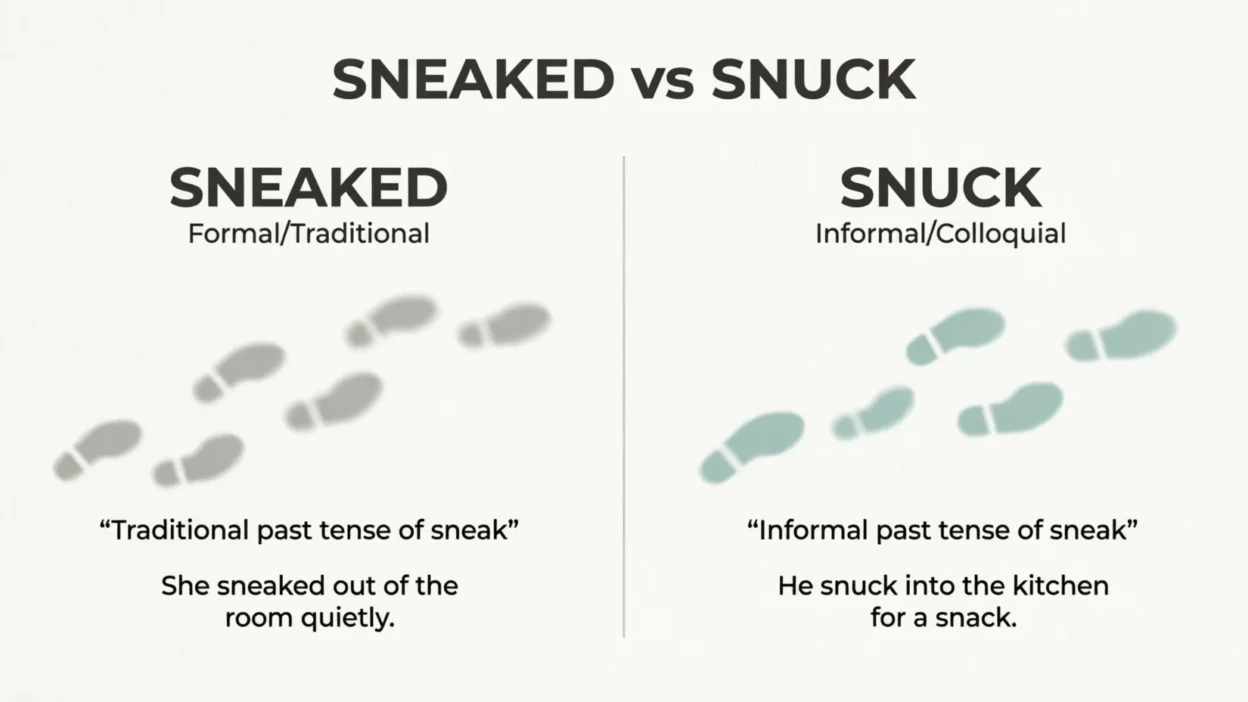
Both “sneaked” and “snuck” are correct past tense forms of “sneak.”
- Sneaked is more traditional and formal.
- Snuck is more informal and common in American English.
Examples:
- She sneaked into the room quietly. ✅
- She snuck into the room quietly. ✅
What Does “Sneak” Mean?
The verb “sneak” means:
- to move secretly
- to go quietly and carefully
- to avoid being noticed
It often suggests:
- stealth
- secrecy
- quiet movement
Examples of Sneak
- The child tried to sneak cookies before dinner.
- He sneaked past security.
- They snuck into the theater quietly.
What Is “Sneaked”?
“Sneaked” is the traditional past tense and past participle form of “sneak.”
It has been used for centuries and remains widely accepted in:
- formal writing
- academic English
- British English
Examples of Sneaked
- She sneaked out after midnight.
- The cat sneaked through the door.
- He had sneaked into the building unnoticed.
Tone of Sneaked
“Sneaked” sounds:
- more formal
- more traditional
- grammatically conservative
What Is “Snuck”?
“Snuck” is a newer irregular past tense form of “sneak.”
It became popular mainly in:
- American English
- casual conversation
- storytelling
Today, “snuck” is accepted by major dictionaries and style guides.
Examples of Snuck
- He snuck into the concert.
- They snuck away quietly.
- She had snuck out before sunrise.
Tone of Snuck
“Snuck” sounds:
- conversational
- modern
- informal
Sneaked vs Snuck Comparison Table
| Word | Grammar Type | Tone | Common Usage |
|---|---|---|---|
| Sneaked | Regular past tense | Formal/Traditional | British English, formal writing |
| Snuck | Irregular past tense | Informal/Conversational | American English, casual speech |
Why Both Forms Exist
English sometimes creates irregular verbs naturally through speech patterns.
Examples include:
- dive → dove
- plead → pled
- sneak → snuck
Although “sneaked” came first historically, “snuck” became popular because it sounded more natural in spoken English.
Which One Is More Correct?
Both forms are grammatically correct today.
However:
- “sneaked” is preferred in formal contexts
- “snuck” is preferred in casual American speech
Formal Writing
Better choice:
- sneaked
Informal Conversation
Common choice:
- snuck
American vs British English Differences
Regional preferences play a major role in this grammar choice.
American English
Americans commonly use:
- snuck
Example:
- He snuck into the game.
“Snuck” sounds natural to many American speakers.
British English
British English generally prefers:
- sneaked
Example:
- He sneaked into the game.
“Snuck” exists in British English but is less common.
How to Use “Sneaked” Correctly
Use “sneaked” when:
- writing formally
- creating academic content
- following traditional grammar style
Examples
- The reporter sneaked into the restricted area.
- She sneaked a glance at the answers.
- They had sneaked away before the ceremony ended.
How to Use “Snuck” Correctly
Use “snuck” when:
- speaking casually
- writing conversationally
- mimicking natural American speech
Examples
- He snuck out during the movie.
- The dog snuck onto the couch.
- We snuck snacks into the theater.
Common Mistakes With Sneaked vs Snuck
Although both words are correct, writers still make errors.
Mistake 1: Thinking Snuck Is Always Wrong
Some people incorrectly believe:
- snuck ❌
But modern dictionaries accept it. ✅
Mistake 2: Using Snuck in Highly Formal Writing
In very formal or academic writing, “sneaked” may sound more polished.
Mistake 3: Mixing Verb Tenses Incorrectly
Incorrect:
- He has sneakeded into the room. ❌
Correct:
- He has sneaked into the room. ✅
- He has snuck into the room. ✅
Practical Example Paragraphs
Example Using Sneaked
The student sneaked into the library early to finish her project before class began. She quietly gathered her materials and avoided disturbing others.
Example Using Snuck
The kids snuck downstairs at midnight to grab leftover cake from the refrigerator while everyone else slept.
Placement and Grammar Rules Table
| Phrase | Sentence Placement | Tone | Example Sentence |
|---|---|---|---|
| Sneaked into | Middle sentence | Formal | He sneaked into the office quietly |
| Snuck into | Conversational | Informal | She snuck into the concert |
| Had sneaked | Perfect tense | Professional | They had sneaked away earlier |
| Had snuck | Casual perfect tense | Informal | He had snuck out before dawn |
Pronunciation Differences
Sneaked
Pronounced:
- SNEEKT
Snuck
Pronounced:
- SNUHK
“Snuck” often sounds smoother in casual speech, which partly explains its popularity.
Why Writers Prefer One Over the Other
Why Some Prefer Sneaked
- sounds more formal
- follows regular grammar patterns
- preferred in traditional English education
Why Some Prefer Snuck
- sounds natural in conversation
- widely used in American English
- shorter and smoother to pronounce
Similar Verb Patterns in English
English contains many verbs with both regular and irregular forms.
| Base Verb | Regular Form | Irregular Form |
|---|---|---|
| Dream | Dreamed | Dreamt |
| Learn | Learned | Learnt |
| Dive | Dived | Dove |
| Sneak | Sneaked | Snuck |
Helpful Memory Trick
Use this simple shortcut:
Sneaked = Formal
Think:
- “ed” endings often feel more formal
Snuck = Casual
Think:
- shorter, punchier conversational speech
Everyday Usage Examples
Correct Examples
- The cat sneaked through the window.
- He snuck into the kitchen quietly.
- They sneaked away after dinner.
- She snuck out before sunrise.
Formal Example
- The journalist sneaked into the restricted area for information gathering.
Casual Example
- My brother snuck extra candy into the movie theater.
FAQs About Sneaked vs Snuck
Is snuck a real word?
Yes. “Snuck” is accepted in modern English dictionaries.
Which is more correct: sneaked or snuck?
Both are correct, but “sneaked” is more formal.
Is snuck informal?
Generally, yes. It sounds more conversational.
Do Americans use snuck more often?
Yes. “Snuck” is very common in American English.
Does British English prefer sneaked?
Yes. British English usually favors “sneaked.”
Can I use snuck in professional writing?
You can, but “sneaked” may sound more polished in formal contexts.
Which form is older?
“Sneaked” is the original historical form.
Final Thoughts
The difference between sneaked vs snuck comes down to style, tone, and regional preference rather than strict correctness. Both words function as acceptable past tense forms of “sneak,” but “sneaked” sounds more formal and traditional, while “snuck” feels more conversational and modern.
Understanding when to use each version can improve your writing clarity and help your English sound more natural in different situations. Whether you are writing professionally, speaking casually, or editing content, choosing the right form adds polish and confidence to your communication.
Actionable Takeaway
Use this simple rule:
- formal writing → sneaked
- casual American speech → snuck
If you are unsure, “sneaked” is always a safe choice because it works well in nearly every context.