
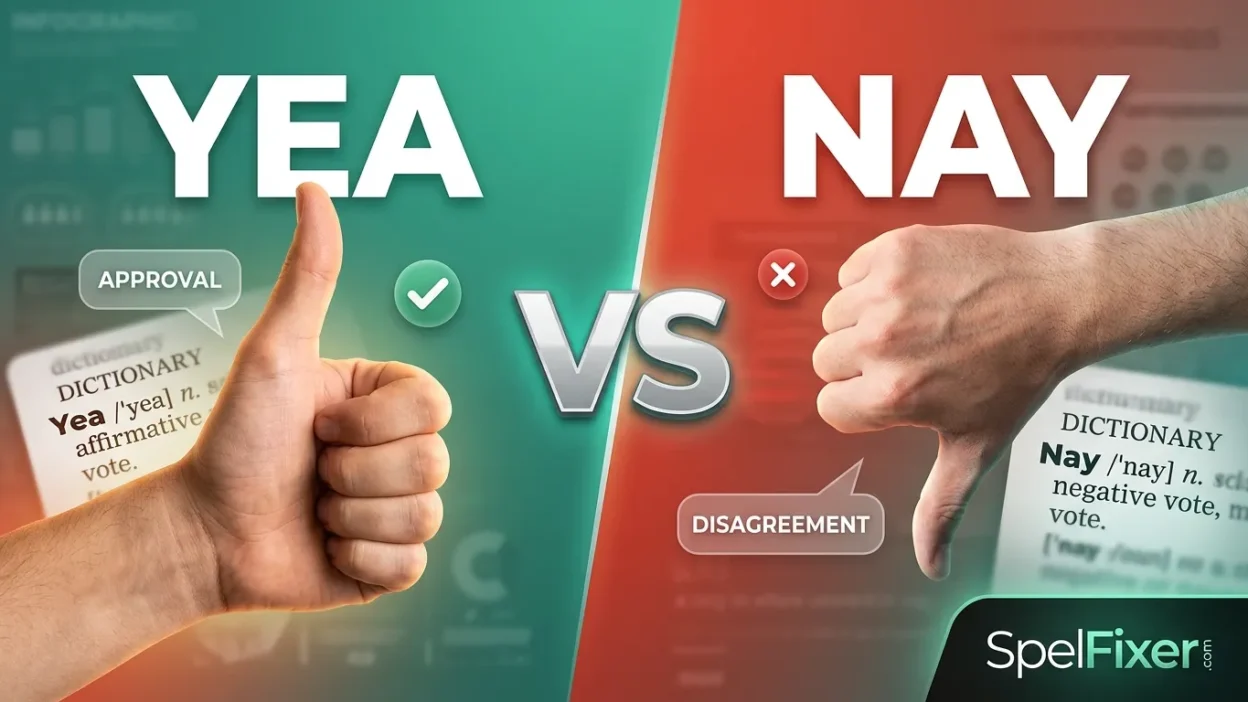
If you’ve ever seen “yea” and “nay” in a vote, meeting, or formal discussion, you may have wondered what these unusual-looking words actually mean. They’re both ways of expressing a vote, but they have different meanings and are used in specific contexts.
The good news is that the distinction is simple: yea means “yes” or a vote in favor, while nay means “no” or a vote against. However, there are a few details worth knowing, especially because “yea” is sometimes confused with “yeah” and “nay” can have a different meaning in other expressions.
Quick Answer:
- Yea means yes, especially when formally voting in favor of something.
- Nay means no, especially when formally voting against something.
- Yea is often used in formal votes, legislative proceedings, and traditional expressions.
- Nay is the opposite of yea in voting contexts.
- Yeah is an informal form of “yes” and is not the same as “yea.”
- Nay can also mean “no” in older or literary English.
Simple rule: If you are voting for something, your vote is a yea. If you are voting against it, your vote is a nay.
What Does “Yea” Mean?
Yea is a word that means yes or indicates an affirmative vote. It is most commonly encountered in formal voting situations rather than everyday conversation.
For example:
The motion passed with 35 yeas and 12 nays.
Here, yeas refers to the people or votes supporting the motion.
The word can also appear in older or formal expressions. In these cases, it carries the sense of yes, indeed, or truly.
Examples of “Yea”
- The members voted yea on the proposal.
- There were 80 yeas and 20 nays.
- The committee recorded her vote as yea.
- The bill received more yea votes than nay votes.
- He answered yea when asked whether he supported the plan.
In ordinary modern conversation, however, most people would simply say yes rather than yea.
What Does “Nay” Mean?
Nay means no, particularly when someone is casting a negative vote.
It is the direct opposite of yea in formal voting.
For example:
The final count was 42 yeas and 18 nays.
This means 42 votes were in favor and 18 were against.
“Nay” can also be used in older, literary, or deliberately formal English to mean “no” or even “more than that.”
Examples of “Nay”
- The members voted nay on the proposal.
- The motion received 15 yeas and 10 nays.
- She cast a nay vote.
- The senator voted nay on the bill.
- He said nay when asked whether he agreed.
You are much less likely to hear nay in casual modern conversation than no.
Yea vs Nay: The Main Difference
The easiest way to remember the difference is to think of them as opposites:
| Word | Meaning | Typical Use | Opposite |
| Yea | Yes; vote in favor | Formal voting | Nay |
| Nay | No; vote against | Formal voting | Yea |
| Yeah | Informal yes | Everyday conversation | No |
| Yes | Affirmative response | Everyday and formal English | No |
So, if a group is voting on whether to approve a proposal:
- Yea = I support it.
- Nay = I oppose it.
This is why you may hear a chairperson say something like, “All those in favor, say yea; those opposed, say nay.”
Yea vs Yeah: Don’t Confuse Them
One of the most common mistakes is confusing yea with yeah.
Although they sound similar, they are not interchangeable.
Yea is primarily associated with formal voting or older/formal English.
Yeah is an informal way of saying yes.
Compare These Examples
Yea:
The committee voted yea on the amendment.
Yeah:
“Are you coming with us?”
“Yeah, I’ll be there.”
Using “yea” in the second example would sound unnatural in modern everyday English.
Likewise, using “yeah” to describe a formal legislative vote would usually be inappropriate.
Easy Memory Trick
Think:
Yea = vote yes
Yeah = casual yes
That simple distinction will help you avoid one of the most common yea vs yeah errors.
When Should You Use “Yea”?
Use yea when the context involves a formal vote or when you intentionally want an old-fashioned or formal tone.
Common contexts include:
- Legislative voting
- Committee meetings
- Formal organizational decisions
- Parliamentary procedures
- Historical writing
- Traditional expressions
For example:
The board recorded six yeas and two nays.
In casual situations, yes is usually a better choice.
Instead of:
Yea, I like that movie.
Modern English would normally use:
Yeah, I like that movie.
or:
Yes, I like that movie.
When Should You Use “Nay”?
Use nay primarily when referring to a formal vote against a proposal.
For example:
The final tally included 27 yeas and 13 nays.
You may also encounter “nay” in historical texts, literature, speeches, or expressions where the writer wants an old-fashioned tone.
In everyday conversation, simply use no.
Instead of:
Nay, I don’t want to go.
A modern speaker would normally say:
No, I don’t want to go.
“Nay” is not incorrect in the first sentence, but it sounds noticeably formal, archaic, or literary.
Yea and Nay in Voting
The words yea and nay are particularly useful for understanding voting terminology.
When a question is put to a formal vote, participants may be asked to indicate whether they support or oppose it.
For example:
The chair called for a vote on the new policy.
The results might be:
- 25 yeas
- 10 nays
- 2 abstentions
The yeas support the proposal, while the nays oppose it.
An abstention means someone chooses not to vote for or against the proposal.
This terminology is especially common in formal political and organizational settings.
Is “Yea” the Same as “Yes”?
Not exactly.
Yea can mean “yes,” but its most recognizable modern use is as a formal affirmative vote.
For ordinary questions, yes is the natural choice.
For example:
“Do you want some coffee?”
“Yes.”
You would not normally respond:
“Yea.”
That would sound unusual unless you were deliberately using an old-fashioned or humorous style.
So while the meanings overlap, their usage and tone are different.
Is “Nay” the Same as “No”?
In voting contexts, essentially yes.
Nay means “no” or indicates opposition to a proposal.
However, “nay” has some additional uses in older English. It can sometimes introduce a correction or stronger statement, similar to “indeed”, “rather,” or “more accurately.”
For example:
It wasn’t merely difficult, nay, it was nearly impossible.
This literary use is quite different from the voting sense.
For everyday writing, however, no is generally the clearer choice.
American vs British English: Yea and Nay
The words yea and nay can be found in both American and British English, particularly in formal, historical, parliamentary, or legislative contexts.
However, their everyday use is limited in both varieties.
In American English, “yea” and “nay” are strongly associated with formal voting, especially legislative votes. You may see phrases such as “yea vote” and “nay vote.”
In British English, aye is also an important voting term, particularly in parliamentary and traditional contexts. “Nay” can still be encountered, but “yea” is less likely to appear in ordinary speech.
This means the words are not really a matter of choosing American English versus British English. Instead, context and formality determine whether they sound natural.
Common Mistakes With Yea and Nay
Understanding the meanings is easy, but several usage mistakes are common.
1. Confusing “Yea” With “Yeah”
Incorrect for a formal vote:
The senator voted yeah.
Better:
The senator voted yea.
“Yeah” is informal; “yea” is the formal voting term.
2. Using “Yea” Instead of “Yes” Everywhere
Although yea can mean yes, it does not sound natural in most everyday conversations.
Better:
Yes, I’d like to come.
rather than:
Yea, I’d like to come.
3. Assuming “Nay” Is Always a Voting Word
“Nay” can mean no, but it also has an older literary use meaning something like “indeed” or “more than that.”
The surrounding sentence determines its meaning.
4. Forgetting That Yea and Nay Are Opposites
Remember:
Yea = in favor
Nay = against
This is especially important when reading voting results.
5. Using Formal Words in Casual Writing
Words like yea and nay can sound stiff in texts, social media posts, and casual conversations.
Usually, yes, yeah, and no are better choices.
Yea vs Nay Examples in Real Sentences
Here are some examples to make the distinction clearer:
Formal voting:
The committee voted yea on the proposed changes.
Formal voting against something:
Three members voted nay.
Voting results:
The motion passed with 18 yeas and 7 nays.
Casual agreement:
“Do you want to watch a movie?”
“Yeah, sure.”
Casual disagreement:
“Are you going to the event?”
“No, I can’t make it.”
Notice how yea and nay work naturally in formal voting, while yeah and no are more natural in everyday conversation.
Frequently Asked Questions
Is “yea” a formal word for yes?
Yes. “Yea” can mean yes, but in modern English it is especially associated with formal voting. For ordinary conversation, “yes” or “yeah” is usually more natural.
Does “nay” mean no?
Yes. “Nay” can mean no, particularly when someone votes against a proposal. It can also appear in older or literary English.
What is the opposite of yea?
The opposite of yea is nay. In a formal vote, yea indicates support and nay indicates opposition.
What is the difference between yea and yeah?
Yea is mainly a formal voting term, while yeah is an informal way of saying yes. They may sound similar, but they have different uses.
Is yea still used today?
Yes. It remains in use, particularly in formal voting and legislative contexts. It is uncommon in ordinary conversation.
Is nay still used today?
Yes, although it is less common in everyday speech. It continues to appear in formal voting and can also be used for an old-fashioned or literary effect.
Is “yea” used in British English?
Yes, but it is not common in everyday British English. Formal and parliamentary contexts may use related traditional voting terminology, including “yea” and “nay.”
Should I use yea or yes?
Use yes in normal conversation and most everyday writing. Use yea when referring to a formal vote or when a deliberately traditional tone is appropriate.
Final Summary
The difference between yea vs nay is straightforward: yea means yes or a vote in favor, while nay means no or a vote against. These words are most strongly associated with formal voting, legislative proceedings, committees, and traditional English. They are still used today, but they are much less common in casual conversation.
Also remember not to confuse yea with yeah. “Yeah” is an informal version of “yes,” while “yea” has a more formal or traditional role. If you’re talking about a vote, think yea = support and nay = oppose. In everyday conversation, stick with yes, yeah, and no for a more natural sound.
Actionable Takeaway
When you see yea vs nay, remember this simple formula:
Yea = Yes / In favor
Nay = No / Against
And if you’re writing casually, choose yes, yeah, or no instead unless you specifically need formal voting terminology.