If you’ve ever typed “foward” and felt a tiny moment of doubt, you’re not alone. It’s one of the most common spelling mistakes in English—especially because the word sounds like it could be spelled either way.
The confusion between foward vs forward happens to students, professionals, and even experienced writers.
The good news? Once you understand the correct form and a quick memory trick, you’ll never make this mistake again.
Quick Answer
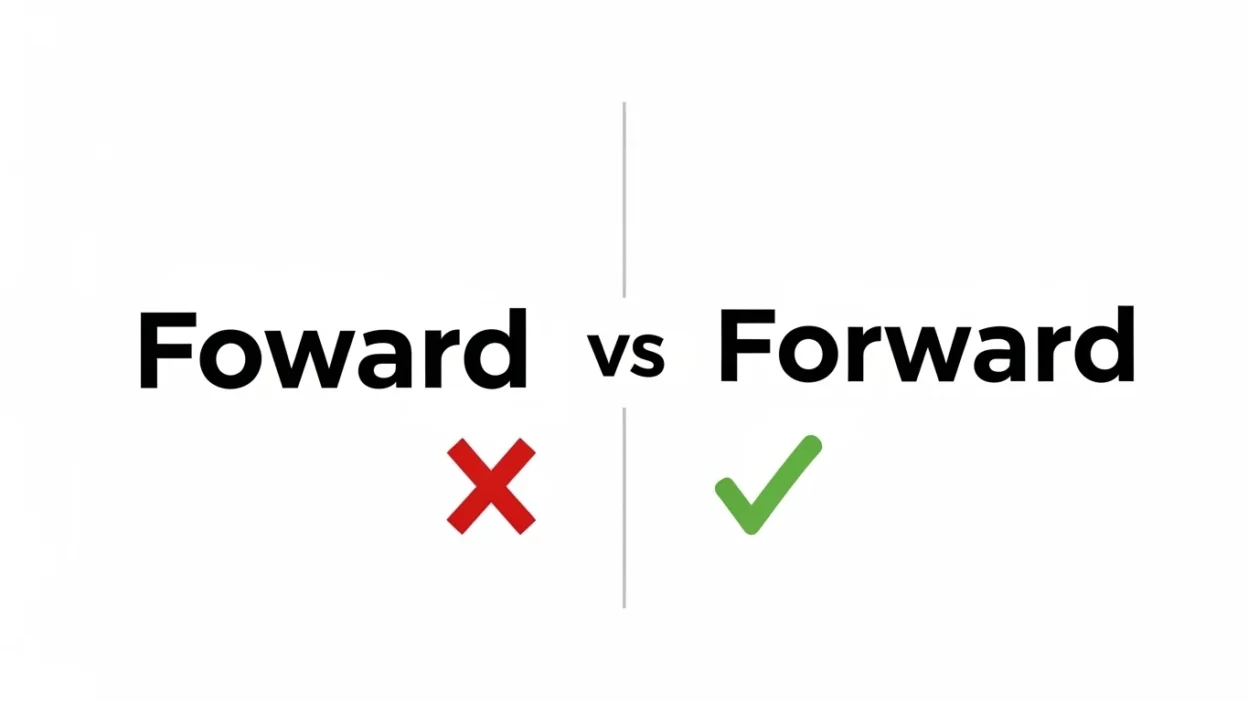
- ❌ Foward is incorrect and not a real English word
- ✅ Forward is the correct spelling
- Always use forward when referring to direction, progress, or movement ahead
What Does “Forward” Mean?
The word forward is both an adverb, adjective, noun, and even a verb in some contexts. It generally refers to movement, direction, or progress toward the front or future.
Core meanings:
- Toward the front
- Ahead in position or time
- Moving or progressing onward
Examples:
- Please step forward.
- We’re looking forward to the event.
- The team is moving forward with the project.
- He played as a forward in the match.
LSI keywords and related phrases:
- ahead
- onward
- progress
- advance
- move ahead
- push forward
These related terms enrich your writing and improve SEO naturally.
What Is “Foward”? Is It Ever Correct?
Let’s be clear: “foward” is not a correct English word.
It’s a common misspelling of “forward”, usually caused by dropping the second “r.”
Why people write “foward”:
- Typing quickly and skipping a letter
- Mishearing pronunciation
- Not realizing the word contains two “r” letters
Important:
- ❌ Foward → Incorrect
- ✅ Forward → Correct
Even in casual writing, “foward” should be corrected.
Foward vs Forward: Side-by-Side Comparison
| Feature | Foward ❌ | Forward ✅ |
|---|---|---|
| Valid word | No | Yes |
| Meaning | None | Toward the front or ahead |
| Usage | Incorrect | Correct |
| Accepted globally | No | Yes (US & UK English) |
| Example | ✖ Move foward | ✔ Move forward |
How to Use “Forward” Correctly
The word forward is versatile and used in many contexts.
1. Direction and movement
- She took a step forward.
- The car moved slowly forward.
2. Progress and development
- We must move forward as a team.
- The company is pushing forward with innovation.
3. Communication (emails/messages)
- Please forward this email to your manager.
- He forwarded the message yesterday.
4. Sports context
- He plays as a forward in football.
Tip:
Use forward whenever you mean ahead, onward, or progressing.
Common Mistakes to Avoid
Here are the most frequent errors people make:
1. Dropping the second “r”
- ❌ Foward thinking
- ✅ Forward thinking
2. Relying on pronunciation
The word sounds like “fo-ward,” which hides the second “r.”
3. Confusing with similar words
- Toward (US spelling)
- Towards (UK spelling)
4. Ignoring spellcheck
Most tools flag “foward”—don’t ignore it.
Why “Forward” Has Two “R” Letters
The correct spelling comes from combining:
- fore (meaning front)
- -ward (directional suffix)
Breakdown:
- fore → front
- ward → direction
Memory trick:
👉 Think: “Forward = fore + ward → two parts, two ‘r’s”
This makes it easier to remember the correct spelling.
American vs British English Differences
Here’s something important:
- Forward is used in both American English and British English
- However, British English sometimes also uses “forwards” (with an “s”) as an adverb
Examples:
- US: Move forward
- UK: Move forwards
Key point:
- ✅ Forward → correct everywhere
- ❌ Foward → incorrect everywhere
Synonyms and Alternatives for “Forward”
To improve variety and readability, here are some alternatives:
For movement:
- ahead
- onward
- in front
For progress:
- advance
- progress
- develop
For communication:
- send
- pass along
- transmit
Examples:
- Move forward → Move ahead
- Forward the email → Send the email
Using synonyms enhances both readability and SEO strength.
Real-Life Usage Examples
Let’s explore how forward appears in everyday contexts:
Daily life:
- Take a step forward and speak clearly.
Workplace:
- The team is moving forward with the new plan.
Technology:
- Please forward the document to the client.
Sports:
- The forward scored the winning goal.
These examples show how essential and versatile the word is.
FAQs About Foward vs Forward
Is “foward” ever correct?
No, it is always a misspelling of “forward.”
What does “forward” mean in simple terms?
It means ahead, toward the front, or progressing.
Why do people write “foward”?
Because they accidentally drop the second “r” while typing.
Is “forward” used in formal writing?
Yes, it is widely used in both formal and informal contexts.
Is there a British spelling of “forward”?
Yes, “forward” is standard, but “forwards” is also used in British English.
Can “forward” be used as a verb?
Yes, it means to send something onward, like an email.
What is a synonym for “forward”?
Ahead, onward, or advance.
Summary
The difference between foward vs forward is simple but important. Forward is the correct and widely accepted spelling used to describe direction, movement, or progress. On the other hand, foward is a common spelling mistake caused by dropping a letter.
By understanding the structure and meaning of forward, you can avoid this error and improve your writing instantly. Whether you’re writing emails, reports, or everyday messages, using the correct spelling helps you communicate more clearly and professionally.
Actionable Takeaway
Here’s your simple rule:
👉 Always use forward with two “r” letters—never write foward
Before you publish or send anything, take a moment to double-check spelling. Small details like this can make a big difference in how polished and credible your writing appears.