
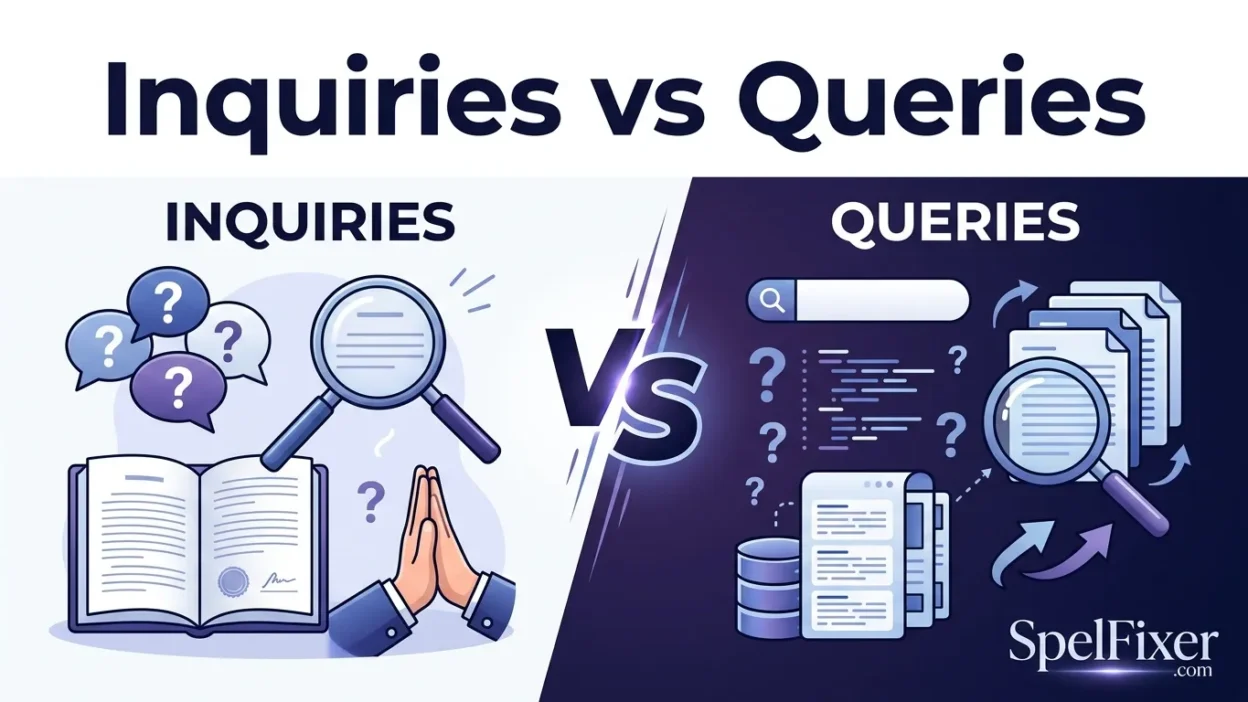
Have you ever wondered whether you should write “inquiry” or “query” when asking for information? These two words are closely related, and in many situations, people use them interchangeably. However, they can carry slightly different meanings depending on context, especially in business, customer service, technology, and everyday communication.
Understanding inquiries vs queries can help you choose the more natural word and make your writing sound clearer and more professional. In this guide, we’ll explain their meanings, differences, examples, common mistakes, and how American and British English treat these words.
Quick Answer:
Inquiry generally means a request for information or an investigation into something.
Query usually means a question or request for information, but it can also refer to a specific question submitted to a database, search engine, or computer system.
In everyday English, the words can often be used interchangeably:
- I made an inquiry about the course.
- I made a query about the course.
However, inquiry is often more natural for formal requests or investigations, while query is especially common in technical, business, and information-search contexts.
What Does “Inquiry” Mean?
An inquiry is a request for information, clarification, or details about something. It can also describe a formal investigation into an issue or event.
For example:
I sent an inquiry to the company about my order.
Here, the person wants information about an order.
The word can also describe a more serious investigation:
The government launched an inquiry into the incident.
In this case, inquiry means a formal investigation rather than simply asking a question.
Common Uses of Inquiry
You might use inquiry when talking about:
- Customer questions
- Business requests
- Product information
- Service information
- Formal investigations
- Academic research
- Requests for clarification
For example:
- “We received several customer inquiries today.”
- “She made an inquiry about the available positions.”
- “The committee conducted an inquiry into the matter.”
What Does “Query” Mean?
A query is usually a question or request for information. It is commonly used when someone wants an answer, clarification, or specific piece of information.
For example:
I have a query about my electricity bill.
This means the speaker has a question or concern about the bill.
Query is also widely used in technology. A search submitted to Google or another search engine can be called a search query. Similarly, a request sent to a database is known as a database query.
Common Uses of Query
You might use query when referring to:
- A question
- A customer question
- A business request
- A search-engine request
- A database request
- A technical request
- A request for clarification
Examples include:
- “Please contact us if you have any queries.”
- “The user entered a search query.”
- “The developer wrote a database query.”
- “I have a query regarding the invoice.”
Inquiries vs Queries: Key Differences
Although inquiry and query overlap, there are some useful distinctions.
| Feature | Inquiry | Query |
| Basic meaning | Request for information or investigation | Question or request for information |
| Formality | Often formal | Neutral to formal |
| Business use | Very common | Very common |
| Customer service | Common | Common |
| Investigation | Can mean a formal investigation | Usually does not mean an investigation |
| Technology | Less common | Extremely common |
| Search engines | Less common | Very common |
| Databases | Rare | Very common |
| American English | Common | Common |
| British English | Common | Very common |
The biggest difference is that inquiry can refer to an investigation, while query generally focuses on a question or request for information.
Inquiry vs Query Examples
Seeing the words in real sentences makes the distinction easier.
Examples With “Inquiry”
- “I submitted an inquiry about the scholarship.”
- “The company received an inquiry from a potential customer.”
- “She made an inquiry about the hotel’s cancellation policy.”
- “The committee opened an inquiry into the complaint.”
Examples With “Query”
- “I have a query about my account.”
- “Please send your query to the support department.”
- “The researcher entered a query into the database.”
- “Google processes millions of search queries.”
Notice that query sounds particularly natural when discussing computers, databases, and search engines.
Inquiry or Query: Which One Should You Use?
The best choice depends on what you are trying to say.
Use inquiry when you mean:
- A request for information
- A formal request
- An investigation
- A customer asking for details
Use query when you mean:
- A question
- A specific request for clarification
- A search-engine request
- A database request
- A technical question
For example, if you are emailing a hotel about room availability, either word could work:
“I am writing to make an inquiry about room availability.”
Or:
“I have a query regarding room availability.”
Both are understandable, but the first may sound slightly more formal, while the second is concise and natural in many business settings.
American vs British English
The distinction between inquiry and query can become more noticeable between American and British English.
In American English, inquiry is widely used for both general requests for information and formal investigations. The word query is also used, particularly in technical and business contexts.
For example:
- “Customer inquiry”
- “Congressional inquiry”
- “Search query”
- “Database query”
In British English, query is especially common for a question or request for information. Inquiry can also be used, particularly for an official investigation.
So, if you are writing for a British audience, you may encounter phrases such as:
“Please contact us if you have any queries.”
For an American audience, you may be more likely to see:
“Please contact us if you have any questions or inquiries.”
Neither usage is inherently wrong. Context and regional preference matter.
Common Mistakes With Inquiry and Query
Because these words have similar meanings, several mistakes are common.
1. Treating Every Inquiry as an Investigation
An inquiry can mean a simple request for information.
Incorrect assumption:
“I made an inquiry” always means “I started an investigation.”
Not necessarily. It could simply mean:
“I asked for information.”
2. Using “Query” Only for Technology
Although query is extremely common in computing, it is not limited to technology.
You can say:
“I have a query about my insurance policy.”
You do not need to be talking about a database or search engine.
3. Assuming the Words Are Always Interchangeable
The words overlap, but they are not identical in every context.
For example:
“The government launched an inquiry.”
This naturally suggests an official investigation.
Replacing it with:
“The government launched a query.”
would change the meaning and sound unnatural.
4. Confusing “Inquiry” With “Enquiry”
You may also encounter enquiry, particularly in British English.
For example:
“Please send your enquiry to our customer service team.”
Enquiry is commonly used for a general request for information in British English, while inquiry can be associated with a formal investigation. However, modern usage varies, and the distinction is not absolute.
Is “Inquiry” More Formal Than “Query”?
Not always.
Both words can appear in professional communication. However, inquiry can sound more formal when referring to an official request or investigation.
For example:
“The company received an inquiry from the regulatory authority.”
Meanwhile:
“I have a query about my invoice.”
sounds like a straightforward customer question.
The tone depends heavily on the surrounding sentence rather than the word alone.
Is “Query” the Same as “Question”?
Usually, they are close in meaning, but query can sound more specific or formal.
Compare:
“I have a question about the application.”
with:
“I have a query about the application.”
Both are correct. The second can sound slightly more professional in business correspondence.
In technology, however, query has a more specialized meaning. A search query is the text or request entered into a search system, while a database query asks a database to retrieve or manipulate information.
Frequently Asked Questions
1. What is the difference between inquiries and queries?
An inquiry is generally a request for information or an investigation, while a query is usually a question or specific request for information. Their meanings overlap in everyday communication.
2. Is an inquiry the same as a query?
They can mean essentially the same thing when referring to a request for information. However, inquiry can also mean a formal investigation, which gives it an additional meaning that query generally does not have.
3. Which is better: inquiry or query?
Neither word is universally better. Choose inquiry for formal requests or investigations and query for questions, technical requests, searches, and database-related contexts.
4. Is “query” formal English?
Yes. Query is standard English and is frequently used in professional, academic, business, and technical writing.
5. Is “inquiry” American or British English?
Inquiry is used in both American and British English. British English also commonly uses enquiry for general requests for information.
6. Should I say “customer inquiry” or “customer query”?
Both are correct. Customer inquiry is especially common in American English, while customer query is also widely used, particularly in British English.
7. What is a search query?
A search query is the word, phrase, or request someone enters into a search engine to find information online.
For example, “inquiries vs queries” can itself be considered a search query.
8. What is a database query?
A database query is a request made to a database to retrieve, filter, update, or otherwise work with stored information. The term is especially common in software development and data management.
Final Summary
The difference between inquiries vs queries is small but useful to understand. Both words can describe a request for information, and they are often interchangeable in everyday or professional communication. However, inquiry can also mean a formal investigation, while query is particularly common for questions, technical requests, search engines, and databases.
When choosing between them, focus on your context rather than trying to memorize a rigid rule. If you are asking for information, either word may work. If you are describing an official investigation, inquiry is usually the better choice. If you are discussing search engines or databases, query is the natural term.
Actionable Takeaway
Use “inquiry” for requests or investigations, and “query” for questions, searches, and technical requests. When both work, choose the word that sounds most natural for your audience and context.