The confusion between either vs whether is extremely common in English grammar. These two words sometimes appear in similar sentence structures, which makes many writers unsure about which one is correct. While both words can relate to choices or alternatives, they serve very different grammatical purposes.
If you have ever paused while writing phrases like “I don’t know either he’s coming” or “You can choose whether option,” you are not alone. Understanding the difference between either and whether can instantly improve your grammar, sentence clarity, and confidence in both casual and professional writing.
In this complete guide, you will learn the meanings of either and whether, grammar rules, sentence examples, comparison tables, common mistakes, practical usage tips, and easy memory tricks to help you choose the correct word every time.
Quick Answer
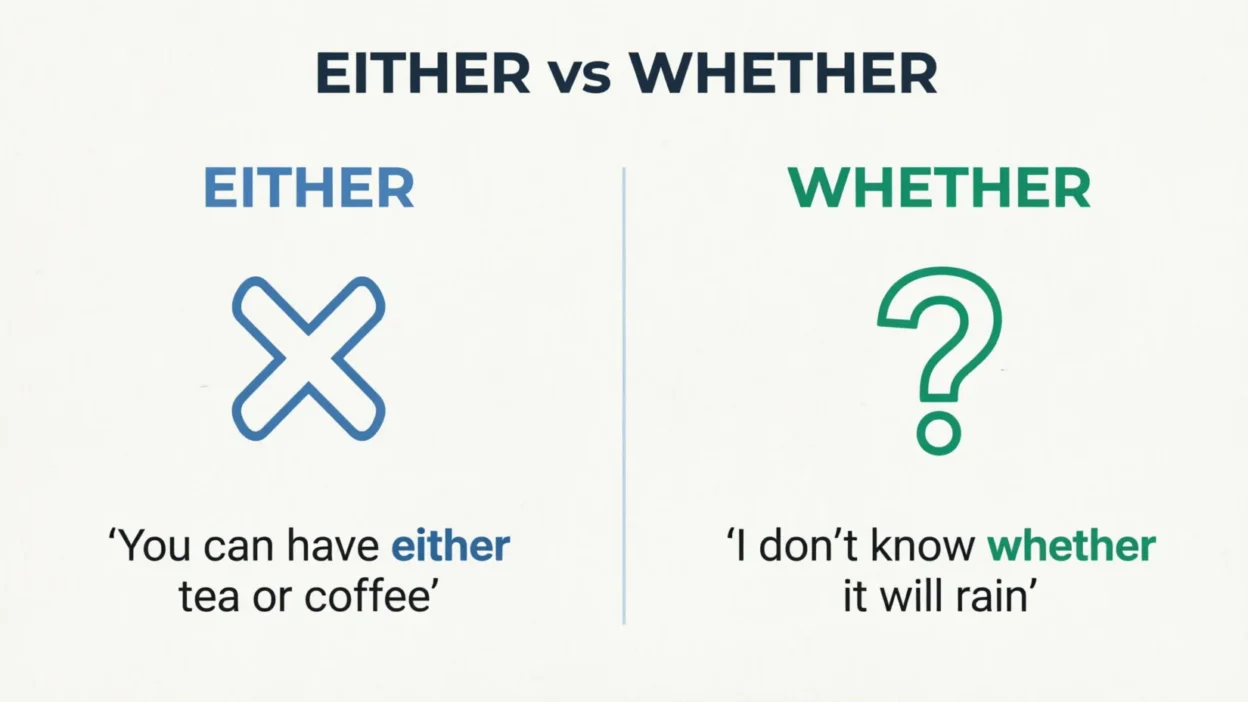
- Either is used when referring to one of two choices or alternatives.
- Whether is used to introduce possibilities, uncertainty, or conditions.
- You can choose either option. ✅
- I don’t know whether she will attend. ✅
Simple rule:
- Either = one choice from two
- Whether = uncertainty or possibility
What Does “Either” Mean?
The word “either” usually refers to:
- one of two options
- alternatives
- choices between two things
It can function as:
- a pronoun
- adjective
- conjunction
- adverb
Common Meanings of Either
- one or the other
- both choices are acceptable
- also not (in negative sentences)
Examples of Either
- You may sit on either chair.
- Either answer is acceptable.
- I don’t like coffee either.
- Either John or Sarah will lead the meeting.
What Does “Whether” Mean?
“Whether” is used to:
- introduce uncertainty
- show alternatives
- express doubt or possibility
It often appears when discussing:
- decisions
- unknown outcomes
- conditions
- indirect questions
Examples of Whether
- I don’t know whether he called.
- She asked whether dinner was ready.
- We are deciding whether to travel.
- Whether you agree or not, we must continue.
Either vs Whether Comparison Table
| Word | Meaning | Main Function | Example |
|---|---|---|---|
| Either | One of two choices | Choice/alternative | Either option works |
| Whether | Expresses uncertainty | Condition/possibility | I wonder whether she knows |
The Main Difference Between Either and Whether
The easiest way to understand the difference is this:
Either = Choice Between Two Things
Use “either” when:
- selecting between two options
- discussing alternatives
Example:
- You can choose either dessert.
Whether = Uncertainty or Possibility
Use “whether” when:
- something is unknown
- discussing possibilities
- introducing indirect questions
Example:
- I’m unsure whether they arrived.
How to Use “Either” Correctly
“Either” works best when talking about:
- alternatives
- choices
- one of two options
Common Uses of Either
- either/or
- either option
- either side
- either one
- not either
Correct Examples
- Either route will get us there.
- You can wear either dress.
- Either my brother or sister is arriving.
- I don’t enjoy horror movies either.
How to Use “Whether” Correctly
Use “whether” when discussing:
- uncertainty
- possibilities
- unknown outcomes
- conditional situations
Common Uses of Whether
- whether or not
- decide whether
- wonder whether
- ask whether
- uncertain whether
Correct Examples
- We haven’t decided whether to move.
- She wondered whether he was serious.
- Tell me whether you can attend.
- Whether or not you agree, the rule stands.
Common Mistakes With Either vs Whether
Because both words can involve alternatives, writers sometimes use the wrong one.
Mistake 1: Using Either for Uncertainty
Incorrect:
- I don’t know either he’s coming. ❌
Correct:
- I don’t know whether he’s coming. ✅
Why?
The sentence expresses uncertainty, not a choice.
Mistake 2: Using Whether for Choices
Incorrect:
- You may choose whether shirt. ❌
Correct:
- You may choose either shirt. ✅
Why?
The sentence refers to choosing between two options.
Mistake 3: Confusing “Either Or” With “Whether Or Not”
Incorrect:
- Whether John or Sarah can drive. ❌
Correct:
- Either John or Sarah can drive. ✅
Why?
This sentence presents two alternatives.
Practical Example Paragraphs
Example Using Either
When shopping for a new laptop, you can choose either the lightweight model for portability or the powerful version for gaming and design work.
Example Using Whether
Before planning the outdoor event, the organizers needed to decide whether the weather conditions would remain stable throughout the weekend.
Placement and Grammar Rules Table
| Phrase | Sentence Placement | Tone/Formality | Example Sentence |
|---|---|---|---|
| Either option | Beginning/middle | Neutral | Either option will work |
| Either/or | Middle | Formal/informal | Either Sarah or Mike called |
| Whether or not | Beginning/middle | Formal | Whether or not he agrees, we proceed |
| Decide whether | Middle | Professional | We must decide whether to invest |
Either vs Whether in Questions
Either in Questions
Use “either” for:
- selecting one of two things
Example:
- Would you like either dessert?
Whether in Questions
Use “whether” in:
- indirect questions
Example:
- She asked whether I was available.
Either vs Whether With “Or”
Many learners confuse:
- either/or
- whether/or
Correct Structure With Either
Use:
- either + option + or + option
Example:
- Either tea or coffee is fine.
Correct Structure With Whether
Use:
- whether + possibility
Example:
- I don’t know whether she agrees.
Sometimes:
- whether or not
Example:
- Whether or not he attends, the meeting will continue.
American vs British English Differences
There are no major spelling differences between American and British English for:
- either
- whether
However, pronunciation of “either” varies slightly.
American Pronunciation
Usually:
- EE-ther
British Pronunciation
Often:
- EYE-ther
Both pronunciations are correct.
Easy Memory Tricks for Either vs Whether
Trick 1: Either = Two Choices
Think:
- either/or
This instantly reminds you of:
- alternatives
Trick 2: Whether = Wondering
Both words start with:
- “w”
Think:
- whether = wondering
This helps connect it to:
- uncertainty
- unknown outcomes
Why Correct Usage Matters
Using the correct word improves:
- grammar accuracy
- professional writing
- sentence clarity
- reader understanding
Confusing these terms can:
- create awkward phrasing
- confuse readers
- weaken formal communication
Correct usage is especially important in:
- academic writing
- emails
- business communication
- essays
- blog content
Similar English Word Confusions
People searching for “either vs whether” often also confuse:
- affect vs effect
- farther vs further
- who’s vs whose
- lay vs lie
- insure vs ensure
Learning these commonly confused words improves overall English fluency.
Everyday Examples of Either and Whether
Correct Uses of Either
- Either solution will solve the issue.
- You can sit on either side.
- Either my manager or supervisor will respond.
- I don’t watch sports either.
Correct Uses of Whether
- I’m unsure whether she called.
- We discussed whether to cancel the trip.
- Whether you win or lose, keep learning.
- Tell me whether this works.
Incorrect Examples
- I wonder either he knows. ❌
- Choose whether jacket you want. ❌
FAQs About Either vs Whether
What is the difference between either and whether?
“Either” refers to a choice between two options, while “whether” expresses uncertainty or possibility.
Can either mean both?
No. “Either” usually refers to one of two choices.
Is “whether or not” grammatically correct?
Yes. It is a common and correct English phrase.
Can whether replace if?
Sometimes, yes. However, “whether” is often more formal and precise.
How do you use either in a sentence?
Example:
- Either answer is acceptable.
How do you use whether in a sentence?
Example:
- I don’t know whether they arrived.
Is either always followed by or?
Not always, but it commonly appears in:
- either/or structures
Final Thoughts
Understanding the difference between either vs whether can greatly improve your grammar and writing confidence. Although both words sometimes relate to alternatives, they serve different purposes. “Either” focuses on choosing between two options, while “whether” introduces uncertainty, conditions, or possibilities.
Mastering commonly confused words helps your writing sound more polished, professional, and natural. Whether you are writing essays, emails, articles, or everyday messages, using the correct word ensures your meaning stays clear and accurate.
Actionable Takeaway
Use this quick rule:
- either = one of two choices
- whether = uncertainty or possibility
Easy memory trick:
- “whether” starts with “w,” like “wondering”
Before choosing the word, ask yourself:
- “Am I discussing a choice or uncertainty?”
That simple question will help you use the correct word every time.

Fenwick Quentin is a creative blogging author known for his analytical yet engaging writing style.
He explores topics such as innovation, digital culture, and personal development with depth and clarity.
Through his articles, Fenwick encourages readers to think critically and embrace continuous growth.