Have you ever wondered whether something has piqued your interest or peaked your interest? These two words sound almost identical, but they have completely different meanings. Choosing the wrong one can change the meaning of your sentence—and it’s a surprisingly common English mistake.
In this guide, I’ll explain piqued vs peaked in simple terms, show you real-world examples, compare their meanings, and give you an easy trick to remember which spelling to use. Whether you’re writing an email, blog post, school assignment, or social media caption, you’ll know exactly which word fits.
Quick Answer:
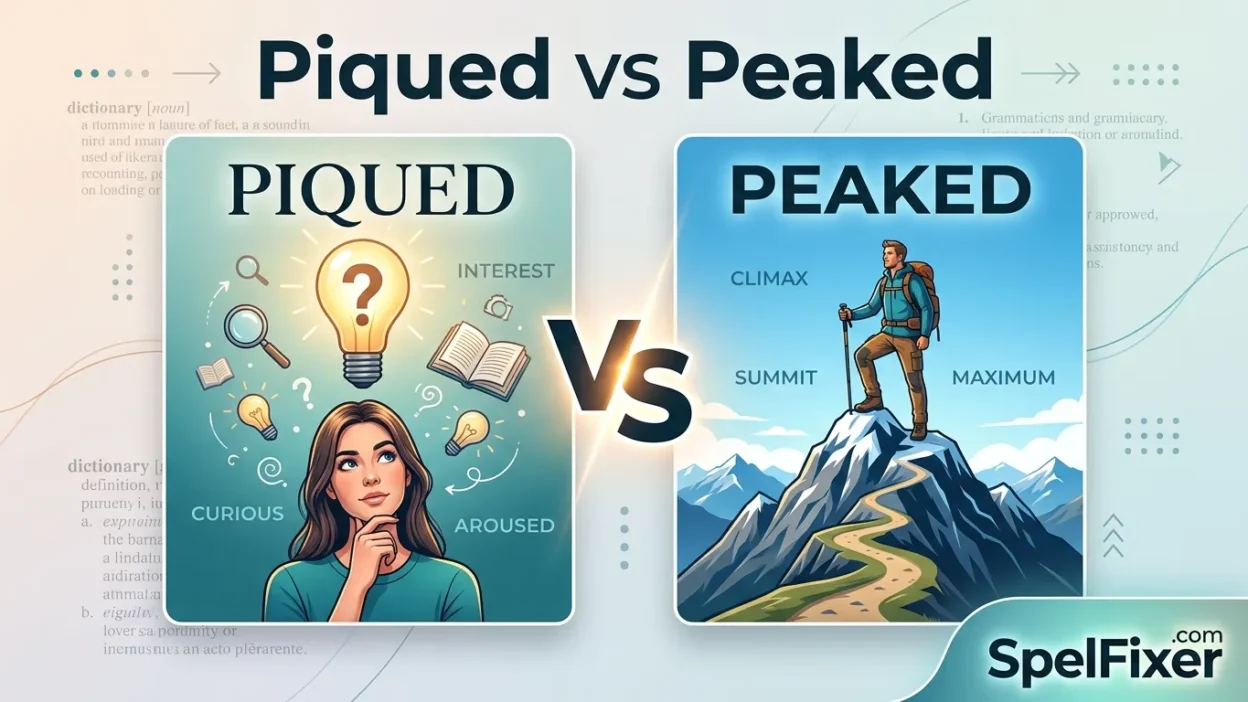
Piqued means aroused, stimulated, or sparked someone’s interest, curiosity, or attention.
Peaked means reached the highest point, level, or stage.
So, when you mean that something made you curious, the correct phrase is:
“It piqued my interest.”
Not:
“It peaked my interest.”
Quick comparison
| Word | Meaning | Example |
| Piqued | Sparked curiosity or interest | The mysterious message piqued my curiosity. |
| Peaked | Reached the highest point | Her career peaked in her thirties. |
If you’re talking about curiosity or interest, use piqued.
If you’re talking about reaching a maximum or highest point, use peaked.
What Does Piqued Mean?
Piqued is the past tense and past participle of pique. As a verb, pique means to stimulate or arouse someone’s interest, curiosity, or attention.
When something piques your interest, it makes you want to learn more about it.
For example:
- The strange headline piqued my interest.
- Her explanation piqued his curiosity.
- The unusual photograph piqued their interest.
- That book title piqued my attention.
The word is particularly common in expressions such as:
- piqued my interest
- piqued my curiosity
- piqued her interest
- piqued his curiosity
- piqued their interest
Piqued in simple English
Think of piqued as “made me curious.”
If something catches your attention and makes you want to investigate further, piqued is usually the word you need.
What Does Peaked Mean?
Peaked comes from the verb peak, which means to reach the highest or maximum point.
Something can peak in popularity, performance, intensity, sales, temperature, or another measurable area.
Examples include:
- The team’s performance peaked during the final match.
- Sales peaked during December.
- The temperature peaked at 40°C.
- His popularity peaked in the early 2000s.
- The athlete peaked at the right time.
Here, peaked has nothing to do with curiosity.
Peaked in simple English
Think of peaked as “reached the top.”
If something rises and eventually reaches its highest level, it peaks.
Piqued vs Peaked: The Main Difference
The easiest way to understand the difference is to focus on what happens after the word.
Piqued = sparked interest or curiosity.
Peaked = reached the highest point.
For example:
The documentary piqued my interest in marine biology.
The documentary made you curious.
Interest in the documentary peaked after its award nomination.
The level of interest reached its highest point.
Notice that both words can appear in sentences about interest, but their meanings are different.
That is why the phrase “piqued my interest” is correct when you mean that something made you interested or curious.
Why Do People Confuse Piqued and Peaked?
The confusion is understandable because piqued and peaked sound very similar when spoken.
There is also a familiar phrase, “peak interest,” which can make the spelling seem logical. However, when you mean to stimulate someone’s curiosity, the traditional and standard expression is “pique someone’s interest.”
Another reason for the mistake is that peak is a very common English word. People already know that something can “peak,” so they may naturally spell the phrase as “peaked my interest.”
The pronunciation can make the distinction even harder because the words are close in sound.
“Piqued My Interest” vs “Peaked My Interest”
This is one of the most important distinctions to remember.
Correct: Piqued my interest
Use piqued when something causes you to become interested or curious.
Example:
The article about space exploration piqued my interest.
Meaning: The article made me curious about space exploration.
Usually incorrect for this meaning: Peaked my interest
The article peaked my interest.
If you mean that the article sparked your curiosity, this spelling is incorrect in standard usage.
But “peaked” can be correct with interest
There is an important exception in meaning:
My interest in photography peaked last summer.
Here, peaked is correct because your level of interest reached its highest point.
So:
- The topic piqued my interest. → It made me interested.
- My interest in the topic peaked last year. → My interest reached its highest level.
Piqued vs Peaked Examples
Here are more examples to make the difference clear.
Examples with “piqued”
- The mystery piqued her curiosity.
- His unusual answer piqued my interest.
- The documentary piqued their curiosity about ancient history.
- The question piqued his interest.
- That strange sound piqued my curiosity.
Examples with “peaked”
- Website traffic peaked on Monday.
- The singer’s popularity peaked in 2024.
- Demand for the product peaked during the holiday season.
- The athlete’s performance peaked during the championship.
- Temperatures peaked in the afternoon.
Common Mistakes With Piqued and Peaked
Mistake 1: “It peaked my interest.”
When you mean “It made me curious,” use piqued.
Correct:
The story piqued my interest.
Mistake 2: Assuming “peak interest” always means “interest reached its highest level”
The phrase can be confusing because interest can refer to curiosity or to a measurable level of enthusiasm.
Compare:
The new subject piqued my interest.
This means it sparked your curiosity.
My interest in the subject peaked last year.
This means your level of interest reached its highest point.
Mistake 3: Using “peeked” instead
There is a third word that sounds similar: peeked.
Peeked means looked quickly or secretly.
For example:
She peeked through the doorway.
So there are three different words:
- Piqued = sparked interest
- Peaked = reached the highest point
- Peeked = took a quick look
Piqued, Peaked, and Peeked Compared
| Word | Meaning | Example |
| Piqued | Sparked interest or curiosity | The question piqued my curiosity. |
| Peaked | Reached the highest point | Sales peaked in December. |
| Peeked | Looked quickly | He peeked inside the box. |
A simple memory trick is:
Piqued → curiosity
Peaked → peak/top
Peeked → look
Once you connect each spelling with its meaning, the three words become much easier to distinguish.
American vs British English: Is There a Difference?
There is no major American vs British English spelling difference between piqued and peaked. Both varieties of English use these words with the same basic meanings.
The confusion is therefore not usually caused by regional spelling. It is mainly caused by the similar pronunciation and the different meanings.
In both American and British English:
- piqued my interest means sparked my interest.
- peaked means reached the highest point.
- peeked means looked quickly.
You may encounter the incorrect form “peaked my interest” in informal writing, but that does not make it the standard choice when you mean “aroused my interest.”
How to Remember Piqued vs Peaked
Here’s a simple memory trick:
Piqued = “Piqued my curiosity”
Both are connected with curiosity.
If something makes you curious, think:
PIQUED → INTEREST
Peaked = “Reached the peak”
A peak is the top of a mountain.
If something reaches its highest level, think:
PEAKED → TOP
Peeked = “Took a peek”
If someone looks quickly, they peek.
PEEKED → LOOK
This three-word association can help prevent most spelling mistakes.
When Should You Use “Piqued My Interest”?
Use “piqued my interest” when something grabs your attention and makes you want to know more.
It works naturally in both casual and professional writing.
For example:
The research paper piqued my interest in environmental science.
Your presentation piqued my interest, so I decided to learn more.
The mysterious title immediately piqued my curiosity.
The phrase is especially useful when describing the beginning of someone’s interest in a subject.
When Should You Use “Peaked”?
Use peaked when describing something that reached its maximum level.
Common combinations include:
- peaked in popularity
- peaked at 100%
- peaked during the summer
- peaked last year
- peaked at noon
- peaked in performance
- peaked in demand
For example:
Online searches for the product peaked during the holiday season.
This tells us that searches reached their highest point.
FAQs
Is it “piqued my interest” or “peaked my interest”?
The standard expression is “piqued my interest” when you mean that something sparked your curiosity or made you interested.
Is “peaked my interest” ever correct?
It can be grammatically possible when peak is being used in its literal sense of reaching a maximum, but it does not mean “sparked my interest.” For that meaning, use piqued.
What does “piqued my curiosity” mean?
“Piqued my curiosity” means something made you curious and encouraged you to find out more.
What does “peaked” mean?
Peaked means reached the highest, strongest, or maximum point.
What is the difference between piqued and peeked?
Piqued means sparked interest, while peeked means looked quickly or secretly.
Is “piqued my interest” correct in British English?
Yes. “Piqued my interest” is standard in both British and American English.
How do I remember the difference?
Remember pique = interest, peak = top, and peek = look.
Which is correct: “piqued interest” or “peaked interest”?
If you mean created or sparked interest, use piqued interest. If you mean interest reached its highest level, use peaked.
Summary
The difference between piqued vs peaked becomes simple once you focus on meaning. Piqued means sparked or stimulated interest and curiosity, as in “The story piqued my interest.” Peaked means reached a highest point, such as “Sales peaked in December.” And remember the third look-alike word, peeked, which means took a quick look.
When you’re unsure, ask yourself what you are trying to say. Did something make you curious? Choose piqued. Did something reach its highest point? Choose peaked. Did someone take a quick look? Choose peeked. This quick check can help you choose the correct word confidently in everyday and professional writing.
Actionable Takeaway
Remember this three-word rule:
Piqued = interest
Peaked = highest point
Peeked = quick look
So if you’re writing “___ my interest,” and you mean “made me curious,” the correct choice is “piqued my interest.”