
Have you ever written “fairing” or “faring” and wondered whether you picked the right word? You’re not alone. These two words sound exactly the same in most varieties of English, but their meanings and uses are completely different.
The easiest way to remember the difference is simple: fairing usually refers to a covering or structure that improves the shape or aerodynamics of something, while faring is related to how someone or something is doing or progressing. Let’s break down fairing vs faring with clear definitions, examples, and practical tips.
Quick Answer:
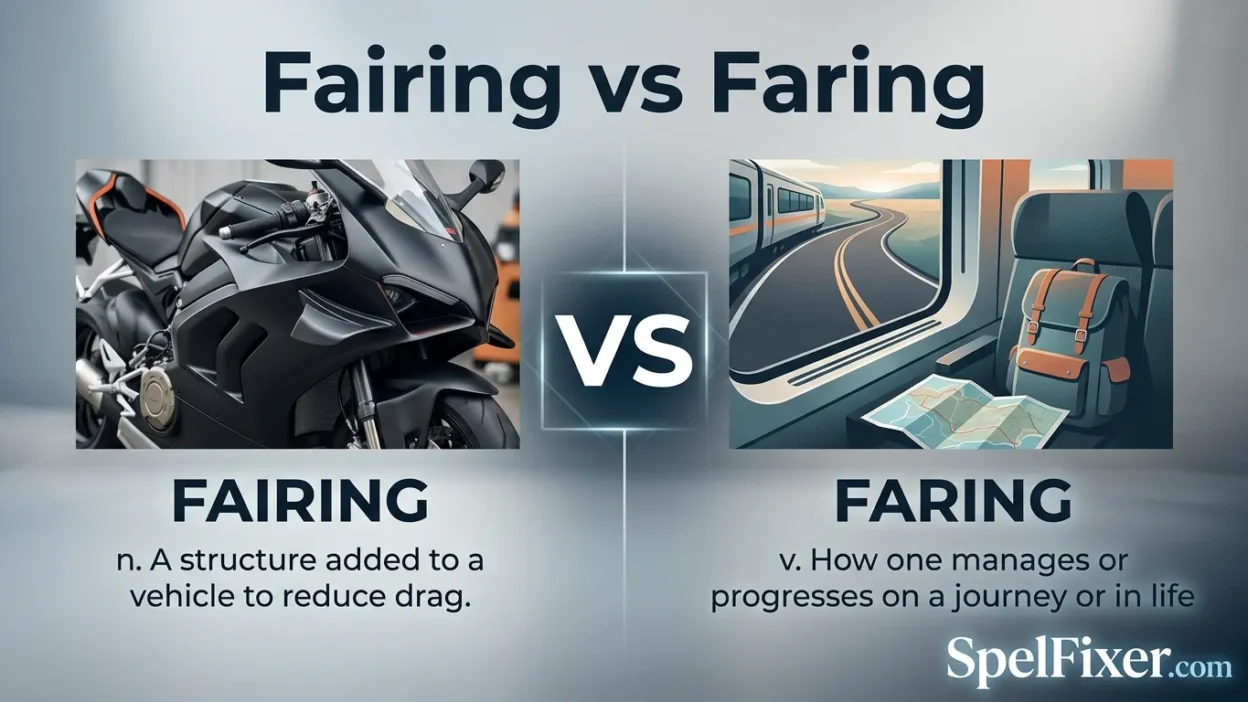
Fairing is a noun that usually means a streamlined covering or structure, especially on an aircraft, motorcycle, boat, or other vehicle.
Faring is the present participle of the verb fare, meaning to get along, perform, or experience a particular situation.
Easy way to remember
- Fairing = a physical covering or aerodynamic structure
- Faring = doing, progressing, or getting along
- Fairing → think fairing on a motorcycle
- Faring → think “How are you faring?”
Although they sound alike, fairing and faring are not interchangeable.
What Does Fairing Mean?
Fairing is a noun derived from the word fair, in the sense of making something smooth or streamlined.
In engineering and transportation, a fairing is a structure designed to reduce drag, protect components, or create a smoother shape. Fairings are commonly found on motorcycles, aircraft, rockets, bicycles, and boats.
For example:
The motorcycle’s fairing protects the engine and improves airflow.
The word can refer to different types of protective or aerodynamic coverings depending on the context.
Examples of fairing
- The airplane’s fairing helps create a smoother aerodynamic surface.
- He replaced the damaged motorcycle fairing.
- The rocket has a protective fairing around its payload.
- The bicycle’s aerodynamic fairing reduces wind resistance.
- The mechanic repaired the front fairing after the accident.
In technical writing, fairing is particularly common when discussing aerodynamics, vehicles, engineering, and mechanical design.
What Does Faring Mean?
Faring comes from the verb fare. It describes how someone or something is doing, progressing, or managing in a particular situation.
The word is often used in questions such as:
How are you faring at your new job?
Here, faring does not describe a physical object. It describes someone’s experience or progress.
Examples of faring
- How are you faring in your new school?
- The team is faring well this season.
- She is faring better than expected.
- How did you fare on the exam?
- Small businesses are faring differently in the current economy.
A useful synonym for faring is doing, although “faring” can sound slightly more formal.
For example:
How are you faring?
means approximately:
How are you doing?
Fairing vs Faring: The Main Difference
The biggest difference between fairing and faring is their grammatical function and meaning.
| Word | Meaning | Part of Speech | Example |
| Fairing | A streamlined covering or structure | Noun | The motorcycle has a new fairing. |
| Faring | Doing, progressing, or managing | Verb form | How are you faring at work? |
The distinction becomes much easier when you look at the context.
If you are talking about a vehicle, aircraft, rocket, or aerodynamic covering, you probably need fairing.
If you are talking about performance, progress, or someone’s situation, you probably need faring.
Fairing Examples in Everyday Writing
Here are several examples to make fairing easier to recognize:
- The mechanic installed a new fairing on the motorcycle.
- The aircraft’s wing fairing was inspected before takeoff.
- The damaged fairing needed to be replaced.
- Engineers designed a lightweight fairing to reduce drag.
- The rocket’s payload fairing protects the equipment during launch.
Notice that in each sentence, fairing is a thing—a physical component or covering.
Faring Examples in Everyday Writing
Now compare those examples with faring:
- How are you faring in your new position?
- The company is faring well despite the competition.
- He is faring better after changing his study routine.
- The students are faring well in their final exams.
- How is your project faring so far?
In these sentences, faring describes progress or circumstances.
Fairing vs Faring: A Simple Memory Trick
If you regularly confuse these words, use this quick trick:
Fairing = Physical thing
Think:
Fairing → vehicle → covering
A motorcycle fairing is something you can see and touch.
Faring = How things are going
Think:
Faring → fare → how you’re doing
If you can replace the word with doing, you probably need faring.
For example:
How are you faring?
You could say:
How are you doing?
But you cannot say:
The motorcycle has a new doing.
That clearly tells you that fairing is the correct word in the motorcycle example.
Common Mistakes With Fairing and Faring
Because these words are homophones, spelling mistakes are common.
Mistake 1: “How are you fairing?”
❌ How are you fairing in your new job?
This is incorrect when you mean “How are you doing?”
✅ How are you faring in your new job?
Mistake 2: “The motorcycle needs a new faring.”
❌ The motorcycle needs a new faring.
If you’re referring to the motorcycle’s outer covering, use fairing.
✅ The motorcycle needs a new fairing.
Mistake 3: Assuming “fairing” means “doing well”
The spelling fairing may look connected to the adjective fair, but in this context it refers to a streamlined structure.
Faring, on the other hand, comes from fare.
Understanding their origins can make the distinction much easier.
Are Fairing and Faring Homophones?
Yes. Fairing and faring are generally pronounced the same.
They are examples of homophones: words that sound alike but have different meanings and spellings.
Other common English homophones include:
- there / their / they’re
- to / too / two
- brake / break
- pair / pare
- principal / principle
Because fairing and faring sound identical, you have to rely on the sentence’s meaning to choose the correct spelling.
American vs British English: Fairing vs Faring
There is no major American-versus-British spelling difference between fairing and faring.
Both forms are used in American and British English with essentially the same meanings.
Faring is particularly common in expressions such as:
How are you faring?
The verb fare can sometimes sound slightly formal or old-fashioned in casual conversation, but it remains perfectly standard English.
Fairing is widely used in technical contexts in both varieties of English, particularly in aviation, motorsports, engineering, and transportation.
So whether you’re writing for an American or British audience, the key is meaning rather than regional spelling.
When Should You Use Fairing?
Use fairing when you’re referring to a physical covering or streamlined structure.
Use fairing for:
- Motorcycle bodywork
- Aircraft components
- Rocket structures
- Aerodynamic covers
- Boat components
- Mechanical or engineering structures
Example:
The technician replaced the motorcycle’s damaged fairing.
When Should You Use Faring?
Use faring when you mean doing, progressing, or managing.
Use faring for:
- Someone’s performance
- A company’s progress
- An individual’s situation
- Results or outcomes
- Asking how someone is doing
Example:
How are you faring in your new role?
Fairing vs Faring in a Sentence
Compare these two sentences:
The aircraft’s fairing was damaged during the flight.
Here, fairing is a physical component.
The airline is faring well despite rising costs.
Here, faring describes performance.
This side-by-side comparison is one of the easiest ways to understand the difference.
Why Do People Confuse Fairing and Faring?
The main reason is pronunciation.
When two words sound identical, it is easy to choose the spelling that looks more familiar. Fair is a common English word, so people may instinctively write fairing when they actually mean faring.
Another reason is that fare has several meanings, and its connection to “faring” isn’t always obvious.
Remembering the root word helps:
fare → faring
while:
fair → fairing
The context then tells you which word belongs in the sentence.
FAQs
1. Is it “How are you fairing” or “How are you faring”?
The correct expression is “How are you faring?” when you mean “How are you doing?” or “How are things going?”
2. What is the meaning of fairing?
Fairing usually means a streamlined covering or structure used to improve aerodynamics or protect components, especially on vehicles and aircraft.
3. What is the meaning of faring?
Faring is the present participle of fare and means doing, progressing, or managing in a particular situation.
4. Are fairing and faring pronounced the same?
Yes. They are generally homophones, meaning they have the same pronunciation but different spellings and meanings.
5. Is “faring well” correct?
Yes. “Faring well” is correct when you mean that someone or something is doing well or progressing successfully.
For example:
The business is faring well this year.
6. Is “motorcycle faring” correct?
No, if you’re referring to the motorcycle’s body covering. The correct spelling is motorcycle fairing.
7. Is fairing used in aviation?
Yes. Fairing is commonly used in aviation to describe aerodynamic structures or coverings that help create smoother airflow or protect components.
8. How can I remember fairing vs faring?
Remember: fairing is a thing; faring is how someone or something is doing. If you mean “doing,” choose faring.
Summary:
The difference between fairing vs faring is straightforward once you focus on meaning. Fairing is generally a noun referring to a streamlined or protective covering, especially in vehicles, aircraft, and engineering. Faring is the -ing form of fare, meaning to do, progress, or manage in a particular situation.
A quick memory trick is to associate fairing with a physical object and faring with performance or progress. If you could replace the word with “doing,” faring is almost certainly the spelling you need. If you’re talking about a motorcycle, aircraft, or aerodynamic covering, choose fairing.
Actionable Takeaway
Before choosing between these two homophones, stop and ask: Am I talking about a physical covering, or am I describing how something is going? Physical covering = fairing. Progress or performance = faring. This simple test will help you avoid one of the most common spelling and word-choice mistakes.

Fenwick Quentin is a creative blogging author known for his analytical yet engaging writing style.
He explores topics such as innovation, digital culture, and personal development with depth and clarity.
Through his articles, Fenwick encourages readers to think critically and embrace continuous growth.