
Have you ever wondered whether you should write remarks or notes when adding extra information? These two words are closely related, but they are not always interchangeable. Choosing the right one can make your writing sound clearer and more natural, especially in emails, reports, schoolwork, meetings, and professional documents.
The good news is that the difference between remarks vs notes is fairly simple once you understand the purpose behind each word. In this guide, I’ll explain their meanings, show practical examples, compare their usage, and point out common mistakes so you can confidently choose the right word.
Quick Answer:
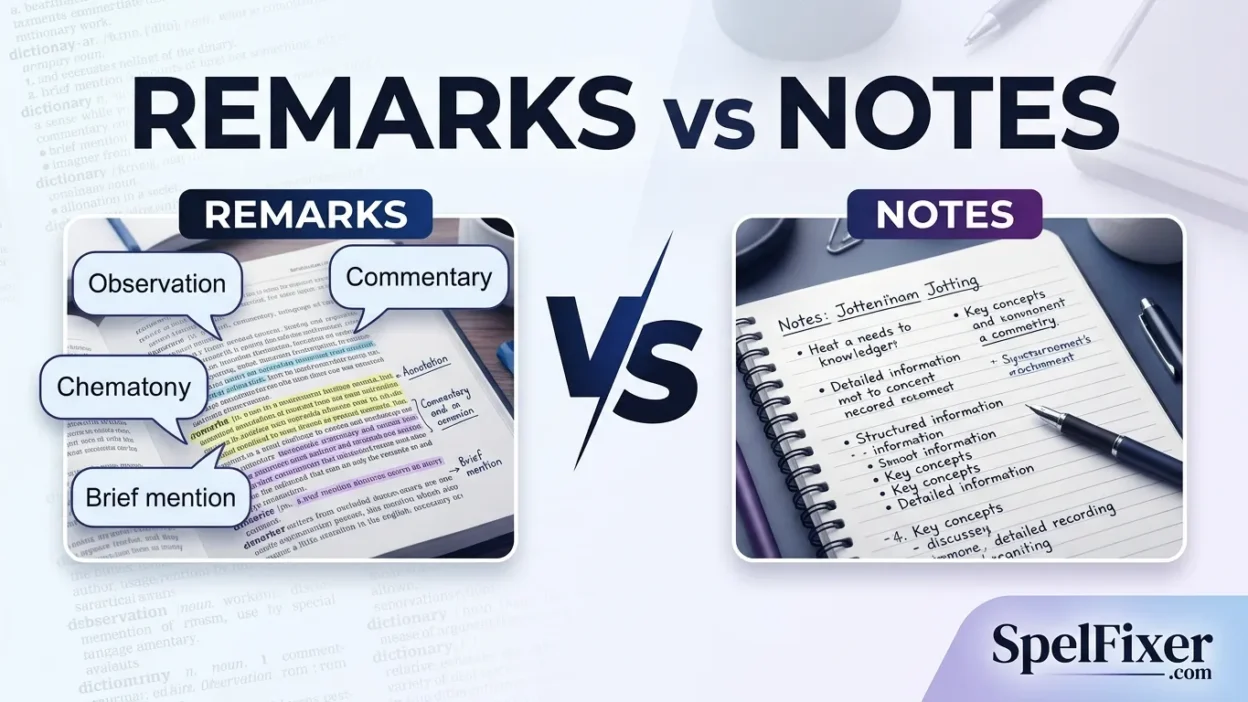
Remarks are comments, observations, or statements made about something, often expressing an opinion or reaction.
Notes are pieces of information written down or added to help someone remember, understand, or clarify something.
Simple rule:
- Remarks = comments or observations
- Notes = information or reminders
For example:
The manager made several remarks about the new policy.
I wrote some notes during the meeting.
Although both words can refer to additional information, notes usually have a practical or informational purpose, while remarks are more often comments or observations.
What Does “Remarks” Mean?
The noun remark means a comment, statement, or observation made about a particular subject.
When someone makes a remark, they are usually saying something about something. A remark can be positive, negative, neutral, serious, humorous, or even critical depending on the context.
Examples of “Remarks”
- The teacher made some helpful remarks about my essay.
- His remarks about the project started a discussion.
- She made a funny remark during the meeting.
- The customer left positive remarks about the service.
- His careless remarks offended several people.
The word can also refer to a person’s spoken or written comments.
For example:
The speaker’s remarks focused on the importance of education.
Here, remarks means the comments or statements made by the speaker.
“Remarks” Can Have Different Tones
The context determines whether a remark is positive or negative.
Positive:
Her remarks about my presentation were encouraging.
Neutral:
The professor made a few remarks about the assignment.
Negative:
His remarks about the team were inappropriate.
So, remarks are essentially comments that communicate a person’s thoughts, observations, or reactions.
What Does “Notes” Mean?
The word notes has several meanings, but in everyday writing it commonly refers to information that someone writes down for remembering, explaining, or recording something.
For example:
I took notes during the lecture.
Here, notes are written pieces of information recorded during the lecture.
The word can also refer to an additional explanation included in a document.
Note: The office will be closed on Monday.
In this case, the note gives the reader useful additional information.
Examples of “Notes”
- I took notes during the meeting.
- Please read the notes at the bottom of the page.
- She made notes about the important dates.
- I left a note on your desk.
- The doctor added some notes to the patient’s record.
Notes are often connected with remembering, recording, explaining, or clarifying information.
Remarks vs Notes: Key Differences
The easiest way to understand remarks vs notes is to focus on their purpose.
| Feature | Remarks | Notes |
| Basic meaning | Comments or observations | Written information or reminders |
| Main purpose | Express a thought or comment | Record, explain, or remember information |
| Usually spoken? | Often | Usually written |
| Can express an opinion? | Yes | Sometimes, but less commonly |
| Common in meetings? | Yes | Yes |
| Common in documents? | Yes | Yes |
| Example | “He made several remarks about the plan.” | “I took notes about the plan.” |
The distinction isn’t absolute. Both words can appear in similar contexts, but their intended function is different.
When Should You Use “Remarks”?
Use remarks when you are talking about someone’s comments, observations, or statements.
Think about what a person said.
For example:
The CEO’s remarks about the company’s future were optimistic.
The focus is on what the CEO said.
You can also use remarks when discussing comments made in response to something:
The teacher’s remarks helped me understand where I had made mistakes.
Here, the remarks are comments or observations about the student’s work.
Common Expressions With “Remarks”
You may see remarks in phrases such as:
- opening remarks
- closing remarks
- concluding remarks
- introductory remarks
- critical remarks
- positive remarks
- negative remarks
- public remarks
- final remarks
For example:
The president gave his opening remarks before the ceremony began.
In formal events, opening remarks means the introductory comments made at the beginning.
When Should You Use “Notes”?
Use notes when you’re referring to information recorded for reference, memory, explanation, or clarification.
Think about what someone writes down.
For example:
I took notes while listening to the presentation.
Here, the purpose is to record important information.
You can also use notes for additional information in books, reports, instructions, and documents.
Please read the notes below the table.
This means the reader should look at the additional information provided below the table.
Common Expressions With “Notes”
Some common phrases include:
- meeting notes
- class notes
- lecture notes
- personal notes
- handwritten notes
- detailed notes
- explanatory notes
- footnotes
- revision notes
- notes section
For example:
I reviewed my class notes before the exam.
Can “Remarks” and “Notes” Be Interchangeable?
Sometimes, but not always.
Consider this example:
The manager added some remarks to the report.
This suggests the manager added comments or observations.
Now compare:
The manager added some notes to the report.
This suggests the manager added additional information, reminders, or explanations.
The difference is subtle, but the meaning changes.
A useful test is:
Is it mainly a comment? → Use “remark.”
Is it mainly information for reference? → Use “note.”
Remarks vs Notes in Professional Writing
Both words are common in professional communication, but they serve different purposes.
In Meetings
You might say:
The director made several remarks about the budget.
This refers to comments made by the director.
But:
I prepared notes from the meeting.
This refers to information recorded during the meeting.
In Reports
You could write:
The reviewer included several remarks about the findings.
The reviewer is commenting on the findings.
But:
See the notes below for additional information.
The notes provide clarification or extra details.
In Emails
You might write:
I wanted to add one quick remark about the proposal.
This introduces a comment.
Or:
Please note that the deadline has changed.
This provides important information.
American English vs British English
There is no major difference in meaning between American and British English when it comes to remarks and notes. Both varieties use these words in broadly the same ways.
However, the frequency and preferred wording can vary depending on the situation and level of formality.
For example, remarks can sound somewhat formal when referring to someone’s comments:
The minister’s remarks attracted considerable attention.
In everyday American English, speakers may simply say:
The minister’s comments attracted considerable attention.
Similarly, notes is extremely common in both American and British English for written information, reminders, and recorded details.
So, you generally do not need to change your choice based on whether you’re writing for an American or British audience. Focus instead on the meaning and context.
Common Mistakes With Remarks and Notes
Understanding the difference is easier when you know what to avoid.
Mistake 1: Using “Remarks” for Every Written Detail
Not every piece of information is a remark.
Incorrect or unnatural:
I wrote some remarks during the lecture.
This could mean comments you personally made, but if you mean information you recorded, notes is much more natural.
Better:
I wrote some notes during the lecture.
Mistake 2: Assuming “Notes” Always Means Reminders
Notes can contain explanations, observations, or comments too. Their defining feature is usually their informational or recording function.
For example:
The notes explain how the system works.
Here, the notes aren’t simply reminders; they’re explanatory information.
Mistake 3: Confusing “Remarks” With “Recommendations”
A remark is a comment, not necessarily advice.
She made a remark about the schedule.
This doesn’t automatically mean she recommended changing the schedule.
If someone suggests what you should do, words such as advice, recommendation, or suggestion may be more appropriate.
Mistake 4: Ignoring Context
The same situation can sometimes involve both words.
For example:
I took notes on the speaker’s remarks.
This sentence is perfectly natural.
The notes are the information you recorded, while the remarks are the comments made by the speaker.
Easy Trick to Remember the Difference
Here’s a simple memory trick:
Remarks = what someone says.
Notes = what someone writes down or adds for information.
Imagine you’re attending a meeting.
The manager makes several remarks about the company’s plans.
You write those comments in your notes.
So:
Speaker → remarks
Listener/writer → notes
This isn’t a rule for every possible context, but it’s a useful shortcut for everyday English.
Frequently Asked Questions
Are remarks and notes the same thing?
No. They overlap in some contexts, but remarks usually mean comments or observations, while notes usually mean recorded information, reminders, or explanations.
Is “remarks” formal English?
It can be. Remarks is common in formal speeches, reports, meetings, and professional writing. In casual conversation, comments may sometimes sound more natural.
Can I say “meeting remarks”?
Yes, but the meaning depends on context. Meeting remarks usually refers to comments made during a meeting, while meeting notes refers to information recorded from the meeting.
Should I say “take remarks” or “take notes”?
The standard expression is take notes.
I took notes during the presentation.
You generally wouldn’t say take remarks when you mean writing down information.
What is the difference between a remark and a comment?
They are often synonyms. A remark is a statement or observation, while comment is the more general and frequently used word for expressing an opinion or observation.
What is the difference between notes and comments?
Notes generally provide information, reminders, or explanations, while comments express reactions, opinions, or observations. However, the two can overlap.
Is “remarks” singular or plural?
Remark is singular, while remarks is plural.
She made one remark.
He made several remarks.
Which word should I use in a report: remarks or notes?
Use remarks for comments or observations and notes for additional information, explanations, or reference material. The correct choice depends on what you’re trying to communicate.
Summary:
The difference between remarks vs notes becomes clear when you focus on their purpose. Remarks are comments, statements, or observations, often connected to something a person has said. Notes, on the other hand, are usually information recorded or added for remembering, explaining, or clarifying something.
In everyday English, remember the simple distinction: remarks are comments, while notes are information or reminders. When you’re talking about what a speaker said, remarks may be the better choice. When you’re recording information from a class, meeting, book, or presentation, notes is usually the natural word.
Actionable Takeaway
Before choosing between the two, ask yourself:
- Am I talking about a comment or observation? → Use remark.
- Am I recording information or giving additional information? → Use note.
- Am I describing someone’s spoken comments? → Remarks is often appropriate.
- Am I describing information written for reference? → Notes is usually better.