The confusion between segway vs segue is extremely common in English writing. Because both words sound almost identical, many people accidentally use “segway” when they actually mean “segue.” While the mix-up may seem minor, using the wrong word can make professional writing appear careless or confusing.
If you have ever written phrases like “let me segway into another topic,” you are definitely not alone. This mistake appears everywhere from blog posts and emails to social media captions and even business presentations. Fortunately, the difference between these words is easy to understand once you know what each one actually means.
In this guide, you will learn the meanings of “segway” and “segue,” when to use each word, common mistakes, grammar tips, pronunciation help, real-life examples, and simple memory tricks to remember the correct usage every time.
Quick Answer
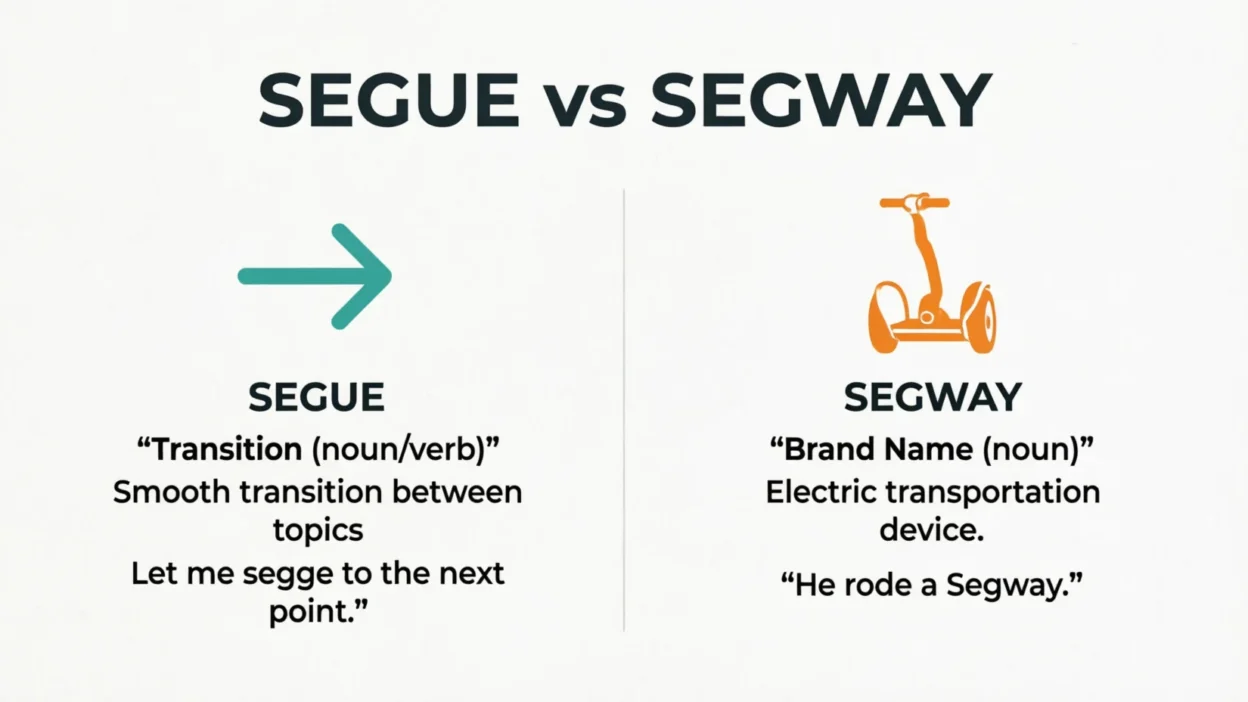
“Segue” is the correct word when referring to a smooth transition from one topic to another.
“Segway” is a brand name for a two-wheeled personal transportation device.
Examples:
- Let me segue into the next point. ✅
- Let me segway into the next point. ❌
What Does “Segue” Mean?
“Segue” is both:
- a verb
- a noun
It means:
- to transition smoothly from one topic, section, or activity to another
The word is commonly used in:
- conversations
- presentations
- writing
- music
- broadcasting
Examples of Segue
- The speaker smoothly segued into the next topic.
- This paragraph serves as a segue between ideas.
- She used humor to segue into the discussion.
- The movie segues perfectly from drama into comedy.
Segue in Music
In music, “segue” describes:
- a smooth transition from one song or movement to another without interruption
What Does “Segway” Mean?
“Segway” is a trademarked brand name.
It refers to:
- a self-balancing two-wheeled electric vehicle
The company became famous for producing personal transporters often used in:
- tourism
- security patrols
- urban transportation
Examples of Segway
- We rented Segways during the city tour.
- The officer rode a Segway through the park.
- Tourists enjoyed traveling on Segways.
Segway vs Segue Comparison Table
| Word | Meaning | Part of Speech | Correct Usage |
|---|---|---|---|
| Segue | Smooth transition | Verb/Noun | Transitioning between ideas |
| Segway | Electric scooter brand | Proper noun | Referring to the vehicle |
Why People Confuse Segway and Segue
The confusion mainly happens because:
- both words sound alike
- English spelling can be unpredictable
- “segue” has an unusual spelling
Pronunciation Similarity
Both are pronounced roughly as:
- SEG-way
That pronunciation causes many people to spell “segue” incorrectly as “segway.”
How to Use “Segue” Correctly
Use “segue” whenever discussing:
- transitions
- topic changes
- smooth movement between ideas
Correct Examples
- Let’s segue into our next discussion point.
- The article segues naturally into the conclusion.
- He used a joke as a segue.
- The teacher smoothly segued between lessons.
Professional Writing Examples
- This section segues into the broader argument.
- The presentation segued from marketing into finance.
How to Use “Segway” Correctly
Use “Segway” only when referring to:
- the transportation device
- the company brand
Correct Examples
- We explored downtown on Segways.
- Security guards used Segways for patrol.
- She bought a Segway for commuting.
Common Mistakes With Segway vs Segue
Many writers accidentally replace “segue” with “segway.”
Incorrect Example
- Let me segway into another topic. ❌
Correct Version
- Let me segue into another topic. ✅
Another Incorrect Example
- The article segways smoothly into the conclusion. ❌
Correct Version
- The article segues smoothly into the conclusion. ✅
Segue Grammar Rules
“Segue” changes form depending on usage.
Verb Forms
| Form | Example |
|---|---|
| Segue | We will segue into the topic |
| Segues | She segues naturally |
| Segued | He segued into the discussion |
| Segueing/Seguing | They are segueing into another issue |
Most Common Usage
The most common modern form is:
- segue into
Example:
- The speaker segued into politics.
Placement and Usage Rules Table
| Phrase | Sentence Placement | Tone | Example |
|---|---|---|---|
| Segue into | Middle sentence | Formal/Neutral | Let’s segue into the next section |
| Smooth segue | Descriptive phrase | Professional | The article included a smooth segue |
| Ride a Segway | Action phrase | Casual/Neutral | We rode a Segway downtown |
| Segway tour | Noun phrase | Informal | The Segway tour lasted two hours |
American vs British English Differences
There are no major spelling differences between American and British English for these words.
In Both Variations
- “Segue” means transition
- “Segway” refers to the vehicle brand
However, British English writers sometimes use “segue” slightly more often in formal journalism and broadcasting contexts.
Practical Example Paragraphs
Example Using Segue Correctly
The presenter smoothly segued from the company’s financial results into future marketing strategies. This transition helped the audience stay engaged throughout the meeting.
Example Using Segway Correctly
During our vacation, we joined a Segway tour around the historic district. It was a fun and efficient way to explore the city.
Easy Memory Trick
A simple memory trick can help you avoid this mistake forever.
Remember This:
- Segue = transition
- Segway = transportation
Another helpful trick:
- “Segue” has unusual spelling because English borrowed it from Italian musical terminology.
Related Words and Synonyms
Synonyms for Segue
- transition
- shift
- move into
- bridge
- flow into
- connect
Related Phrases
- smooth transition
- topic transition
- conversational flow
- natural progression
Why Correct Usage Matters
Using the correct word improves:
- professionalism
- clarity
- credibility
- grammar accuracy
Mixing up “segway” and “segue” may:
- distract readers
- weaken authority
- create confusion in formal writing
This is especially important in:
- business presentations
- academic papers
- blogs
- professional emails
- public speaking
Examples in Everyday Communication
Correct Uses
- The host segued into the interview naturally.
- This paragraph serves as a segue to the next idea.
- We toured the park on Segways.
- The discussion segued into politics.
Incorrect Uses
- He segwayed into another subject. ❌
- The article used a segway between paragraphs. ❌
FAQs About Segway vs Segue
Is segue or segway correct for transitions?
“Segue” is correct when talking about transitions.
What is a Segway?
A Segway is a two-wheeled electric transportation device.
Why do people spell segue as segway?
Because both words are pronounced similarly.
Is segway a real word?
Yes, but it refers to the transportation brand, not transitions.
How do you use segue in a sentence?
Example:
- She segued smoothly into the next topic.
Is segue formal or informal?
“Segue” is commonly used in both formal and informal communication.
Do British and American English use different spellings?
No. Both use “segue” and “Segway” the same way.
Final Thoughts
The difference between segway vs segue comes down to meaning and context. “Segue” refers to a smooth transition between ideas, topics, or sections, while “Segway” is a brand name for an electric personal transporter. Even though they sound alike, their meanings are completely different.
Understanding this distinction helps improve your writing accuracy and professional communication. Whether you are giving a presentation, writing an article, or speaking casually, using the correct term ensures your message stays polished and clear.
Actionable Takeaway
Remember this quick rule:
- Segue = transition
- Segway = vehicle
If you are talking about moving smoothly between ideas, always choose “segue.” Save “Segway” for the electric scooter brand.