The confusion between coaches vs coachs is a common English spelling mistake, especially for learners and writers who are unsure how plural nouns work. At first glance, both spellings may seem reasonable, but only one follows proper English grammar rules. Using the wrong spelling can make writing look unprofessional and distract readers from your message.
Whether you are talking about sports coaches, life coaches, fitness coaches, or business mentors, knowing the correct plural form matters. English pluralization rules can sometimes feel inconsistent, but this particular example follows a simple and reliable pattern. Once you understand the rule, you will never confuse these spellings again.
In this guide, you will learn the difference between “coaches” and “coachs,” why one is correct, grammar rules, examples, common mistakes, pronunciation tips, and memory tricks that make the spelling easy to remember.
Quick Answer
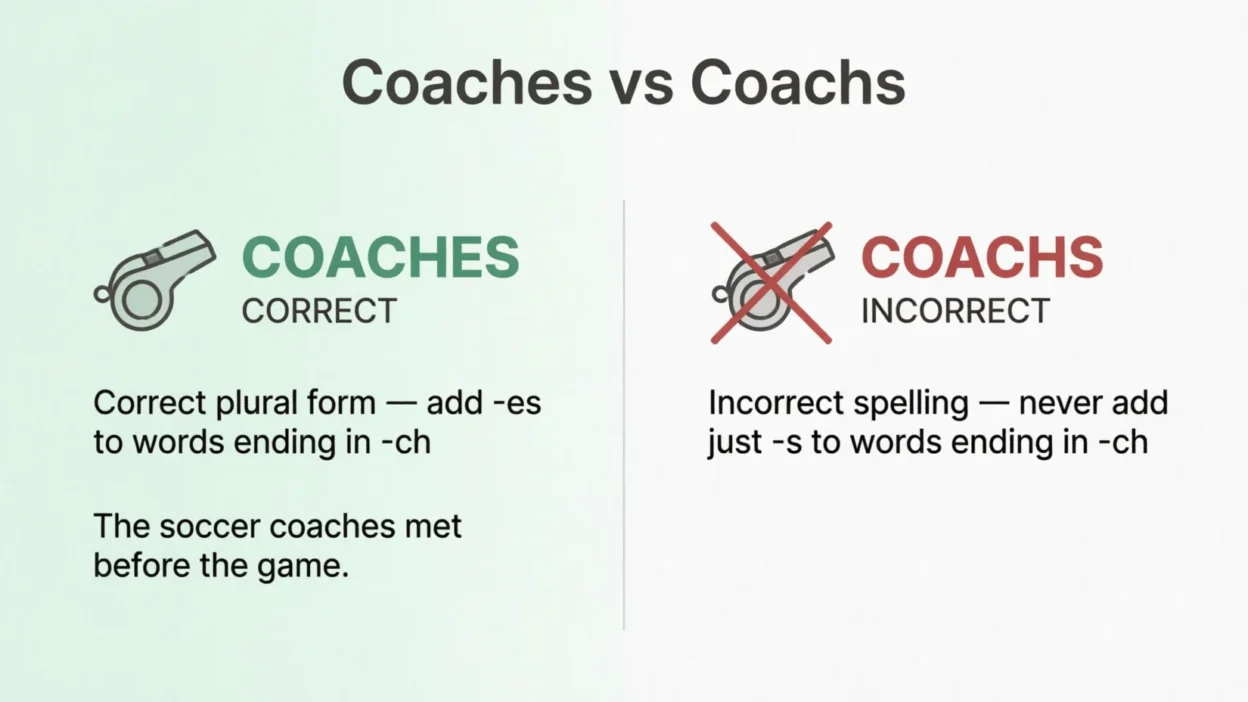
“Coaches” is the correct plural form of “coach.”
“Coachs” is incorrect and not accepted in standard English grammar.
Examples:
- The coaches met before the game. ✅
- The coachs met before the game. ❌
What Does “Coach” Mean?
The word “coach” can refer to:
- a sports trainer
- a mentor
- an instructor
- a personal development guide
It may also describe:
- a passenger vehicle in British English
- a tutoring or training professional
Examples of Coach
- The coach prepared the team.
- She hired a business coach.
- Our fitness coach created a workout plan.
- The football coach inspired the players.
What Is the Correct Plural of Coach?
The correct plural form is:
- coaches
This follows a standard English spelling rule for nouns ending in:
- ch
- sh
- s
- x
- z
These words usually form plurals by adding:
- es
Examples
| Singular | Plural |
|---|---|
| Coach | Coaches |
| Church | Churches |
| Bus | Buses |
| Box | Boxes |
Why “Coachs” Is Incorrect
“Coachs” breaks English pluralization rules.
When a noun ends in:
- ch
You generally add:
- es
Not:
- s
That is why:
- coach → coaches ✅
- coach → coachs ❌
Coaches vs Coachs Comparison Table
| Word | Correct or Incorrect | Meaning | Example |
|---|---|---|---|
| Coaches | Correct | More than one coach | The coaches discussed strategy |
| Coachs | Incorrect | Not a valid plural form | The coachs arrived early ❌ |
How to Use “Coaches” Correctly
Use “coaches” whenever referring to:
- multiple coaches
- several trainers
- many instructors or mentors
Examples
- The coaches organized practice sessions.
- Several life coaches attended the seminar.
- The basketball coaches shared advice.
- Coaches play an important leadership role.
Grammar Tip
“Coaches” functions as:
- a plural noun
Examples:
- talented coaches
- experienced coaches
- sports coaches
Common Mistakes With Coaches vs Coachs
Writers often make predictable spelling mistakes with this word.
Mistake 1: Adding Only “S”
Incorrect:
- We spoke to the coachs. ❌
Correct:
- We spoke to the coaches. ✅
Mistake 2: Confusing Pronunciation With Spelling
Because “coaches” sounds smooth in speech, some writers incorrectly assume the spelling should be shorter.
Mistake 3: Forgetting the “ES” Rule
Nouns ending in:
- ch
- sh
- s
- x
- z
Usually require:
- es
Practical Example Paragraphs
Real-world examples help make grammar rules easier to remember.
Example Using Coaches
The coaches met after practice to discuss player performance, training schedules, and strategies for the upcoming tournament. Their teamwork helped the athletes improve significantly throughout the season.
Incorrect Example Using Coachs
The coachs prepared the team for the championship. ❌
Corrected version:
- The coaches prepared the team for the championship. ✅
Placement and Grammar Rules Table
| Word Form | Usage | Tone | Example Sentence |
|---|---|---|---|
| Coach | Singular noun | Neutral | The coach gave instructions |
| Coaches | Plural noun | Neutral | The coaches planned training |
| Head coaches | Compound plural | Professional | Head coaches attended the meeting |
| Life coaches | Career/professional phrase | Formal | Life coaches help clients grow |
Pronunciation of Coaches
“Coaches” is pronounced:
- KOH-chiz
The extra “es” creates:
- an additional syllable sound
This pronunciation pattern is similar to:
- churches
- judges
- buses
American vs British English Differences
There are no major spelling differences between American and British English for this word.
American English
“Coaches” is the standard plural form.
British English
British English also uses:
- coaches
Interestingly, in British English, “coach” may additionally refer to:
- a long-distance bus
- a train compartment
Example:
- We traveled by coach.
Plural:
- coaches
Why Correct Plural Spelling Matters
Using proper plural forms improves:
- grammar accuracy
- professionalism
- readability
- credibility
Misspellings like “coachs” may:
- distract readers
- reduce trust
- appear careless
This is especially important in:
- academic writing
- resumes
- websites
- business communication
Similar Plural Rules in English
Understanding similar words strengthens grammar skills naturally.
Words Ending in “CH”
| Singular | Plural |
|---|---|
| Match | Matches |
| Church | Churches |
| Watch | Watches |
| Coach | Coaches |
Words Ending in “SH”
| Singular | Plural |
|---|---|
| Brush | Brushes |
| Dish | Dishes |
| Wish | Wishes |
Words Ending in “X”
| Singular | Plural |
|---|---|
| Box | Boxes |
| Fox | Foxes |
Helpful Memory Trick
Simple memory tricks make spelling easier.
Coach Ends in “CH”
Words ending in “CH” usually add:
- ES
Think:
- coach → coaches
- church → churches
Never:
- coachs
Coaches in Different Contexts
The word “coaches” appears in many industries today.
Sports Coaches
- football coaches
- basketball coaches
- tennis coaches
Professional Coaches
- business coaches
- leadership coaches
- executive coaches
Personal Development Coaches
- wellness coaches
- relationship coaches
- mindset coaches
Everyday Usage Examples
Correct Examples
- The coaches praised the team’s effort.
- Experienced coaches improve player confidence.
- Our school hired two new coaches.
- Fitness coaches often create personalized plans.
Incorrect Example
- The coachs helped the athletes train. ❌
FAQs About Coaches vs Coachs
Is coaches or coachs correct?
“Coaches” is correct. “Coachs” is incorrect.
Why does coach become coaches?
Because nouns ending in “ch” usually add “es” to form plurals.
Is coachs a real word?
No. “Coachs” is not accepted in standard English.
What is the plural of coach?
The plural of coach is:
- coaches
How do you spell multiple coaches?
You spell it:
- coaches
Does British English use coachs?
No. Both American and British English use “coaches.”
What is an easy way to remember the spelling?
Remember:
- words ending in “ch” usually add “es”
Final Thoughts
The difference between coaches vs coachs is simple once you understand English plural rules. “Coaches” is the only correct plural spelling, while “coachs” is a common but incorrect mistake. Because “coach” ends in “ch,” you must add “es” to create the plural form.
Learning these grammar patterns strengthens your writing confidence and improves your overall English accuracy. Whether you are discussing sports coaches, business mentors, or personal trainers, using the correct spelling helps your communication look polished and professional.
Actionable Takeaway
Remember this simple grammar rule:
- nouns ending in “ch” usually add “es”
Quick examples:
- coach → coaches
- church → churches
- watch → watches
If a word ends in “ch,” avoid adding only “s.” This easy rule will help you spell “coaches” correctly every time.

Fenwick Quentin is a creative blogging author known for his analytical yet engaging writing style.
He explores topics such as innovation, digital culture, and personal development with depth and clarity.
Through his articles, Fenwick encourages readers to think critically and embrace continuous growth.