
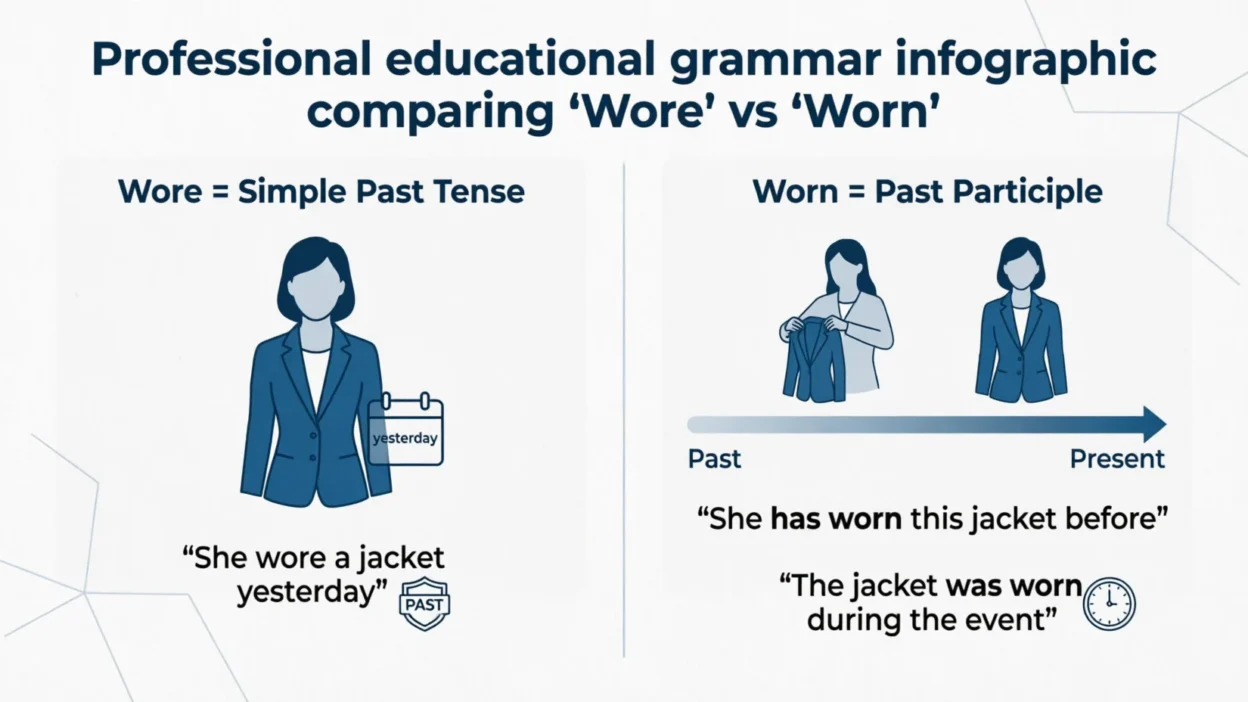
Many English learners struggle with wore and worn because both words come from the verb wear. Since they look similar and refer to clothing or using something over time, it’s easy to mix them up.
The good news is that the difference is straightforward once you understand English verb tenses. Wore is the simple past tense, while worn is the past participle. Knowing when to use each form will make your writing and speaking sound much more natural.
Quick Answer
- Wore is the simple past tense of wear.
- Worn is the past participle of wear and is used with helping verbs such as has, have, had, was, or were.
Examples:
- She wore a blue dress yesterday. ✅
- She has worn that blue dress before. ✅
A simple rule:
👉 Wore = past action
👉 Worn = used with a helping verb
What Does “Wore” Mean?
Definition of Wore
Wore is the simple past tense of the verb wear.
It describes something that someone wore at a specific time in the past.
Examples of Wore in Sentences
- I wore a jacket yesterday.
- She wore red shoes to the party.
- They wore uniforms at school.
- He wore a hat during the game.
In each sentence, the action happened in the past and is complete.
When to Use Wore
Use wore when:
- Talking about a completed action in the past
- No helping verb is needed
- The sentence refers to a specific past time
Examples:
- She wore a beautiful necklace last night.
- We wore costumes for Halloween.
- He wore glasses when he was younger.
What Does “Worn” Mean?
Definition of Worn
Worn is the past participle form of wear.
It cannot usually stand alone as the main verb. Instead, it is used with helping verbs.
Examples of Worn in Sentences
- She has worn that dress many times.
- I have worn these shoes for years.
- They had worn coats because it was cold.
- The uniform was worn by all students.
In each example, worn works with a helping verb.
When to Use Worn
Use worn with:
- Has
- Have
- Had
- Is
- Are
- Was
- Were
- Being
- Been
Examples:
- He has worn that watch since college.
- The costumes were worn during the performance.
- She had worn the same jacket all winter.
Wore vs Worn: Key Differences
| Feature | Wore | Worn |
|---|---|---|
| Verb Form | Simple past tense | Past participle |
| Helping Verb Needed | No | Yes |
| Example | She wore a coat. | She has worn a coat. |
| Time Reference | Completed past action | Perfect or passive tenses |
| Common Usage | Everyday past events | Perfect and passive constructions |
The easiest way to remember:
Wore works alone. Worn needs help.
Understanding the Verb Wear
Here are the main forms of the verb:
| Verb Form | Word |
|---|---|
| Base Form | Wear |
| Present Tense | Wear/Wears |
| Past Tense | Wore |
| Past Participle | Worn |
| Present Participle | Wearing |
Examples:
- I wear a uniform.
- I wore a uniform yesterday.
- I have worn a uniform before.
- I am wearing a uniform now.
Common Examples of Wore
Clothing
- She wore a black dress.
- He wore a suit to the wedding.
Accessories
- I wore my favorite watch.
- She wore silver earrings.
Protective Gear
- The workers wore helmets.
- The players wore safety equipment.
These sentences describe completed actions in the past.
Common Examples of Worn
Present Perfect Tense
- I have worn these boots for years.
- She has worn that necklace before.
Past Perfect Tense
- He had worn the same coat all winter.
- They had worn uniforms at their previous school.
Passive Voice
- The costumes were worn during the ceremony.
- Traditional clothing is worn on special occasions.
Why People Confuse Wore and Worn
Both Come From Wear
Since both words originate from the same verb, many learners assume they can be used interchangeably.
Similar Meanings
Both refer to wearing clothing or using something over time.
Irregular Verb Forms
Unlike regular verbs, wear does not become:
- Wear-ed ❌
Instead, it changes to:
- Wore
- Worn
This irregular pattern can be confusing.
Common Mistakes to Avoid
Mistake 1: Using Worn Without a Helping Verb
Incorrect:
- She worn a blue dress yesterday. ❌
Correct:
- She wore a blue dress yesterday. ✅
Mistake 2: Using Wore with Has or Have
Incorrect:
- She has wore that dress before. ❌
Correct:
- She has worn that dress before. ✅
Mistake 3: Mixing Up Past and Perfect Tenses
Incorrect:
- I had wore a jacket. ❌
Correct:
- I had worn a jacket. ✅
Real-Life Examples
Example 1
Correct:
- He wore a tuxedo to the wedding.
Incorrect:
- He worn a tuxedo to the wedding.
Example 2
Correct:
- She has worn those shoes many times.
Incorrect:
- She has wore those shoes many times.
Example 3
Correct:
- The uniforms were worn during the parade.
Incorrect:
- The uniforms were wore during the parade.
Easy Memory Tricks
Wore Works Alone
If there’s no helping verb, wore is usually correct.
Example:
- She wore a scarf.
Worn Needs Help
If you see:
- Has
- Have
- Had
- Was
- Were
Then worn is usually needed.
Example:
- She has worn a scarf before.
Quick Reminder
- Wore = simple past
- Worn = helping verb required
American vs British English Differences
There is no significant difference between American and British English regarding wore and worn.
American English
- She wore a sweater yesterday.
- She has worn that sweater many times.
British English
- She wore a jumper yesterday.
- She has worn that jumper many times.
The grammar rules remain exactly the same.
Related Grammar Topics
When learning wore vs worn, you may also encounter:
- Wear vs put on
- Past tense verbs
- Past participles
- Irregular verbs
- Has worn vs wore
- Have worn vs wore
- Verb conjugation
- English grammar rules
- Perfect tenses
- Passive voice
Understanding these topics will strengthen your overall grammar skills.
FAQs About Wore vs Worn
What is the difference between wore and worn?
Wore is the simple past tense, while worn is the past participle.
Is “I have wore” correct?
No. The correct phrase is I have worn.
Can worn be used without a helping verb?
Usually no. Worn typically requires a helping verb.
Which is correct: wore a coat or worn a coat?
Both can be correct depending on the sentence structure.
- He wore a coat. ✅
- He has worn a coat. ✅
Is worn a past tense?
No. Worn is the past participle form.
Why is wear an irregular verb?
Because its past forms change to wore and worn rather than following the standard -ed pattern.
Which word is used with has and have?
Worn.
How can I remember the difference?
Remember: Wore works alone. Worn needs help.
Final Summary
Understanding wore vs worn becomes much easier when you focus on verb tense. Wore is the simple past tense and describes something someone wore at a specific time in the past. It can stand alone without a helping verb.
Worn is the past participle and must typically be used with helping verbs such as has, have, had, was, or were. Once you remember this simple distinction, you’ll avoid one of the most common mistakes involving irregular English verbs.
Actionable Takeaway
Before choosing between wore and worn, ask yourself:
Is there a helping verb in the sentence?
- No helping verb → Wore
- Has, have, had, was, were → Worn
Remember this simple phrase:
Wore works alone. Worn needs help.
Using this quick rule will help you choose the correct form every time.