The difference between any time vs anytime confuses many English writers because the two expressions look nearly identical. However, they are not always interchangeable. One is a two-word phrase, while the other functions as a single-word adverb. Using the wrong form can make your writing appear awkward or grammatically incorrect.
If you have ever paused while typing phrases like “contact me anytime” or “do you have any time tomorrow,” you are not alone. These expressions appear constantly in emails, conversations, business writing, text messages, and academic English. Understanding when to use each one will help your writing sound smoother, clearer, and more professional.
In this guide, you will learn the meanings of “any time” and “anytime,” grammar rules, sentence structures, practical examples, common mistakes, regional differences, and simple memory tricks to help you choose the correct form confidently.
Quick Answer
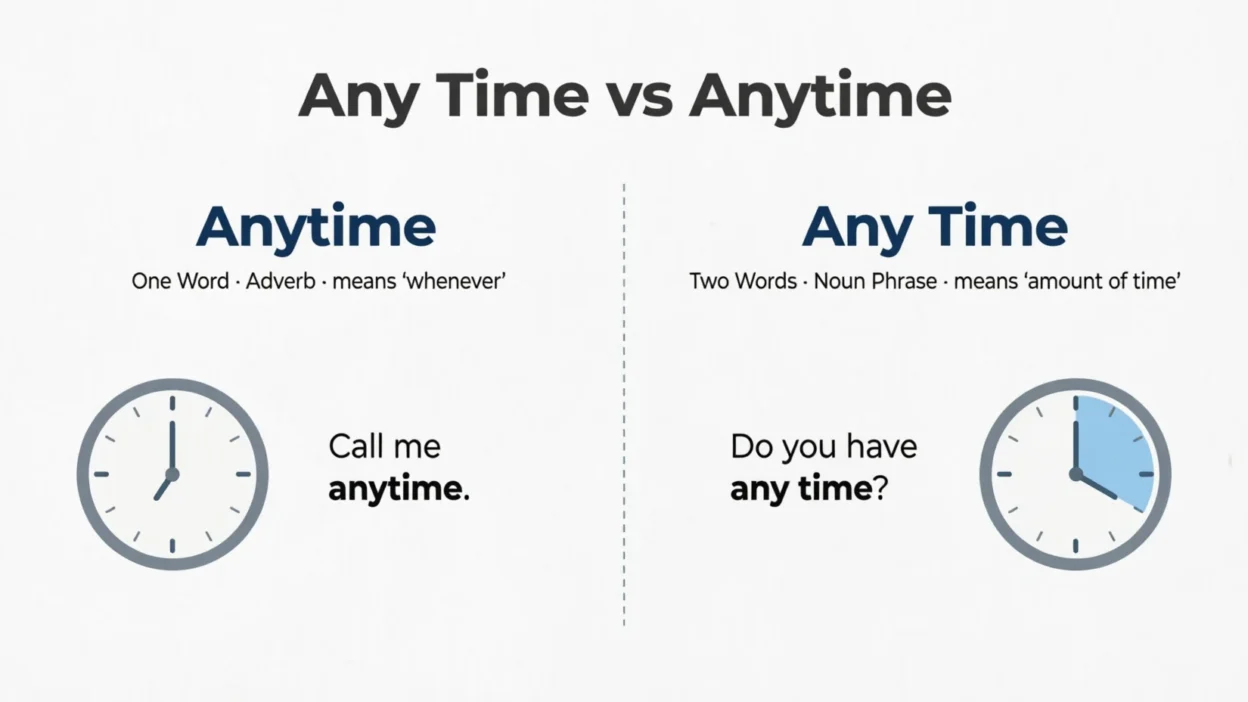
Use “anytime” as a single word when it means “whenever” or acts as an adverb.
Use “any time” as two words when referring to an amount of time.
Examples:
- You can call me anytime. ✅
- Do you have any time available tomorrow? ✅
What Does “Anytime” Mean?
“Anytime” is an adverb meaning:
- whenever
- at any moment
- no matter when
It describes when something can happen.
Examples of Anytime
- You can visit anytime.
- Call me anytime you need help.
- She is welcome anytime.
- We can meet anytime this week.
How Anytime Functions in a Sentence
“Anytime” usually modifies verbs.
Examples:
- stop by anytime
- contact us anytime
- return anytime
What Does “Any Time” Mean?
“Any time” is a noun phrase referring to:
- an amount of time
- some available time
- any period of time
Examples of Any Time
- Do you have any time to talk?
- I don’t have any time today.
- She spent hardly any time studying.
- Is there any time left before the deadline?
Grammar Function
“Any time” acts as:
- determiner + noun
Here:
- “any” modifies the noun “time.”
Any Time vs Anytime Comparison Table
| Phrase | Part of Speech | Meaning | Example |
|---|---|---|---|
| Anytime | Adverb | Whenever | Call me anytime |
| Any time | Noun phrase | Amount of time | Do you have any time? |
How to Use “Anytime” Correctly
Use “anytime” when you could replace it with:
- whenever
- at any moment
Examples
- Come anytime you want.
- You may leave anytime.
- Feel free to text anytime.
- We’re open anytime during the weekend.
Easy Test
If “whenever” works naturally, use:
- anytime
Example:
- Call me whenever. ✅
- Call me anytime. ✅
How to Use “Any Time” Correctly
Use “any time” when discussing:
- quantity of time
- duration
- available time
Examples
- I don’t have any time right now.
- Do you have any time after work?
- She barely had any time to prepare.
Easy Test
If you can replace it with:
- some time
- enough time
then use:
- any time
Example:
- Do you have some time? ✅
- Do you have any time? ✅
Common Mistakes With Any Time vs Anytime
Many writers confuse these forms because spoken English often sounds identical.
Mistake 1: Using Anytime as a Noun
Incorrect:
- I don’t have anytime today. ❌
Correct:
- I don’t have any time today. ✅
Mistake 2: Using Any Time as an Adverb
Incorrect:
- You can visit any time. ⚠️
Technically acceptable in some cases, but modern style guides often prefer:
- You can visit anytime. ✅
Mistake 3: Mixing Formal and Informal Usage
“Anytime” sounds slightly more casual in some contexts.
Formal:
- Please contact us at any time.
Casual:
- Contact us anytime.
Practical Example Paragraphs
Real examples make the difference easier to understand.
Example Using Anytime
The customer service team assured clients they could contact support anytime during the week. This flexible communication policy improved customer satisfaction significantly.
Example Using Any Time
After finishing her assignments, Maria realized she finally had some free time. Unfortunately, she still did not have any time to relax before the next project deadline arrived.
Placement and Grammar Rules Table
| Phrase | Sentence Placement | Tone | Example Sentence |
|---|---|---|---|
| Anytime | Usually after verb | Casual/Neutral | Call me anytime |
| Any time | Before or after noun structures | Neutral/Formal | I don’t have any time |
| At any time | Formal phrase | Professional | Access may occur at any time |
| Anytime soon | Informal expression | Casual | I won’t leave anytime soon |
Formal vs Informal Usage
Understanding tone helps you choose naturally.
Formal Writing
Professional or academic writing often favors:
- at any time
- any time
Examples:
- Employees may submit requests at any time.
- The manager did not have any time available.
Informal Writing
Casual English commonly uses:
- anytime
Examples:
- Stop by anytime.
- Text me anytime.
American vs British English Differences
There are slight regional style differences.
American English
American English widely accepts:
- anytime
in both casual and semi-formal writing.
British English
British English traditionally preferred:
- any time
in more contexts.
However, “anytime” has become increasingly accepted in modern British usage as well.
Anytime vs Any Time in Common Expressions
Certain phrases almost always use one form.
Common Anytime Expressions
- anytime soon
- anytime now
- anytime you want
Common Any Time Expressions
- any time left
- any time available
- any time at all
Why This Grammar Rule Matters
Correct usage improves:
- readability
- professionalism
- grammar accuracy
- writing confidence
Small differences like these matter in:
- emails
- blogs
- essays
- resumes
- professional communication
They also help your writing sound more natural to native English speakers.
Synonyms and Related Terms
Learning related expressions improves vocabulary naturally.
Synonyms for Anytime
- whenever
- at any moment
- whenever necessary
Synonyms for Any Time
- available time
- free time
- spare time
Related Grammar Searches
People searching for “any time vs anytime” also search for:
- everyday vs every day
- awhile vs a while
- setup vs set up
- anymore vs any more
- sometime vs some time
Helpful Memory Trick
A simple trick makes this difference much easier.
Anytime = Whenever
If you can replace the word with:
- whenever
use:
- anytime
Example:
- Visit anytime.
- Visit whenever.
Any Time = Amount of Time
If you are talking about:
- how much time
use:
- any time
Example:
- Do you have any time?
Any Time vs Anytime in Business Communication
Business writing often depends on tone.
More Professional
- Please contact us at any time.
More Conversational
- Feel free to contact us anytime.
Both are understandable, but formality changes the tone slightly.
FAQs About Any Time vs Anytime
What is the difference between anytime and any time?
“Anytime” means whenever, while “any time” refers to an amount of time.
Is anytime one word or two?
It depends on usage. Both forms are correct in different situations.
Can I say “call me any time”?
Yes. Many style guides now accept it, though “call me anytime” is more common.
Which is more formal: anytime or any time?
“Any time” and “at any time” generally sound more formal.
Is anytime grammatically correct?
Yes. It is a standard English adverb.
How do I know which one to use?
If “whenever” fits, use “anytime.” If discussing available time, use “any time.”
Is anytime common in British English?
Yes, though British English traditionally used “any time” more often.
Final Thoughts
The difference between any time vs anytime becomes much simpler once you understand their grammar roles.
“Anytime” functions as an adverb meaning “whenever,” while “any time” refers to an amount or quantity of time. Although the expressions sound identical in speech, their written forms depend on sentence structure and meaning.
Mastering this small grammar distinction can improve your clarity, professionalism, and confidence in English writing. Whether you are composing emails, blog posts, essays, or casual messages, knowing when to use “anytime” or “any time” helps your communication feel more polished and natural.
Actionable Takeaway
Remember this simple rule:
- anytime = whenever
- any time = amount of time
Quick test:
- If “whenever” works → use anytime
- If discussing available time → use any time
Using this shortcut will help you choose the correct form quickly and confidently.

Fenwick Quentin is a creative blogging author known for his analytical yet engaging writing style.
He explores topics such as innovation, digital culture, and personal development with depth and clarity.
Through his articles, Fenwick encourages readers to think critically and embrace continuous growth.