If you often confuse too vs. to, you are not alone. These two words sound exactly the same in most English accents, but they have completely different meanings and grammatical roles. The good news is that once you learn a few simple rules, choosing between too and to becomes much easier.
To is usually used before a verb in its base form or to show direction, connection, or purpose. Too generally means “also” or “more than is needed.” For example, “I want to learn” uses to before a verb, while “I want some too” means “I want some also.” Understanding these basic patterns can help you avoid one of the most common English word-choice mistakes.
Quick Answer:
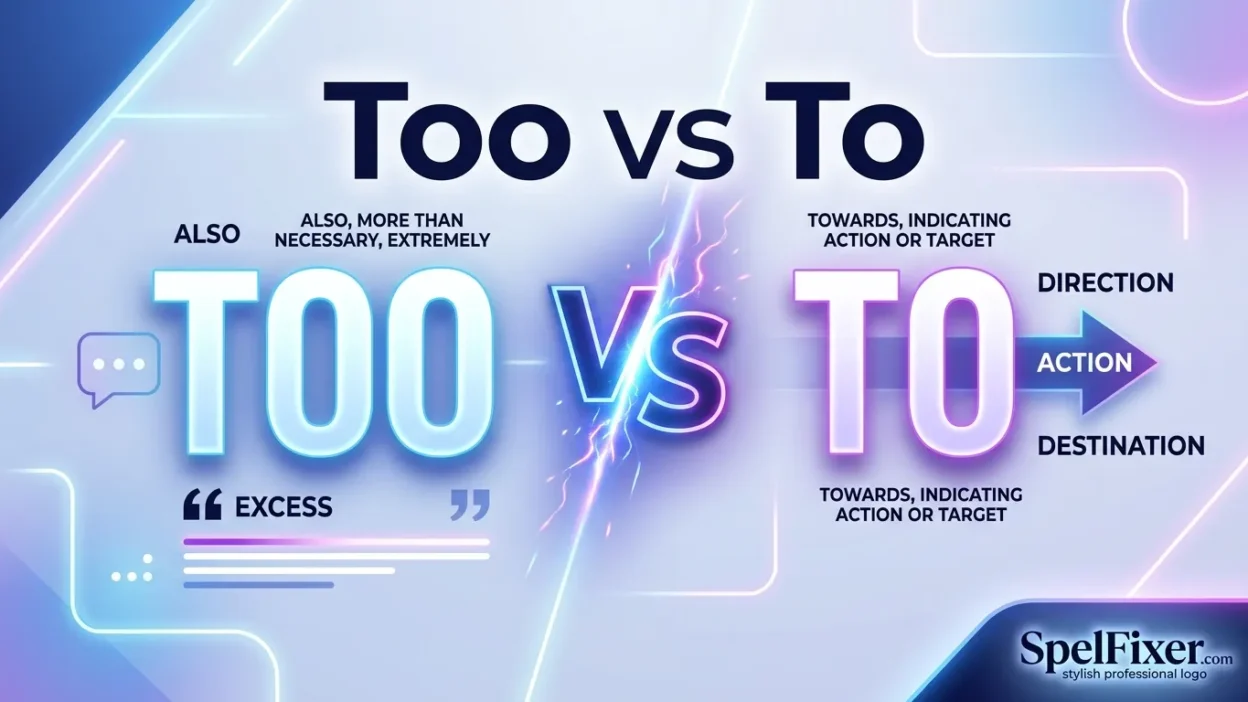
To is mainly used as a preposition or before a verb in the infinitive form: “go to school” and “want to eat.” Too means “also” or “excessively”: “I am coming too” and “It is too cold.” They sound alike but have different meanings and uses.
Why Do People Confuse Too and To?
The main reason people confuse too and to is pronunciation. In everyday English, they are usually pronounced the same way.
They are therefore homophones—words that sound alike but have different meanings and spellings.
Compare:
- I want to play.
- I want to play too.
The first to connects want with the verb play. The second too means also.
A simple spelling difference can completely change the meaning of a sentence.
First Word: To
To is one of the most frequently used words in English. It has several important functions.
1. To Before a Verb
Use to before the base form of a verb to create an infinitive.
Examples:
- I want to learn English.
- She likes to read.
- We need to leave now.
- He decided to study harder.
- They hope to win.
Here, to does not mean “also” or “too much.” It introduces the verb.
2. To Show Direction
To can show movement toward a person, place, or destination.
Examples:
- We went to school.
- She walked to the store.
- He traveled to London.
- Give this book to Sarah.
- They drove to the airport.
3. To Show a Relationship or Connection
Examples:
- This belongs to me.
- The answer to the question is simple.
- She is married to a doctor.
- What happened to your phone?
Second Word: Too
Too has two main meanings: also and excessively/more than necessary.
1. Too Means “Also”
When too means “also,” it adds another person or thing.
Examples:
- I like pizza too.
- She is coming too.
- He wants to join us too.
- I was tired too.
- Can I come too?
In these sentences, you can usually replace too with also.
I like pizza too.
I also like pizza.
2. Too Means “Excessively”
Too can also mean that something is more than necessary, desirable, or acceptable.
Examples:
- The coffee is too hot.
- This bag is too heavy.
- He talks too loudly.
- The test was too difficult.
- It is too late to call.
Here, too often appears before an adjective or adverb.
Too vs. To: Comparison Table
| Word | Main Meaning | Common Use | Example |
| to | Direction, connection, or infinitive marker | Before a place, person, or verb | I want to go. |
| too | Also | Adding another person or thing | I want to go too. |
| too | Excessively | Before an adjective or adverb | It is too expensive. |
When Should You Use To or Too?
A quick test can help.
Use to when:
- You are talking about direction: “Go to school.”
- You are connecting a verb to another verb: “I want to sleep.”
- You are showing a relationship: “Give it to him.”
- You are expressing a destination: “She went to Canada.”
Use too when:
- You mean also: “I want one too.”
- You mean excessively: “It is too expensive.”
- Something is more than necessary: “The box is too heavy.”
10+ Examples of Too vs. To
Here are practical examples that show the difference clearly:
- I want to learn Spanish.
- I want to learn Spanish too.
- She went to the library.
- She came too.
- It is too cold outside.
- We need to buy a jacket.
- He is too tired to study.
- They decided to stay home.
- Can I go too?
- Give the message to your brother.
- This shirt is too small.
- I would like to order some food.
- My sister wants to come too.
- The music is too loud.
- We walked to the park.
Notice that to and too can even appear in the same sentence:
I want to go too.
The first to introduces the verb go. The second too means also.
Common Mistakes With Too and To
Mistake 1: “I want too go.”
❌ I want too go.
✅ I want to go.
Because to comes before the base verb go.
Mistake 2: “I like pizza to.”
❌ I like pizza to.
✅ I like pizza too.
Here, you mean “I also like pizza.”
Mistake 3: “It is to expensive.”
❌ It is to expensive.
✅ It is too expensive.
Here, too means “more than is acceptable or needed.”
Mistake 4: “She went too school.”
❌ She went too school.
✅ She went to school.
Here, to shows the destination.
Easy Memory Trick
Remember this:
To = toward or a verb
Too = also or extra
Think of the extra o in too as meaning extra.
- Too = extra → “too much”
- Too = also → “me too”
- To = direction or verb → “go to school,” “want to eat”
This simple trick works well when you need to choose quickly.
American vs. British English
There is no major difference between American and British English in the basic rules for too and to.
Both varieties use:
- to for direction: “go to school”
- to before an infinitive: “to eat”
- too for “also”: “me too”
- too for excessive amounts: “too expensive”
Pronunciation can vary slightly depending on accent and context, but the spelling and basic grammar rules remain the same.
Similar Words
Understanding related words can make the distinction easier.
Also
Also usually means the same thing as too when too means “in addition.”
- I like tea too.
- I also like tea.
Excessively
When too means “more than necessary,” related expressions include:
- excessively
- overly
- more than necessary
- beyond what is needed
Example:
The box is too heavy.
This means the box is heavier than is practical or acceptable for the situation.
Toward
To can sometimes indicate movement toward something.
She walked to the door.
The word to can also introduce an infinitive:
She wants to walk.
Final Verdict
The easiest way to remember the difference is that to is commonly used for direction or before a verb, while too means also or excessively.
If you can replace the word with also, choose too. If you are talking about movement, a relationship, or placing the word before a base verb, to is usually the correct choice. And if something is “more than necessary,” too is the right word.
FAQs
1. What is the difference between too and to?
To is commonly used for direction, relationships, and infinitive verbs. Too means “also” or “more than necessary.”
2. Is it “I want to” or “I want too”?
It is “I want to” when the sentence continues with a verb, such as “I want to eat.”
3. Is “me too” correct?
Yes. “Me too” is correct when you mean “me also.”
4. Is it “too much” or “to much”?
The correct expression is “too much” because too means more than necessary.
5. Is “to school” correct?
Yes. Use to when showing movement or direction toward a destination: “I am going to school.”
6. Can too and to be in the same sentence?
Yes. For example: “I want to go too.” The first to introduces the verb, while too means “also.”
7. How can I remember too vs. to?
Remember “too = also or extra.” The extra o can remind you of something extra. To is commonly used for direction or before a verb.
8. Are too and to homophones?
Yes. In most varieties of English, too and to are pronounced alike, even though their meanings and spellings are different.
Remember This
TO → direction or before a verb
TOO → also or excessively
Examples:
- Go to school.
- I want to learn.
- I want one too.
- It is too hot.
Conclusion
Understanding too vs. to becomes much easier when you focus on meaning rather than pronunciation. Use to for direction, relationships, and infinitive verbs, such as “go to work” and “want to eat.” Use too when you mean “also” or “more than necessary,” such as “I want to come too” or “It is too expensive.”
Because these words sound alike, mistakes are easy to make, especially when writing quickly. Before choosing one, ask yourself: Does it mean “also” or “extra”? If yes, use too. Otherwise, if you are showing direction or using it before a verb, to is usually the correct choice.