
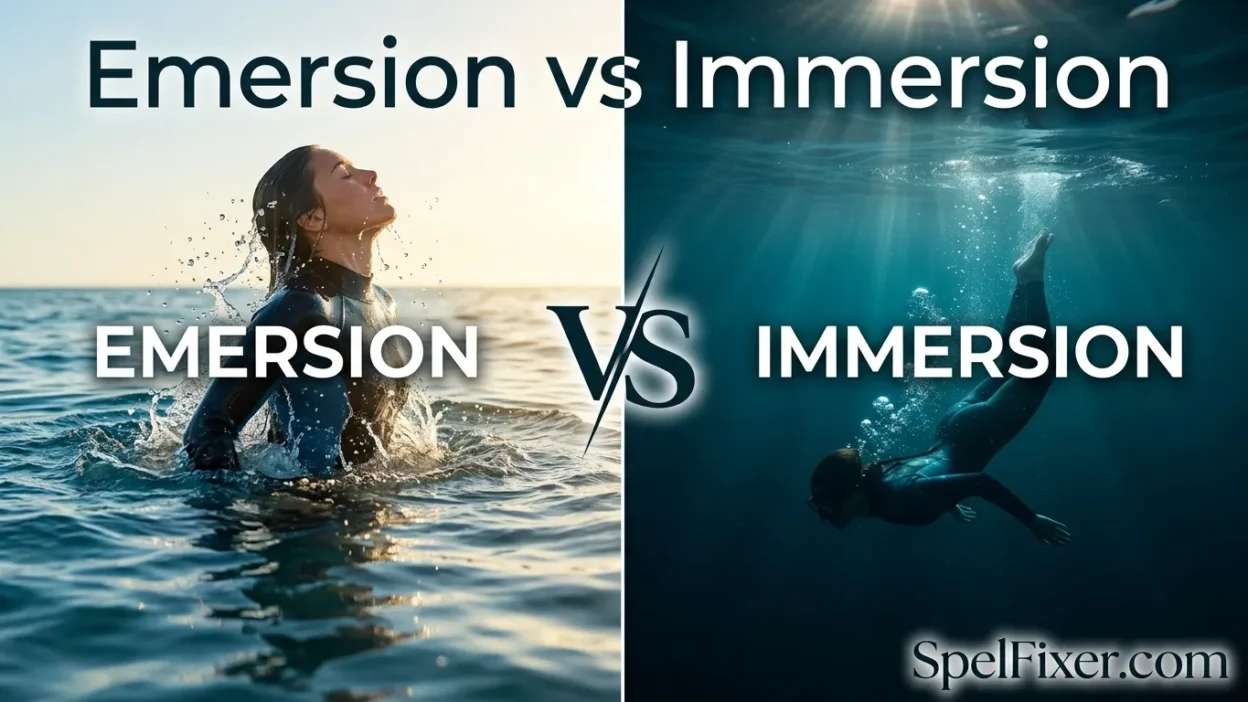
If you are confused about emersion vs immersion, you are not alone. The two words look and sound similar, but they have different meanings and are used in different contexts. Immersion is the much more common word and usually means being completely involved in something or putting something fully under a liquid. Emersion, on the other hand, is a less common word that generally refers to emerging from something, especially from being hidden, covered, or submerged.
Understanding the difference becomes easier when you connect each word with its basic idea. Immersion is about going into or becoming deeply involved, while emersion is about coming out. In everyday writing, education, language learning, and general conversation, immersion is usually the word you need.
Quick Answer
Immersion means becoming completely involved in something or being placed completely under a liquid. Emersion is a much less common word associated with emerging or coming out, particularly from being submerged or concealed. For language learning, deep involvement, or being underwater, use immersion.
Why Do People Confuse It?
The confusion comes mainly from the spelling and pronunciation.
Both emersion and immersion contain the same basic ending, -mersion, and both are related to the idea of movement in relation to something. However, their meanings point in different directions.
Think of them this way:
- Immersion → going in or being deeply involved
- Emersion → coming out or emerging
The difference of just one letter can completely change the meaning.
For most everyday situations, you will encounter immersion far more often than emersion.
What Does “Emersion” Mean?
Emersion is a noun referring to the act or process of emerging or coming out from something.
It is a relatively uncommon word in everyday English. It can be used in technical or specialized contexts, including situations involving something becoming visible again after being hidden or obscured.
For example:
- The astronomers observed the emersion of the celestial body.
- The object became visible again after its emersion from the shadow.
- The scientist recorded the moment of emersion.
Because emersion is uncommon, many people mistakenly write it when they actually mean immersion.
Is “Emersion” a Common English Word?
No. Emersion is a legitimate English word, but it is much less common than immersion.
If you mean deep involvement in an activity or putting something under water, immersion is the correct choice.
What Does “Immersion” Mean?
Immersion is the noun form related to immerse.
It commonly has two main meanings:
- Putting something completely under the surface of a liquid.
- Becoming completely involved in an activity, subject, culture, or experience.
Cambridge Dictionary defines immersion as complete involvement in something and also as putting someone or something completely under the surface of a liquid.
For example:
- Water immersion: The immersion of the object took several seconds.
- Language immersion: She learned Spanish through immersion.
- Cultural immersion: Traveling provided an opportunity for cultural immersion.
- Reading immersion: He became completely absorbed in the novel.
Emersion vs Immersion: Comparison Table
| Feature | Emersion | Immersion |
|---|---|---|
| Part of speech | Noun | Noun |
| Basic idea | Emerging or coming out | Going in, being submerged, or becoming deeply involved |
| Frequency | Uncommon | Very common |
| Common context | Technical or specialized contexts | Education, language, water, culture, activities |
| Related verb | Emerge | Immerse |
| Example | The emersion became visible. | She enjoyed total immersion in the language. |
| Everyday use | Rare | Very common |
When Should You Use Each Word?
Use “emersion” when something emerges
Use emersion when you specifically need a noun describing an emergence or coming out, particularly in a specialized context.
Example:
The telescope recorded the emersion of the object.
This is not a word you will normally need in casual conversation.
Use “immersion” for deep involvement
Use immersion when someone becomes completely involved in an activity, environment, subject, language, or culture.
Example:
Language immersion helped her become more comfortable speaking French.
Use “immersion” for liquids
Use immersion when something is completely placed under a liquid.
Example:
The equipment must be cleaned by immersion in water.
This sense is formal but well established.
Emersion vs Immersion: 12 Examples
Here are practical examples to make the difference clearer.
- The students benefited from total immersion in English.
- She became immersed in her new book.
- The course uses language immersion to develop speaking skills.
- The object was completely submerged during immersion.
- He experienced cultural immersion during his stay abroad.
- The game provides an immersive experience.
- The researchers observed the emersion of the object.
- The telescope detected the object’s emersion from the shadow.
- Immersion in the subject helped the student understand it better.
- The laboratory procedure required immersion in liquid.
- She immersed herself in the history of the country.
- The emersion marked the point when the previously hidden object became visible.
Notice that the majority of ordinary examples use immersion.
Common Mistakes
Mistake 1: Using “emersion” for language learning
❌ English emersion helped him improve.
✅ English immersion helped him improve.
When you mean learning a language by surrounding yourself with it, immersion is the correct word. Cambridge specifically lists language learning through immersion as a use of the word.
Mistake 2: Writing “emersion” when you mean deep involvement
❌ She experienced complete emersion in the project.
✅ She experienced complete immersion in the project.
Mistake 3: Assuming “emersion” is simply a spelling variation
Emersion and immersion are not interchangeable spellings.
They are separate words with different meanings.
Mistake 4: Confusing “immersion” with “immersive”
Immersion is a noun.
Immersive is an adjective describing something that makes you feel completely involved.
For example:
- The course provides language immersion.
- The course provides an immersive experience.
Cambridge describes immersive as something that surrounds or involves a person so that they feel completely involved.
Memory Trick: “In” = Immersion
A simple trick can help you remember:
IMMERSION = IN
The word immersion starts with im-, which you can associate with going in.
Think:
Then remember:
So if something is coming out, think emersion. If something is going in or becoming deeply involved, think immersion.
American vs British English
There is no major American-versus-British spelling difference between emersion and immersion.
Both varieties of English use the same spellings.
There can, however, be differences in pronunciation. Cambridge gives different pronunciation forms for American and British English, particularly for immersion.
The important point is that the meaning and spelling distinction remains the same in both varieties:
- American English: immersion
- British English: immersion
And:
- American English: emersion
- British English: emersion
Similar Words
Several words are closely related to immersion and emersion.
Immerse
Immerse is the verb related to immersion.
She immersed herself in her studies.
It can also mean putting something completely under a liquid.
Immersed
Immersed is the past tense or past participle of immerse.
He was completely immersed in the project.
Immersive
Immersive is an adjective.
The museum offers an immersive experience.
Emerge
Emerge means to come out or become visible.
The bird emerged from the bushes.
Emergence
Emergence is the noun related to emerge.
The emergence of the new technology changed the industry.
Final Verdict: Emersion or Immersion?
For almost all common situations involving deep involvement, language learning, culture, experiences, or being completely under water, choose immersion.
Emersion is a real word, but it is uncommon and has a different meaning connected with emerging or coming out.
The easiest rule is:
If you are writing about learning English through constant exposure to the language, the correct phrase is English immersion, not English emersion.
Frequently Asked Questions
Is emersion a real word?
Yes. Emersion is a real English noun, but it is relatively uncommon. It refers to emerging or coming out, especially in specialized contexts.
Is immersion the correct word for language learning?
Yes. Language immersion is the standard term for learning or using a language by being surrounded by and actively exposed to that language.
What is the difference between emersion and immersion?
Emersion relates to emerging or coming out, while immersion relates to going into something, being submerged, or becoming completely involved in something.
Is it “English emersion” or “English immersion”?
The correct phrase is English immersion.
For example:
The school offers an English immersion program.
Is immersion only related to water?
No. Although immersion can mean putting something completely under a liquid, it also commonly means becoming deeply involved in an activity, subject, language, or culture.
What is the verb form of immersion?
The related verb is immerse.
For example:
She immersed herself in her studies.
What adjective comes from immersion?
The common adjective is immersive.
For example:
The game offers an immersive experience.
Which word is more common: emersion or immersion?
Immersion is much more common in everyday English. You are likely to see it in education, language learning, culture, technology, entertainment, and descriptions of physical submersion.
Remember This
Immersion = going in, being submerged, or becoming deeply involved.
Emersion = emerging or coming out.
If you are unsure, ask yourself: Am I talking about going in or becoming deeply involved? If yes, immersion is almost certainly the word you need.
Conclusion
The difference between emersion vs immersion is small in spelling but significant in meaning. Immersion is the familiar word used for complete involvement in an activity, language, culture, or experience, and it can also describe being completely under a liquid. Emersion is much less common and refers to emerging or becoming visible after being hidden or submerged.
For everyday English, remember the simple connection: immersion means going in, while emersion means coming out. Once you connect immersion with immerse and emersion with emerge, choosing the correct word becomes much easier.