Have you ever paused while writing and wondered whether to use boys or boy’s? You’re not alone. Apostrophes are one of the most common sources of confusion in English grammar, and these two forms often trip up students, writers, and native speakers alike.
The good news is that the difference between boys and boy’s is straightforward once you understand the role of possession. In this guide, you’ll learn exactly when to use each form, see plenty of examples, avoid common mistakes, and gain confidence in your writing.
Quick Answer
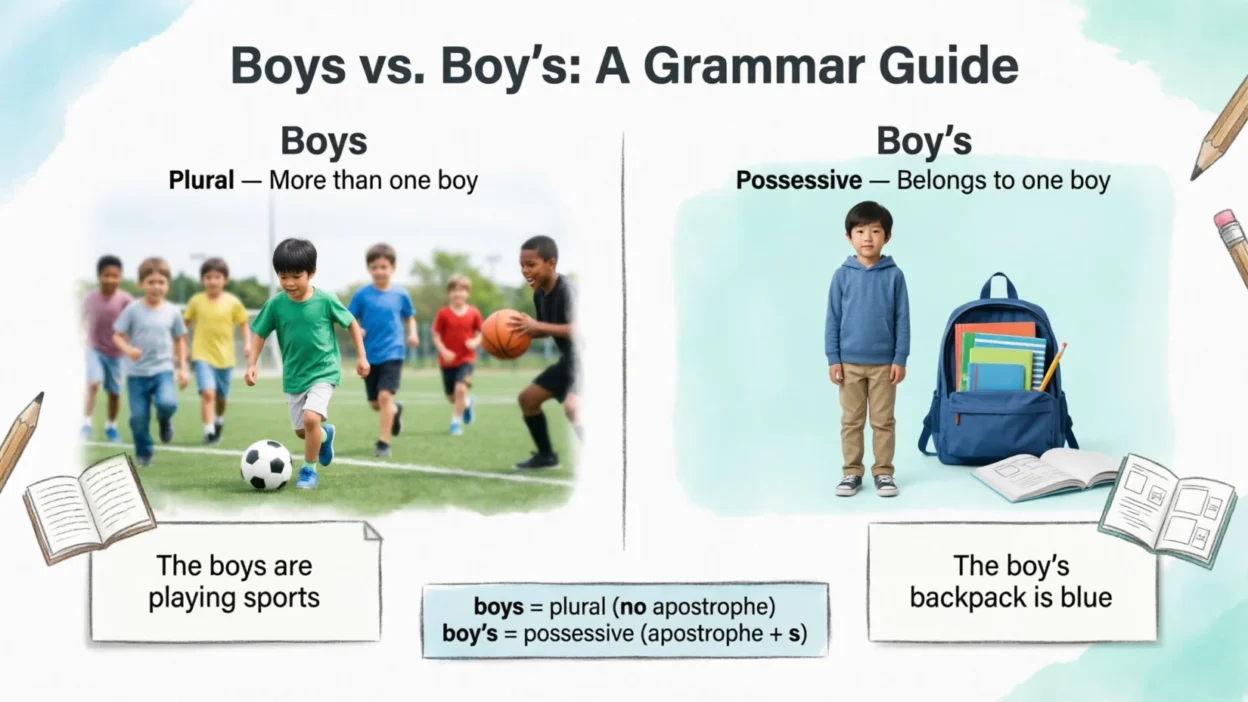
- Boys is the plural form of boy and means more than one boy.
- Boy’s is the singular possessive form and means something belongs to one boy.
Examples:
- The boys are playing soccer. ✅
- The boy’s backpack is on the floor. ✅
A simple rule:
👉 Boys = more than one boy
👉 Boy’s = belonging to one boy
What Does “Boys” Mean?
Definition of Boys
Boys is simply the plural form of the noun boy.
You use it when referring to two or more boys.
Examples of Boys in Sentences
- The boys played basketball after school.
- Several boys volunteered for the project.
- The boys were excited about the field trip.
- Those boys live next door.
In each sentence, boys means multiple boys.
When to Use Boys
Use boys when:
- Referring to more than one boy
- No ownership is involved
- The word functions as a regular plural noun
Examples:
- The boys laughed loudly.
- All the boys completed the assignment.
- The boys gathered in the playground.
What Does “Boy’s” Mean?
Definition of Boy’s
Boy’s is the singular possessive form of boy.
It shows that something belongs to one boy.
Examples of Boy’s in Sentences
- The boy’s bicycle is new.
- The boy’s jacket was hanging on the chair.
- Everyone admired the boy’s artwork.
- The boy’s phone rang during class.
In each example, the item belongs to one boy.
When to Use Boy’s
Use boy’s when:
- One boy owns something
- One boy is associated with something
- You need to show possession
Examples:
- The boy’s dog is friendly.
- The boy’s room is tidy.
- The boy’s answer was correct.
Boys vs Boy’s: Key Differences
Here’s a simple comparison.
| Feature | Boys | Boy’s |
|---|---|---|
| Meaning | More than one boy | Belonging to one boy |
| Type | Plural noun | Singular possessive noun |
| Apostrophe | No | Yes |
| Example | The boys arrived. | The boy’s hat fell off. |
The apostrophe makes all the difference.
Understanding Possessive Apostrophes
Apostrophes often indicate ownership.
Singular Possession
For one person or thing, add ‘s.
Examples:
- Boy → Boy’s
- Girl → Girl’s
- Teacher → Teacher’s
Example sentence:
- The boy’s backpack is blue.
Plural Without Possession
For simple plurals, do not use an apostrophe.
Examples:
- Boys
- Girls
- Teachers
Example sentence:
- The boys are waiting outside.
What About “Boys’”?
Many people asking about boys or boy’s actually need to know about boys’ as well.
Definition of Boys’
Boys’ is the plural possessive form.
It shows that something belongs to multiple boys.
Examples:
- The boys’ locker room is downstairs.
- The boys’ soccer team won the championship.
- The boys’ parents attended the meeting.
Quick Comparison
| Form | Meaning |
|---|---|
| Boy | One boy |
| Boys | More than one boy |
| Boy’s | Belonging to one boy |
| Boys’ | Belonging to multiple boys |
Why People Confuse Boys and Boy’s
Apostrophe Misuse
Many writers mistakenly add apostrophes to regular plurals.
Incorrect:
- Three boy’s attended the event. ❌
Correct:
- Three boys attended the event. ✅
Similar Appearance
The only visual difference is the apostrophe.
- Boys
- Boy’s
This small punctuation mark changes the meaning significantly.
Uncertainty About Possession
Many people know apostrophes relate to ownership but aren’t always sure when ownership is actually being expressed.
Common Mistakes to Avoid
Mistake 1: Using Boy’s as a Plural
Incorrect:
- The boy’s are playing outside.
Correct:
- The boys are playing outside.
No possession exists, so no apostrophe is needed.
Mistake 2: Forgetting Possession
Incorrect:
- The boys backpack is red.
Correct:
- The boy’s backpack is red.
One boy owns the backpack.
Mistake 3: Mixing Up Boy’s and Boys’
Incorrect:
- The boys’s coach arrived early.
Correct:
- The boys’ coach arrived early.
The coach belongs to multiple boys.
Real-Life Examples
Example 1
Correct:
- The boys ran across the field.
Meaning: Multiple boys.
Example 2
Correct:
- The boy’s shoes were muddy.
Meaning: One boy owns the shoes.
Example 3
Correct:
- The boys’ uniforms were washed.
Meaning: Multiple boys own the uniforms.
Easy Memory Tricks
Boys = More Than One
If you’re simply counting boys, use boys.
Examples:
- Two boys
- Five boys
- Several boys
Boy’s = One Boy Owns Something
Think:
- Boy + owns something = Boy’s
Examples:
- Boy’s bike
- Boy’s jacket
- Boy’s notebook
Quick Test
Ask yourself:
Does something belong to one boy?
- Yes → Boy’s
- No → Boys
American vs British English Differences
There is no significant difference between American and British English regarding boys and boy’s.
American English
- The boys are waiting.
- The boy’s backpack is missing.
British English
- The boys are waiting.
- The boy’s backpack is missing.
The same grammar rules apply in both varieties of English.
Related Grammar Topics
When learning boys or boy’s, you may also encounter:
- Apostrophe rules
- Singular possessives
- Plural possessives
- Noun forms
- Grammar punctuation
- Children’s vs childrens’
- Girls vs girl’s
- Students vs student’s
- Possessive nouns
- English writing rules
Mastering these concepts will improve your grammar and writing accuracy.
FAQs About Boys vs Boy’s
What is the difference between boys and boy’s?
Boys is the plural form of boy, while boy’s shows possession by one boy.
Is “the boy’s playing soccer” correct?
Usually no. If you mean multiple boys, write the boys are playing soccer.
When should I use boy’s?
Use boy’s when something belongs to one boy.
Example:
- The boy’s bicycle is parked outside.
What does boys’ mean?
Boys’ is the plural possessive form, meaning something belongs to multiple boys.
Is boys a possessive noun?
No. Boys is simply a plural noun.
Why does boy’s have an apostrophe?
The apostrophe shows ownership or possession.
Which is correct: boys school or boys’ school?
If the school is intended for boys, boys’ school is generally correct because it indicates association with multiple boys.
How can I remember the difference?
Remember: Boys = many boys. Boy’s = one boy owns something.
Final Summary
Understanding boys or boy’s comes down to recognizing the difference between plurality and possession. Boys is simply the plural form of boy and refers to more than one boy. Boy’s is the singular possessive form and shows that something belongs to one boy.
Many grammar mistakes happen because apostrophes are added unnecessarily. If you’re merely talking about multiple boys, use boys. If you’re showing ownership by one boy, use boy’s. Keeping this distinction in mind will make your writing clearer and more accurate.
Actionable Takeaway
Before choosing between boys and boy’s, ask yourself:
Am I talking about more than one boy, or am I showing ownership?
- More than one boy → Boys
- One boy owns something → Boy’s
Remember this simple phrase:
Boys = plural. Boy’s = possession.
Following this rule will help you avoid one of the most common apostrophe mistakes in English.

Fenwick Quentin is a creative blogging author known for his analytical yet engaging writing style.
He explores topics such as innovation, digital culture, and personal development with depth and clarity.
Through his articles, Fenwick encourages readers to think critically and embrace continuous growth.