Have you ever written flair when you meant flare, or vice versa? You’re not alone. These two words sound exactly alike, making them a common source of confusion for writers, students, and English learners.
Although flair and flare are homophones, they have very different meanings. One relates to natural talent, style, or elegance, while the other refers to a sudden burst of light, fire, emotion, or activity. Understanding the distinction can help you avoid embarrassing mistakes and improve your writing. In this guide, you’ll learn the meanings, examples, common errors, and memory tricks for mastering flair vs flare.
Quick Answer
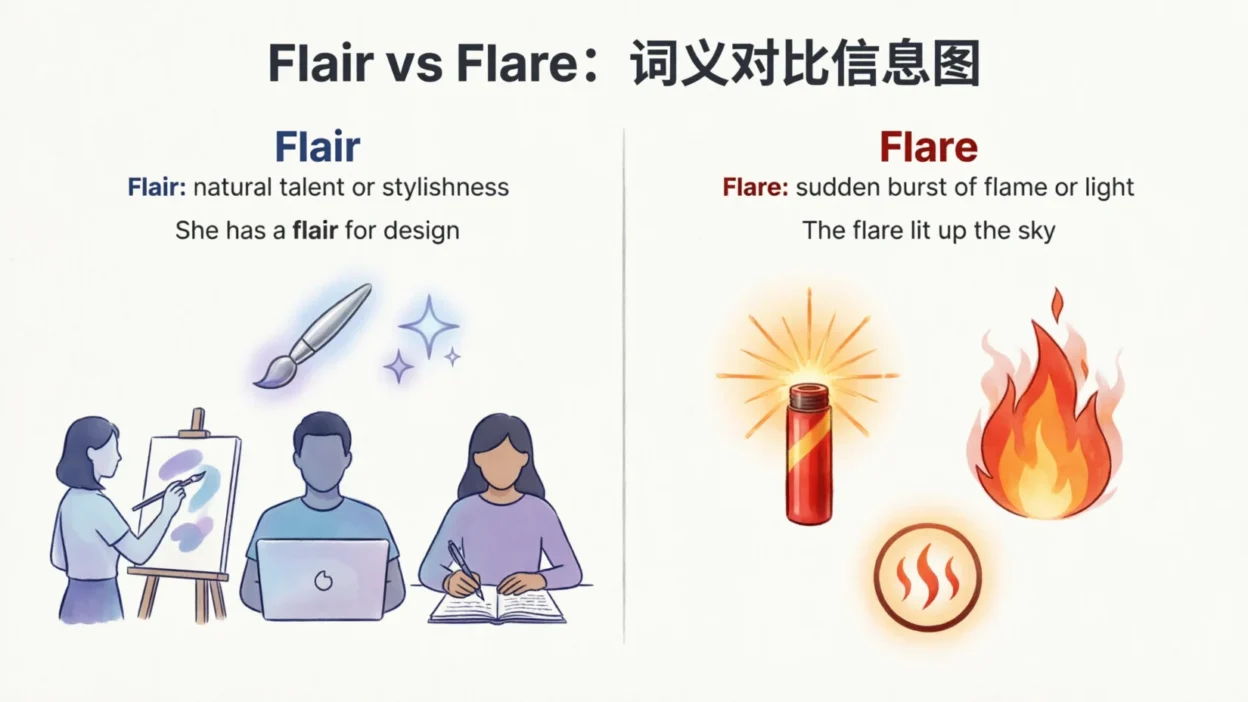
- Flair means natural talent, style, aptitude, or a distinctive quality.
- Flare means a sudden burst of light, fire, emotion, activity, or widening shape.
Examples:
- She has a flair for interior design. ✅
- The firefighters saw a flare in the distance. ✅
A simple way to remember:
👉 Flair = talent or style
👉 Flare = burst or spread
What Does “Flair” Mean?
Definition of Flair
Flair is a noun that refers to a natural ability, talent, elegance, or distinctive style.
When someone has a special gift for doing something well, they are said to have a flair for it.
Examples of Flair in Sentences
- She has a flair for creative writing.
- The chef’s flair for presentation impressed everyone.
- He decorated the room with flair and imagination.
- The designer is known for her flair and originality.
In these examples, flair refers to talent, creativity, or style.
Common Uses of Flair
You may hear phrases such as:
- Flair for design
- Flair for languages
- Flair for fashion
- Flair for storytelling
- Artistic flair
Examples:
- He has a flair for public speaking.
- She showed a flair for leadership from an early age.
Synonyms for Flair
- Talent
- Gift
- Aptitude
- Knack
- Ability
- Style
- Elegance
- Creativity
What Does “Flare” Mean?
Definition of Flare
Flare can be a noun or a verb. It usually refers to a sudden burst of light, fire, emotion, activity, or an outward widening shape.
Examples of Flare in Sentences
- A rescue flare lit up the night sky.
- The fire began to flare unexpectedly.
- Tempers started to flare during the argument.
- Her medical condition can flare up under stress.
In each example, something suddenly increases or becomes more noticeable.
Common Uses of Flare
Light or Fire
- The flare was visible from miles away.
- The flames flared after strong winds arrived.
Emotions
- Emotions flared during the debate.
- Anger flared between the rivals.
Medical Conditions
- His allergies flare every spring.
- The symptoms flared up again.
Fashion
- The dress features flare sleeves.
- She wore flare jeans.
Flair vs Flare: Key Differences
Although they sound the same, their meanings are completely different.
| Feature | Flair | Flare |
|---|---|---|
| Part of Speech | Noun | Noun and Verb |
| Meaning | Talent, style, aptitude | Burst of light, fire, emotion, or widening shape |
| Related To | Ability and creativity | Sudden increase or expansion |
| Example | She has a flair for music. | The fire began to flare. |
| Common Phrase | Flair for design | Flare up |
The easiest distinction:
Flair = skill or style
Flare = burst or spread
Why People Confuse Flair and Flare
They Sound Identical
Flair and flare are true homophones. Their pronunciation is the same in both American and British English.
Similar Spellings
Only one letter differs:
- Flair
- Flare
This small difference often leads to typing mistakes.
Context Is Everything
Since spell-check programs recognize both words, they may not catch incorrect usage.
For example:
- She has a flare for painting. ❌
The sentence is grammatically correct but uses the wrong word.
When to Use Flair
Talking About Natural Talent
Use flair when referring to someone’s special ability.
Examples:
- She has a flair for photography.
- He has a flair for negotiation.
Talking About Style
Examples:
- The actor performed with flair.
- The restaurant is decorated with flair.
Talking About Creativity
Examples:
- The writer has a flair for storytelling.
- Her flair for innovation helped the company succeed.
When to Use Flare
Talking About Light or Fire
Examples:
- The flare guided rescuers to the location.
- The fire suddenly flared up.
Talking About Emotions
Examples:
- Tempers flared during the discussion.
- Tensions flared between the groups.
Talking About Medical Symptoms
Examples:
- Her arthritis flares up in cold weather.
- The condition can flare unexpectedly.
Talking About Shape
Examples:
- The skirt flares at the bottom.
- The road flares outward near the intersection.
Common Mistakes to Avoid
Mistake 1: Using Flare Instead of Flair
Incorrect:
- She has a flare for painting.
Correct:
- She has a flair for painting.
Talent requires flair.
Mistake 2: Using Flair Instead of Flare
Incorrect:
- The fire began to flair.
Correct:
- The fire began to flare.
Fire requires flare.
Mistake 3: Confusing Flair and Flare Up
Incorrect:
- My allergies flair up every spring.
Correct:
- My allergies flare up every spring.
Medical symptoms use flare up.
Real-Life Examples
Example 1
Correct:
- The artist has a flair for color combinations.
Incorrect:
- The artist has a flare for color combinations.
Example 2
Correct:
- A flare was launched from the stranded boat.
Incorrect:
- A flair was launched from the stranded boat.
Example 3
Correct:
- Tensions flared after the announcement.
Incorrect:
- Tensions flaired after the announcement.
Easy Memory Tricks
Flair Contains “Air”
Think of talent floating naturally in the air around someone.
Examples:
- Flair for music
- Flair for fashion
- Flair for leadership
Flare Looks Like Fire
The word flare contains the letters found in words associated with heat and expansion.
Think:
- Flare = fire
- Flare = burst
- Flare = explosion
Quick Reminder
- Flair = talent
- Flare = burst
American vs British English Differences
There are virtually no differences between American and British English regarding flair vs flare.
American English
- She has a flair for cooking.
- The fire began to flare.
British English
- She has a flair for cooking.
- The fire began to flare.
Both spellings and meanings remain the same.
Related Words and LSI Keywords
When learning flair vs flare, you may also encounter:
- Commonly confused words
- Homophones
- English vocabulary
- Grammar tips
- Word choice
- Talent and aptitude
- Flare up meaning
- Writing mistakes
- Vocabulary comparison
- English language learning
Understanding these related terms can strengthen your vocabulary and writing skills.
FAQs About Flair vs Flare
What is the difference between flair and flare?
Flair means talent, style, or aptitude, while flare refers to a burst of light, fire, emotion, or activity.
Is “flair for writing” correct?
Yes. Flair is commonly used when describing natural talent.
What does flare up mean?
It means to suddenly become more intense, especially regarding emotions, fires, or medical symptoms.
Is flare a noun or a verb?
It can be both. For example, a flare (noun) and flames flare (verb).
Is flair always a noun?
Yes. Flair functions as a noun.
How do I remember the difference?
Remember: Flair = talent. Flare = burst.
Can medical conditions flare up?
Yes. Symptoms often flare up during periods of stress or illness.
Are flair and flare pronounced differently?
No. They are pronounced the same way.
Final Summary
Understanding flair vs flare is easier than it first appears. Flair refers to talent, creativity, style, or natural ability. It is commonly used when describing someone who excels at something or performs with elegance and originality.
Flare, on the other hand, refers to a sudden burst of light, fire, emotion, activity, or outward expansion. It can function as both a noun and a verb and frequently appears in phrases such as flare up. Although these words sound identical, their meanings are completely different.
Actionable Takeaway
Before choosing between these words, ask yourself:
Am I talking about talent or a sudden burst?
- If it’s talent, style, or aptitude, use flair.
- If it’s fire, light, emotion, symptoms, or expansion, use flare.
Remember this simple phrase:
Flair = talent. Flare = burst.
Using this quick rule will help you avoid one of the most common homophone mistakes in English.

Fenwick Quentin is a creative blogging author known for his analytical yet engaging writing style.
He explores topics such as innovation, digital culture, and personal development with depth and clarity.
Through his articles, Fenwick encourages readers to think critically and embrace continuous growth.