Have you ever come across the words draws and drawers and wondered whether they mean the same thing? You’re not alone. Because these words look and sound similar, many English learners and even native speakers occasionally confuse them.
The truth is that draws and drawers have completely different meanings and grammatical functions. One is a verb, while the other is a noun. Understanding the distinction will help you avoid common writing mistakes and communicate more clearly. In this guide, you’ll learn the meanings, examples, common errors, and easy memory tricks for mastering draws vs drawers.
Quick Answer
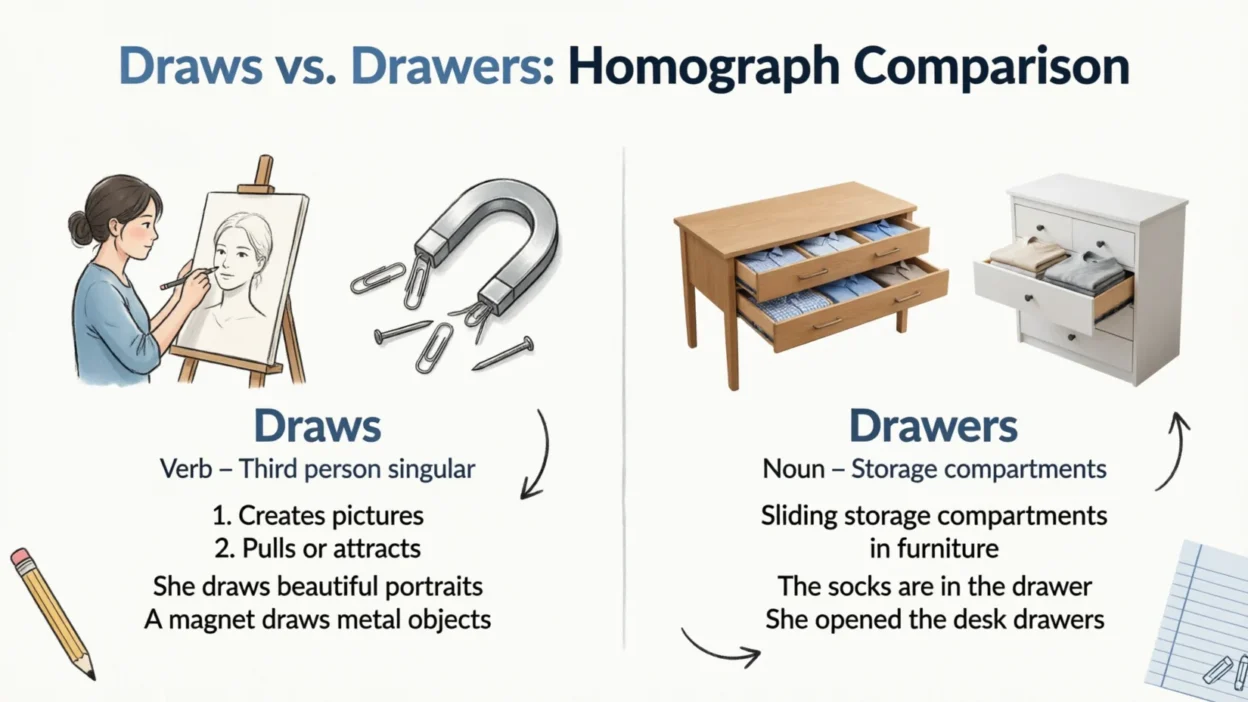
- Draws is usually the third-person singular form of the verb draw.
- Drawers is a plural noun referring to storage compartments in furniture.
Examples:
- She draws beautiful portraits. ✅
- The desk has three drawers. ✅
A simple way to remember:
👉 Draws = an action
👉 Drawers = storage spaces
What Does “Draws” Mean?
Definition of Draws
Draws is most commonly the third-person singular present tense of the verb draw.
It describes an action performed by someone or something.
Examples of Draws in Sentences
- He draws comic book characters every weekend.
- The artist draws inspiration from nature.
- She draws a map whenever visitors get lost.
- The company draws customers through social media marketing.
In these examples, draws describes an action.
Other Meanings of Draws
The verb draw has several meanings, so draws can be used in different contexts.
To Create a Picture
- She draws animals exceptionally well.
To Attract
- The event draws thousands of visitors.
To Pull Something
- He draws the curtains every evening.
To Obtain
- The researcher draws conclusions from the data.
What Does “Drawers” Mean?
Definition of Drawers
Drawers is the plural form of drawer, a noun that refers to a sliding storage compartment found in furniture such as desks, dressers, and cabinets.
Examples of Drawers in Sentences
- The dresser has six drawers.
- She organized her clothes in separate drawers.
- The office desk contains multiple drawers.
- Please check the kitchen drawers for the scissors.
In these examples, drawers refers to physical storage compartments.
Common Types of Drawers
- Desk drawers
- Kitchen drawers
- Filing drawers
- Dresser drawers
- Cabinet drawers
Draws vs Drawers: Key Differences
The easiest way to understand the distinction is through comparison.
| Feature | Draws | Drawers |
|---|---|---|
| Part of Speech | Verb | Noun |
| Meaning | Performs the action of drawing, pulling, attracting, or obtaining | Storage compartments |
| Singular Form | Draw | Drawer |
| Plural Form | Not applicable | Drawers |
| Example | She draws well. | The drawers are full. |
The words may look similar, but they belong to completely different parts of speech.
Why People Confuse Draws and Drawers
Similar Spellings
The words differ by only a few letters:
- Draws
- Drawers
This visual similarity often causes mistakes while reading or typing.
Similar Pronunciation
In some accents, especially when spoken quickly, the words can sound somewhat alike.
Autocorrect Doesn’t Always Help
Since both are legitimate English words, spell-check tools may not catch the error.
For example:
- The desk has three draws. ❌
The sentence contains a real word, but the wrong one.
When to Use Draws
For Artistic Activities
Use draws when someone creates pictures or illustrations.
Examples:
- The child draws every afternoon.
- My sister draws realistic portraits.
For Attraction
Examples:
- The museum draws tourists from around the world.
- The festival draws large crowds.
For Pulling Actions
Examples:
- He draws the blinds at sunset.
- She draws water from the well.
For Conclusions
Examples:
- The scientist draws conclusions from the experiment.
- The judge draws attention to important evidence.
When to Use Drawers
For Furniture Storage
Use drawers when referring to storage compartments.
Examples:
- The dresser drawers are full of clothes.
- The desk drawers contain office supplies.
For Organization
Examples:
- She labeled all the kitchen drawers.
- The documents are stored in filing drawers.
Around the Home
Examples:
- The silverware is kept in the top drawers.
- The children organized their toys in separate drawers.
Common Mistakes to Avoid
Mistake 1: Using Draws Instead of Drawers
Incorrect:
- The desk has four draws.
Correct:
- The desk has four drawers.
Storage compartments require drawers.
Mistake 2: Using Drawers Instead of Draws
Incorrect:
- She drawers beautiful landscapes.
Correct:
- She draws beautiful landscapes.
Artistic actions require draws.
Mistake 3: Assuming They Are Interchangeable
Although the words look similar, they serve entirely different purposes.
Remember:
- Draws = action
- Drawers = object
Real-Life Examples
Example 1
Correct:
- The artist draws portraits professionally.
Incorrect:
- The artist drawers portraits professionally.
Example 2
Correct:
- The filing cabinet contains several drawers.
Incorrect:
- The filing cabinet contains several draws.
Example 3
Correct:
- The concert draws thousands of fans.
Incorrect:
- The concert drawers thousands of fans.
Easy Memory Tricks
Draws Has No Extra “er”
Think of draws as the action word.
Examples:
- Draws pictures
- Draws attention
- Draws water
Actions don’t need extra storage!
Drawers Contains “er”
Notice that drawer ends in -er, which often refers to a thing or person.
Examples:
- Printer
- Toaster
- Freezer
- Drawer
This can help remind you that drawers are physical objects.
Quick Reminder
- Draws = does something
- Drawers = holds something
American vs British English Differences
There is very little difference between American and British English regarding draws vs drawers.
American English
- She draws cartoons.
- The desk has three drawers.
British English
- She draws cartoons.
- The desk has three drawers.
The spellings and meanings remain the same in both varieties of English.
Related Words and LSI Keywords
When learning draws vs drawers, you may also encounter:
- Draw vs drawer
- Commonly confused words
- English vocabulary
- Grammar mistakes
- Homophones and near-homophones
- Writing tips
- Furniture terminology
- Verb vs noun
- Vocabulary building
- English language learning
Understanding these related concepts can improve your overall language skills.
FAQs About Draws vs Drawers
What is the difference between draws and drawers?
Draws is a verb that describes an action, while drawers is a noun referring to storage compartments.
Is “draws” a verb?
Yes. It is usually the third-person singular form of the verb draw.
What are drawers in furniture?
Drawers are sliding storage compartments found in desks, dressers, cabinets, and similar furniture.
Is “the desk has three draws” correct?
No. The correct word is drawers.
Can “draws” mean attracts?
Yes. For example: The attraction draws many visitors each year.
Why do people confuse draws and drawers?
Because they look and sound similar, especially in fast speech.
Is drawer singular or plural?
Drawer is singular. Drawers is plural.
How can I remember the difference?
Remember: Draws = action. Drawers = storage.
Final Summary
Understanding draws vs drawers is easier once you recognize that they belong to different parts of speech. Draws is a verb used for actions such as sketching, attracting, pulling, or obtaining. Drawers is a noun referring to storage compartments found in furniture.
Although the words look similar, their meanings are completely different. By focusing on whether you’re describing an action or an object, you’ll be able to choose the correct word every time and avoid a common English mistake.
Actionable Takeaway
Before using either word, ask yourself:
Am I talking about an action or a storage compartment?
- If it’s an action, use draws.
- If it’s a piece of furniture storage, use drawers.
Remember this simple phrase:
Draws does. Drawers stores.
Using this quick rule will help you confidently distinguish between these commonly confused words.