
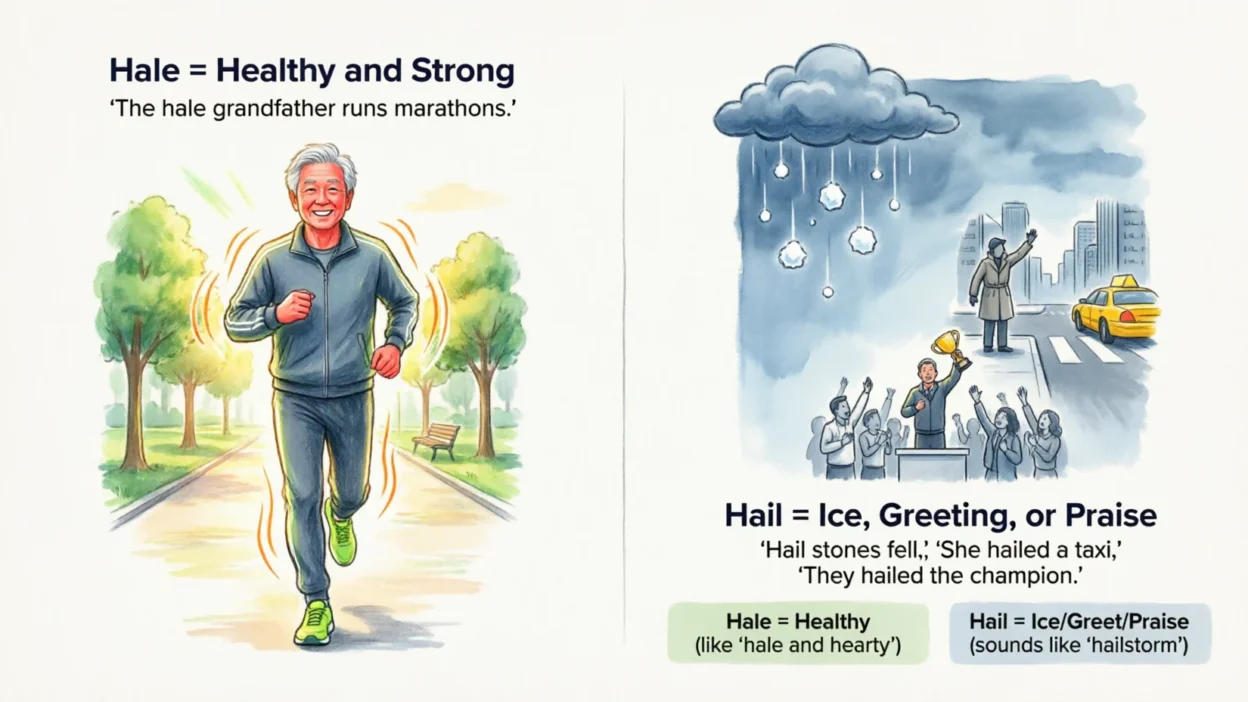
The words hale and hail sound exactly alike, making them a common source of confusion for English learners and native speakers alike. Since they are homophones, it’s easy to accidentally choose the wrong spelling when writing.
Despite their similar pronunciation, hale and hail have very different meanings. One relates to health and well-being, while the other can refer to weather, greetings, or praise. Understanding the distinction will help you use both words correctly and confidently.
Quick Answer
- Hale means healthy, strong, and in good physical condition.
- Hail refers to ice pellets falling from the sky, calling out to someone, or praising and welcoming someone or something.
Examples:
- Despite his age, he remains hale and active. ✅
- The storm brought heavy hail. ✅
- The crowd hailed the champion. ✅
A simple rule:
👉 Hale = healthy
👉 Hail = weather, greeting, or praise
What Does “Hale” Mean?
Definition of Hale
Hale is an adjective that describes someone who is healthy, vigorous, and physically fit, especially an older person.
It is often used in the expression “hale and hearty.”
Examples of Hale in Sentences
- My grandfather is still hale at ninety years old.
- She remained hale and energetic throughout her life.
- The doctor was pleased that the patient looked hale.
- He is surprisingly hale for his age.
In each example, hale means healthy and strong.
Common Uses of Hale
Hale and Hearty
This is the most common phrase involving the word.
Examples:
- The retired teacher remains hale and hearty.
- After recovering, she felt hale and hearty again.
Describing Good Health
Examples:
- The athlete looked hale and confident.
- He stayed hale through years of outdoor work.
What Does “Hail” Mean?
Definition of Hail
Hail can be a noun or a verb.
As a noun, it refers to small balls of ice that fall during certain storms.
As a verb, it can mean:
- To greet or call out to someone
- To signal a vehicle
- To praise or celebrate someone
Examples of Hail in Sentences
- Large hail damaged several cars.
- She hailed a taxi.
- The crowd hailed the team’s victory.
- We watched hail fall during the storm.
Common Uses of Hail
Weather
Examples:
- The storm produced hail the size of golf balls.
- Hail damaged the roof.
Greeting Someone
Examples:
- He hailed his friend across the street.
- She hailed the waiter for assistance.
Praising Someone
Examples:
- Critics hailed the movie as a masterpiece.
- The scientist was hailed for her discovery.
Hale vs Hail: Key Differences
| Feature | Hale | Hail |
|---|---|---|
| Meaning | Healthy and strong | Ice pellets, greeting, praise |
| Part of Speech | Adjective | Noun or verb |
| Related To | Health and wellness | Weather, communication, recognition |
| Example | A hale old man | A hailstorm |
| Common Phrase | Hale and hearty | Hail a taxi |
The easiest distinction:
Hale = health
Hail = ice, greeting, or praise
Why People Confuse Hale and Hail
They Are Homophones
Both words are pronounced exactly the same.
- Hale
- Hail
This makes spelling errors common.
Similar Appearance
The words differ by only one letter.
Context Is Essential
Spell-check tools may not catch mistakes because both words are valid English words.
Example:
- The crowd haleed the hero. ❌
- The crowd hailed the hero. ✅
When to Use Hale
Talking About Good Health
Examples:
- She remains hale despite her advanced age.
- The farmer stayed hale throughout his life.
Describing Strength and Vitality
Examples:
- He appeared hale and energetic.
- The hikers looked hale after their adventure.
Using the Phrase “Hale and Hearty”
Examples:
- The grandparents are still hale and hearty.
- She returned to work hale and hearty.
When to Use Hail
Talking About Weather
Examples:
- The forecast warned of hail.
- The hail cracked several windows.
Calling Out to Someone
Examples:
- He hailed a passing driver.
- She hailed her friend from across the park.
Praising or Celebrating
Examples:
- The invention was hailed as revolutionary.
- Fans hailed the player’s performance.
Common Mistakes to Avoid
Mistake 1: Using Hale for Weather
Incorrect:
- The storm produced hale. ❌
Correct:
- The storm produced hail. ✅
Ice falling from the sky is hail.
Mistake 2: Using Hail for Health
Incorrect:
- My grandfather is hail and hearty. ❌
Correct:
- My grandfather is hale and hearty. ✅
Healthy people are hale.
Mistake 3: Confusing Praise With Health
Incorrect:
- The critics haled the novel. ❌
Correct:
- The critics hailed the novel. ✅
Praise requires hailed.
Real-Life Examples
Example 1
Correct:
- The elderly woman remained hale and active.
Incorrect:
- The elderly woman remained hail and active.
Example 2
Correct:
- The storm brought heavy hail.
Incorrect:
- The storm brought heavy hale.
Example 3
Correct:
- The crowd hailed the winner.
Incorrect:
- The crowd haled the winner.
Easy Memory Tricks
Hale = Health
Both words begin with H.
Think:
- Hale = Healthy
This connection makes it easy to remember.
Hail = Ice From the Sky
Think of hailstones falling during a storm.
- Hail = weather
Quick Reminder
- Hale = healthy
- Hail = storm, greeting, praise
Popular Expressions Using Hale
Hale and Hearty
Meaning healthy and energetic.
Example:
- At eighty-five, he is still hale and hearty.
Hale Appearance
Meaning healthy-looking.
Example:
- She looked hale after her recovery.
Popular Expressions Using Hail
Hail a Taxi
Meaning signal a taxi to stop.
Example:
- We hailed a taxi outside the hotel.
Hail a Victory
Meaning celebrate or praise a success.
Example:
- The media hailed the achievement.
Hailstorm
A storm that produces hail.
Example:
- The hailstorm caused extensive damage.
American vs British English Differences
There are no significant differences between American and British English regarding hale and hail.
American English
- He remains hale and active.
- The hail damaged several vehicles.
British English
- He remains hale and active.
- The hail damaged several vehicles.
The meanings and spellings are the same in both varieties.
Related Words and LSI Keywords
When learning hale vs hail, you may also encounter:
- Hale and hearty
- Healthy and strong
- Hailstorm
- Hailstones
- Praise and acclaim
- Signal a taxi
- Commonly confused words
- Homophones
- English vocabulary
- Grammar tips
These related terms help reinforce the difference between the two words.
FAQs About Hale vs Hail
What is the difference between hale and hail?
Hale means healthy and strong, while hail refers to ice pellets, greetings, or praise.
What does hale mean?
Hale means physically healthy, vigorous, and robust.
What is hail in weather?
Hail is frozen balls of ice that fall from storm clouds.
What does it mean to hail a taxi?
It means to signal a taxi to stop and pick you up.
Is “hale and hearty” a common phrase?
Yes. It means healthy, energetic, and strong.
Which word means praise or celebrate?
Hail.
Are hale and hail pronounced the same?
Yes. They are homophones.
How can I remember the difference?
Think: Hale = healthy, Hail = ice, greeting, or praise.
Final Summary
Understanding hale vs hail is simple once you remember their core meanings. Hale describes someone who is healthy, vigorous, and strong, especially in the phrase “hale and hearty.” It is almost always connected to health and physical well-being.
Hail, on the other hand, has several meanings. It can refer to frozen ice pellets falling from the sky, calling out to someone, signaling a taxi, or praising and celebrating a person or achievement. Although the words sound identical, their meanings are completely different.
Actionable Takeaway
Before choosing between hale and hail, ask yourself:
Am I talking about health or weather, greetings, and praise?
- Healthy and strong → Hale
- Ice storm, greeting, praise → Hail
Remember this simple phrase:
Hale means healthy. Hail falls from the sky and wins applause.
Using this quick rule will help you choose the correct word every time.

Fenwick Quentin is a creative blogging author known for his analytical yet engaging writing style.
He explores topics such as innovation, digital culture, and personal development with depth and clarity.
Through his articles, Fenwick encourages readers to think critically and embrace continuous growth.