The words apologizes and apologies are often confused because they come from the same root word and are closely related in meaning. However, they serve completely different grammatical purposes. Using the wrong one can make a sentence sound awkward or incorrect.
If you’ve ever wondered whether someone should apologize or offer their apologies, this guide will help you understand the difference. By the end, you’ll know exactly when to use each word and how to avoid common mistakes.
Quick Answer
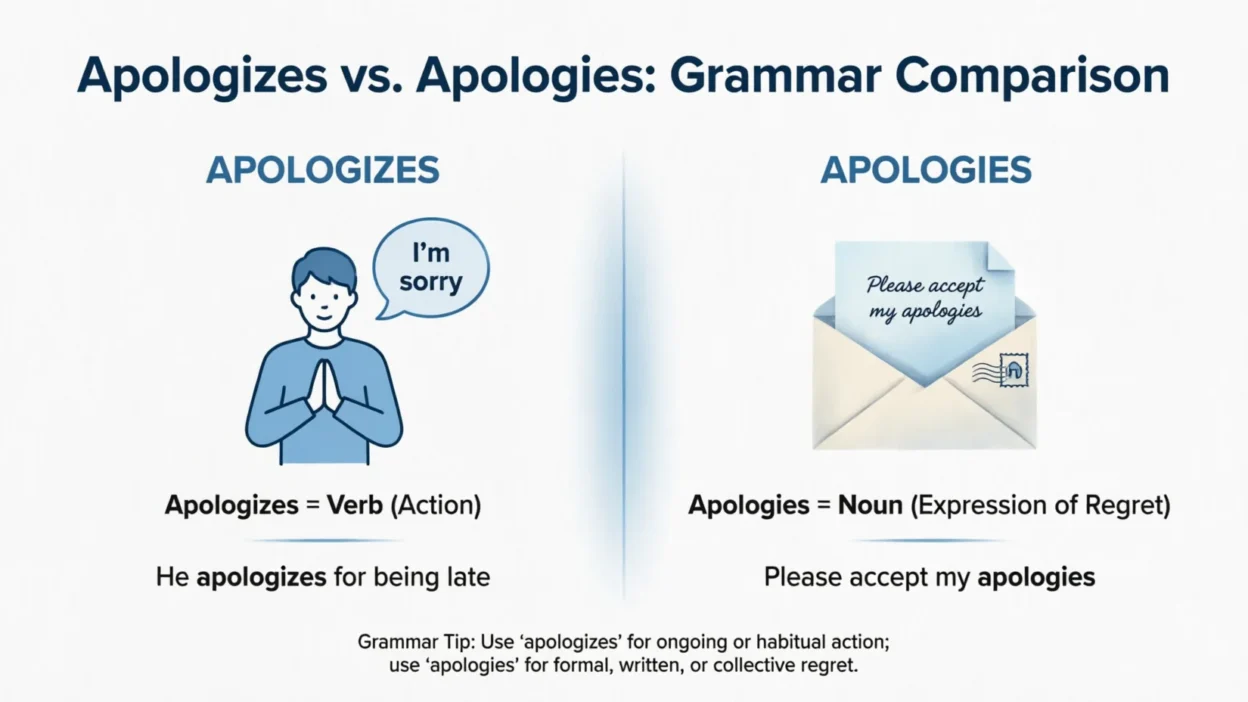
- Apologizes is a verb that means expresses regret or says sorry.
- Apologies is a noun that means expressions of regret or remorse.
Examples:
- She apologizes for being late. ✅
- Please accept my apologies. ✅
A simple rule:
👉 Apologizes = action (verb)
👉 Apologies = thing (noun)
What Does “Apologizes” Mean?
Definition of Apologizes
Apologizes is the third-person singular form of the verb apologize.
It means that someone expresses regret, admits fault, or says sorry for something.
Examples of Apologizes in Sentences
- He apologizes whenever he makes a mistake.
- She apologizes for the misunderstanding.
- The company apologizes for the inconvenience.
- My friend apologizes sincerely after every argument.
In each example, apologizes describes an action being performed.
Common Uses of Apologizes
Personal Situations
- She apologizes for forgetting your birthday.
- He apologizes for his behavior.
Professional Situations
- The airline apologizes for the delay.
- The manager apologizes to customers.
Formal Statements
- The organization apologizes for the error.
- The spokesperson apologizes on behalf of the company.
What Does “Apologies” Mean?
Definition of Apologies
Apologies is the plural form of the noun apology.
It refers to expressions of regret, remorse, or requests for forgiveness.
Examples of Apologies in Sentences
- Please accept my apologies.
- She sent her apologies for missing the meeting.
- The company offered its apologies.
- Our sincere apologies for the inconvenience.
In these examples, apologies functions as a thing rather than an action.
Common Uses of Apologies
Formal Communication
- My apologies for the delay.
- Please accept our apologies.
Written Messages
- She emailed her apologies.
- The speaker sent apologies for being absent.
Business Settings
- The company issued public apologies.
- Customer service offered apologies to affected users.
Apologizes vs Apologies: Key Differences
| Feature | Apologizes | Apologies |
|---|---|---|
| Part of Speech | Verb | Noun |
| Meaning | Expresses regret | Expression of regret |
| Function | Action | Thing or statement |
| Example | She apologizes often. | She offered her apologies. |
| Question | What does someone do? | What is being offered? |
The easiest distinction:
Apologizes = says sorry
Apologies = the actual apology
Why People Confuse Apologizes and Apologies
Similar Spellings
The words differ by only a few letters:
- Apologizes
- Apologies
Same Root Word
Both come from the word apology, which makes confusion natural.
Similar Meanings
Both involve regret, remorse, and saying sorry.
However, one is an action and the other is a noun.
When to Use Apologizes
When Someone Performs the Action
Examples:
- He apologizes immediately after realizing his mistake.
- She apologizes whenever she interrupts someone.
In Present Tense Statements
Examples:
- The company apologizes for the inconvenience.
- The teacher apologizes for the confusion.
In Formal Announcements
Examples:
- The airline apologizes for the canceled flight.
- The manufacturer apologizes for the defect.
When to Use Apologies
When Referring to the Expression Itself
Examples:
- Please accept my apologies.
- His apologies seemed sincere.
In Professional Writing
Examples:
- Our apologies for the delay.
- We extend our apologies to customers.
When Sending Regrets
Examples:
- She sent her apologies before the event.
- They offered their apologies in writing.
Common Mistakes to Avoid
Mistake 1: Using Apologies as a Verb
Incorrect:
- She apologies for being late. ❌
Correct:
- She apologizes for being late. ✅
Actions require the verb.
Mistake 2: Using Apologizes as a Noun
Incorrect:
- Please accept my apologizes. ❌
Correct:
- Please accept my apologies. ✅
Expressions of regret require the noun.
Mistake 3: Confusing Formal Phrases
Incorrect:
- My apologizes for the inconvenience. ❌
Correct:
- My apologies for the inconvenience. ✅
This is a common business-writing mistake.
Real-Life Examples
Example 1
Correct:
- The manager apologizes for the misunderstanding.
Incorrect:
- The manager apologies for the misunderstanding.
Example 2
Correct:
- Please accept our apologies.
Incorrect:
- Please accept our apologizes.
Example 3
Correct:
- The company apologizes publicly.
Incorrect:
- The company apologies publicly.
Easy Memory Tricks
Apologizes Ends in “-izes”
Many verbs end with:
- Realizes
- Organizes
- Recognizes
- Apologizes
Think:
- Apologizes = action
Apologies Ends in “-ies”
Many plural nouns end with:
- Stories
- Memories
- Parties
- Apologies
Think:
- Apologies = thing
Quick Reminder
- Apologizes = does
- Apologies = offers
Common Phrases With Apologizes
Apologizes for
- He apologizes for the mistake.
- The company apologizes for the delay.
Publicly Apologizes
- The celebrity apologizes publicly.
Sincerely Apologizes
- She sincerely apologizes for her actions.
Common Phrases With Apologies
My Apologies
- My apologies for the confusion.
Sincere Apologies
- Please accept our sincere apologies.
Offer Apologies
- The organization offered its apologies.
Send Apologies
- He sent his apologies before the meeting.
American vs British English Differences
There is little difference between American and British English regarding apologizes and apologies.
American English
- The company apologizes for the inconvenience.
- Please accept our apologies.
British English
- The company apologises for the inconvenience.
- Please accept our apologies.
The main difference is spelling:
- American English: apologizes
- British English: apologises
The noun apologies remains the same in both varieties.
Related Words and LSI Keywords
When learning apologizes vs apologies, you may also encounter:
- Apology
- Apologize
- Regret
- Remorse
- Say sorry
- Formal apology
- Written apology
- Sincere apology
- Business communication
- Commonly confused words
These related terms help reinforce proper usage.
FAQs About Apologizes vs Apologies
What is the difference between apologizes and apologies?
Apologizes is a verb meaning to express regret, while apologies is a noun meaning expressions of regret.
Is “she apologies” correct?
No. The correct phrase is she apologizes.
Is “my apologizes” correct?
No. The correct phrase is my apologies.
Which word is a verb?
Apologizes.
Which word is a noun?
Apologies.
What does “please accept my apologies” mean?
It means asking someone to accept your expression of regret.
How is apologizes spelled in British English?
It is usually spelled apologises.
How can I remember the difference?
Think: Apologizes takes action. Apologies are offered.
Final Summary
Understanding apologizes vs apologies is simple once you remember their grammatical roles. Apologizes is a verb that describes the act of expressing regret or saying sorry. It tells us what someone does.
Apologies, on the other hand, is a noun that refers to the actual expression of regret. It is something that can be offered, accepted, sent, or received. Although the words are closely related, they cannot be used interchangeably.
Actionable Takeaway
Before choosing between apologizes and apologies, ask yourself:
Am I describing an action or a thing?
- Action of saying sorry → Apologizes
- Expression of regret → Apologies
Remember this simple phrase:
Apologizes is what you do. Apologies are what you give.
Using this rule will help you choose the correct word every time.