
If you’ve ever wondered whether to use immigrated or migrated, you’re not alone. These words are closely related and often appear in discussions about moving from one place to another. Because they both involve relocation, many people mistakenly use them interchangeably.
However, immigrated and migrated have distinct meanings. Understanding the difference can help you communicate more accurately, whether you’re writing about people, animals, travel, demographics, or global population movements.
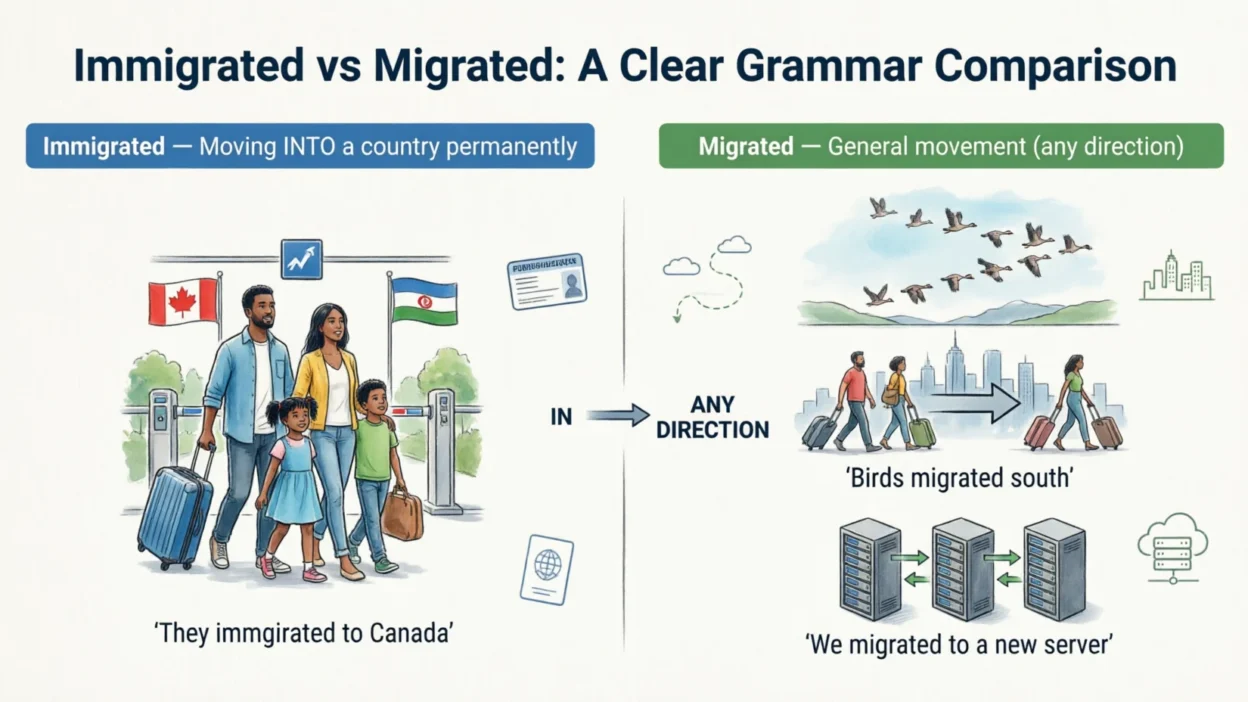
Quick Answer
- Immigrated means moved into a new country to live permanently or long-term.
- Migrated means moved from one place to another, either temporarily or permanently.
Examples:
- Her family immigrated to Canada in 2010. ✅
- Many birds migrated south for the winter. ✅
A simple rule:
👉 Immigrated = moved into a country
👉 Migrated = moved from one place to another
What Does “Immigrated” Mean?
Definition of Immigrated
Immigrated is the past tense of immigrate, meaning to enter a foreign country to live there permanently or for an extended period.
The focus is on arriving in a new country.
Examples of Immigrated in Sentences
- My grandparents immigrated to the United States in the 1950s.
- She immigrated to Australia for better opportunities.
- Thousands of families immigrated to the country last year.
- He immigrated to Germany after finishing university.
In each example, the person moved into a different country.
Key Point About Immigrated
The word emphasizes the destination.
Example:
- They immigrated to Canada.
The focus is on entering Canada.
What Does “Migrated” Mean?
Definition of Migrated
Migrated is the past tense of migrate, meaning to move from one place to another.
The movement can be:
- Temporary
- Seasonal
- Permanent
- Domestic
- International
Examples of Migrated in Sentences
- The birds migrated south during winter.
- Many workers migrated to cities in search of jobs.
- Ancient populations migrated across continents.
- The company migrated its data to a new server.
The word has a much broader meaning than immigrated.
Common Uses of Migrated
Human Migration
- Rural-to-urban migration
- International migration
- Economic migration
Animal Migration
- Birds migrating south
- Whales migrating between oceans
- Monarch butterflies migrating seasonally
Technology Migration
- Data migration
- Cloud migration
- System migration
Immigrated vs Migrated: Key Differences
| Feature | Immigrated | Migrated |
|---|---|---|
| Meaning | Moved into a new country | Moved from one place to another |
| Focus | Arrival in a country | Movement in general |
| Used for People | Yes | Yes |
| Used for Animals | No | Yes |
| Used for Technology | No | Yes |
| Example | She immigrated to Canada. | Birds migrated south. |
The biggest distinction is that immigrated is a specific type of migration.
Understanding Immigration and Migration
Think of it this way:
All Immigration Is Migration
If someone immigrates, they have migrated.
Example:
- She immigrated to Canada.
- She migrated from India to Canada.
Both can be true.
Not All Migration Is Immigration
Example:
- Birds migrated south.
Birds are migrating, but they are not immigrating.
Similarly:
- Workers migrated from rural areas to cities.
This is migration, not immigration.
Immigrated vs Emigrated
Many learners also confuse immigrated with emigrated.
Immigrated
Focuses on entering a country.
Example:
- They immigrated to Australia.
Emigrated
Focuses on leaving a country.
Example:
- They emigrated from India.
Together
- They emigrated from India and immigrated to Australia.
Both describe the same move from different perspectives.
When to Use Immigrated
Moving to a New Country
Examples:
- Her family immigrated to Canada.
- He immigrated to the UK in 2015.
Discussing Citizenship
Examples:
- Many immigrants later became citizens.
- She immigrated legally through a work visa.
Government and Legal Contexts
Examples:
- The country welcomed thousands who immigrated last year.
- Immigration policies changed recently.
When to Use Migrated
Human Population Movements
Examples:
- People migrated to urban centers for jobs.
- Communities migrated across regions.
Animal Movements
Examples:
- Geese migrated south for winter.
- The whales migrated annually.
Technology
Examples:
- The business migrated its database.
- The website migrated to a new platform.
Common Mistakes to Avoid
Mistake 1: Using Immigrated for Animals
Incorrect:
- The birds immigrated south for winter. ❌
Correct:
- The birds migrated south for winter. ✅
Animals migrate.
Mistake 2: Using Migrated When Discussing Entry Into a Country
While not always wrong, immigration is often more precise.
Less Specific:
- She migrated to Canada.
More Precise:
- She immigrated to Canada.
Mistake 3: Confusing Immigration and Emigration
Incorrect:
- He immigrated from France.
Better:
- He emigrated from France.
- He immigrated to Canada.
Real-Life Examples
Example 1
Correct:
- Her parents immigrated to New Zealand.
Example 2
Correct:
- Thousands of workers migrated to major cities.
Example 3
Correct:
- The geese migrated before winter arrived.
Example 4
Correct:
- The company migrated its software to the cloud.
Easy Memory Tricks
Immigrated = Into
Notice that both words begin with I:
- Immigrated
- Into
Think:
- Immigrated = moved into a country
Migrated = Movement
The word migration refers broadly to movement.
Think:
- Migrated = moved somewhere
Quick Reminder
- Into a country → Immigrated
- General movement → Migrated
American vs British English Differences
There is no major difference between American and British English regarding immigrated and migrated.
American English
- She immigrated to the United States.
- The birds migrated south.
British English
- She immigrated to the United Kingdom.
- The birds migrated south.
The meanings remain the same.
Related Words and LSI Keywords
When learning immigrated vs migrated, you may also encounter:
- Immigration
- Migration
- Emigration
- Immigrant
- Migrant
- Population movement
- Relocation
- Settlement
- Human migration
- International migration
These related terms help build a deeper understanding of movement and relocation.
FAQs About Immigrated vs Migrated
What is the difference between immigrated and migrated?
Immigrated means moving into a country, while migrated means moving from one place to another.
Is immigration a type of migration?
Yes. Immigration is a specific form of migration.
Can animals immigrate?
No. Animals migrate rather than immigrate.
Which word is used for moving to another country?
Immigrated is usually the most precise term.
Can people migrate within the same country?
Yes. Moving from one region or city to another is migration.
What is the difference between immigrated and emigrated?
Immigrated focuses on entering a country, while emigrated focuses on leaving one.
Is data migration related to immigration?
No. In technology, migration refers to moving data or systems.
How can I remember the difference?
Think: Immigrated = into a country; Migrated = movement in general.
Final Summary
Understanding immigrated vs migrated is easier when you focus on the scope of movement. Immigrated specifically refers to entering a new country to live there, while migrated refers to moving from one place to another and can apply to people, animals, populations, or even technology systems.
Because immigration is a specific type of migration, every immigrant has migrated, but not every migration is immigration. Choosing the correct word depends on whether you’re emphasizing entry into a country or general movement.
Actionable Takeaway
Before choosing between immigrated and migrated, ask yourself:
Am I talking about entering a country or simply moving somewhere?
- Entering a country → Immigrated
- General movement → Migrated
Remember this simple phrase:
Immigrated = into a country. Migrated = movement anywhere.
Using this rule will help you choose the right word every time.