The confusion between everyone vs every one is surprisingly common in English writing. At first glance, the two expressions seem almost identical. They sound the same when spoken, and both refer to groups of people or things. However, their meanings and grammar rules are different, and using the wrong one can make your writing unclear or grammatically incorrect.
If you have ever paused while typing “everyone is invited” or “every one of the cookies was eaten,” you are not alone. Many students, professionals, bloggers, and English learners struggle with this grammar distinction. The good news is that once you understand the simple rule behind these terms, choosing the correct form becomes easy.
In this complete guide, you will learn the difference between everyone and every one, when to use each one, grammar tips, practical examples, comparison tables, common mistakes, and easy memory tricks to improve your English writing confidence.
Quick Answer
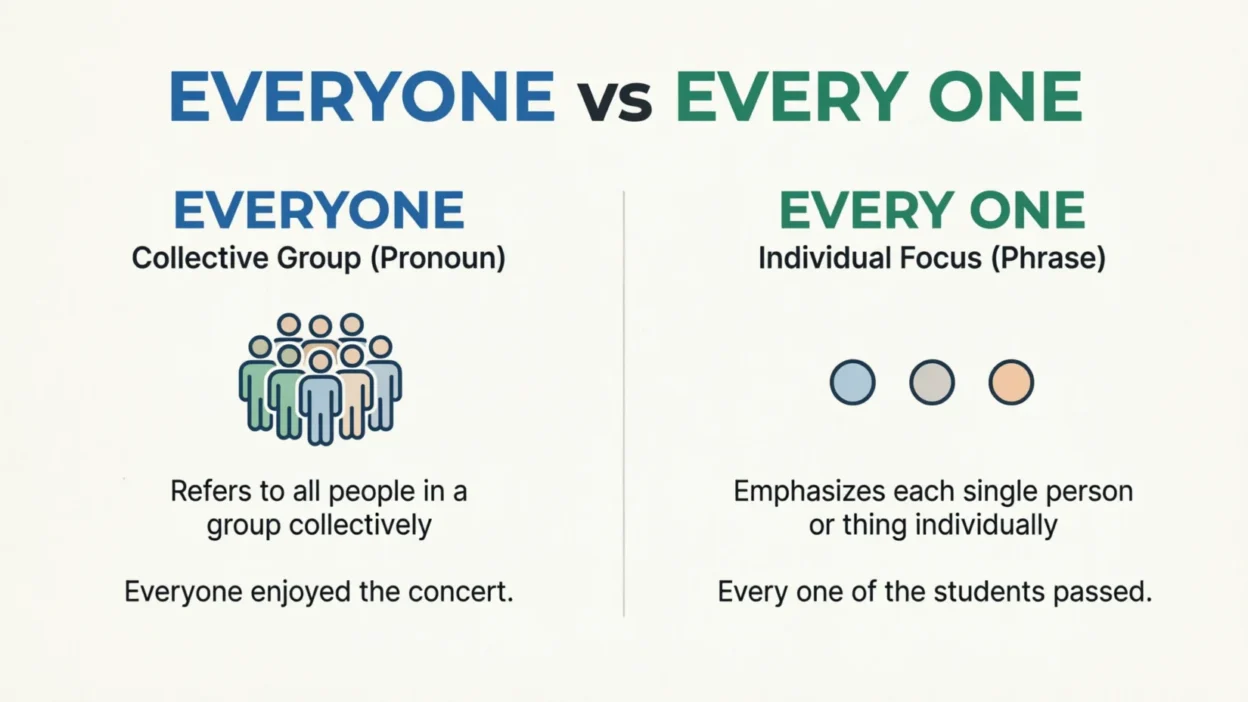
- Everyone is a pronoun meaning all people.
- Every one refers to each individual person or thing in a group.
- Everyone enjoyed the concert. ✅
- Every one of the books was damaged. ✅
Simple rule:
- Use everyone for people generally.
- Use every one when emphasizing individual items or members of a group.
What Does “Everyone” Mean?
“Everyone” is an indefinite pronoun that means:
- all people
- everybody
- all individuals collectively
It refers only to people, not objects.
Examples of Everyone
- Everyone laughed at the joke.
- Everyone is welcome to attend.
- I hope everyone enjoys the meal.
- Everyone agreed with the decision.
In these sentences, the word refers to people as a whole group.
What Does “Every One” Mean?
“Every one” is a phrase that emphasizes:
- each individual member
- each single item
- every separate person or thing
Unlike “everyone,” it can refer to:
- people
- objects
- animals
- items
It is often followed by:
- of
Examples of Every One
- Every one of the cookies disappeared.
- Every one of the students passed.
- I checked every one of the files.
- Every one of the lights was turned off.
Everyone vs Every One Comparison Table
| Term | Part of Speech | Meaning | Refers To | Example |
|---|---|---|---|---|
| Everyone | Pronoun | All people collectively | People only | Everyone enjoyed the event |
| Every one | Phrase | Each individual member | People or things | Every one of the chairs was broken |
The Main Difference Between Everyone and Every One
The easiest way to remember the difference is this:
Everyone = Group of People
Think:
- everybody
- all people together
Example:
- Everyone clapped after the performance.
Every One = Individual Members
Think:
- each single one
- every separate item
Example:
- Every one of the questions was difficult.
How to Use “Everyone” Correctly
Use “everyone” when referring to all people collectively.
Common Uses of Everyone
- everyone knows
- everyone agrees
- everyone wants
- everyone attended
- everyone loves
Correct Examples
- Everyone arrived on time.
- Everyone appreciated her kindness.
- Everyone has their own opinion.
- Everyone in the office supported the idea.
How to Use “Every One” Correctly
Use “every one” when focusing on each individual person or item separately.
Common Uses of Every One
- every one of the books
- every one of the players
- every one of the emails
- every one of the questions
Correct Examples
- Every one of the apples was fresh.
- She answered every one of the interview questions.
- Every one of the employees received training.
- I inspected every one of the products.
Common Mistakes With Everyone vs Every One
These terms are easy to confuse because they sound identical in spoken English.
Mistake 1: Using Everyone for Objects
Incorrect:
- Everyone of the boxes was opened. ❌
Correct:
- Every one of the boxes was opened. ✅
Why?
“Everyone” refers only to people.
Mistake 2: Splitting Everyone Incorrectly
Incorrect:
- Every one enjoyed the movie. ❌
Correct:
- Everyone enjoyed the movie. ✅
Why?
The sentence refers to all people collectively.
Mistake 3: Forgetting “Of” After Every One
“Every one” is commonly followed by:
- of the
Example:
- Every one of the students passed.
Practical Example Paragraphs
Example Using Everyone
Everyone at the wedding enjoyed the music, food, and celebration. The atmosphere was warm and welcoming, and guests stayed late into the evening.
Example Using Every One
The teacher carefully reviewed every one of the assignments before finalizing grades. This attention to detail ensured fairness and accuracy.
Placement and Grammar Rules Table
| Phrase | Sentence Placement | Tone/Formality | Example Sentence |
|---|---|---|---|
| Everyone knows | Beginning/middle | Neutral | Everyone knows the answer |
| Everyone is invited | Beginning | Friendly/formal | Everyone is invited tonight |
| Every one of the items | Beginning/middle | Formal/neutral | Every one of the items was checked |
| Every one of them | Middle/end | Conversational | I thanked every one of them |
Singular or Plural: Which Verb Should You Use?
Both “everyone” and “every one” are grammatically singular.
Correct Examples
- Everyone is excited. ✅
- Every one of the players was ready. ✅
Incorrect Examples
- Everyone are excited. ❌
- Every one of the players were ready. ❌
Even though these phrases refer to multiple individuals, English grammar treats them as singular.
American vs British English Differences
There are no major spelling differences between American and British English for:
- everyone
- every one
Both forms follow the same grammar rules in both language varieties.
In Both Variations
Correct:
- Everyone enjoyed the show.
- Every one of the tickets sold out.
Easy Memory Tricks
Trick 1: Everyone = Everybody
If you can replace the word with:
- everybody
then use:
- everyone
Example:
- Everyone loves music.
- Everybody loves music.
Trick 2: Every One = Each One
If you mean:
- each individual one
then use:
- every one
Example:
- Every one of the chairs was painted.
Why This Difference Matters in Writing
Using the correct term improves:
- grammar accuracy
- readability
- professionalism
- writing clarity
Mistakes can:
- confuse readers
- weaken formal writing
- reduce credibility
This distinction matters especially in:
- academic writing
- business communication
- blog articles
- professional emails
- educational content
Similar English Grammar Confusions
People who search for “everyone vs every one” often also confuse:
- everyday vs every day
- anyone vs any one
- sometime vs some time
- altogether vs all together
- awhile vs a while
These word pairs look similar but function differently in grammar.
Everyday Examples of Everyone and Every One
Correct Uses of Everyone
- Everyone smiled during the speech.
- Everyone in class passed the test.
- Everyone deserves respect.
- Everyone enjoyed the holiday dinner.
Correct Uses of Every One
- Every one of the files was organized.
- I reviewed every one of the comments.
- Every one of the players practiced daily.
- She thanked every one of her supporters.
Incorrect Examples
- Everyone of the cookies was gone. ❌
- Every one attended the ceremony. ❌
FAQs About Everyone vs Every One
What is the difference between everyone and every one?
“Everyone” means all people collectively, while “every one” refers to each individual member of a group.
Is everyone one word or two?
“Everyone” is one word when referring to all people.
Can every one refer to objects?
Yes. “Every one” can refer to objects, people, or items.
Is everyone singular or plural?
“Everyone” is grammatically singular.
Should I say everyone is or everyone are?
Correct:
- Everyone is happy. ✅
Incorrect:
- Everyone are happy. ❌
When should I use every one of?
Use it when emphasizing each individual member or item in a group.
Can everyone replace everybody?
Yes. In most situations, they mean the same thing.
Final Thoughts
Understanding the difference between everyone vs every one can greatly improve your grammar accuracy and writing confidence. Although these expressions sound identical, they serve different purposes in English. “Everyone” refers to all people collectively, while “every one” emphasizes individual members or items.
Mastering commonly confused words like these helps your writing appear clearer, more professional, and easier to understand. Whether you are writing essays, emails, blog posts, or everyday messages, choosing the correct form strengthens communication and avoids unnecessary grammar mistakes.
Actionable Takeaway
Use this quick rule:
- everyone = all people
- every one = each individual one
Easy memory trick:
- If you can replace it with “everybody,” use everyone
- If you mean “each single one,” use every one
Before writing, ask yourself:
- “Am I talking about a group collectively or individual members separately?”
That simple question will help you choose the correct form every time.