
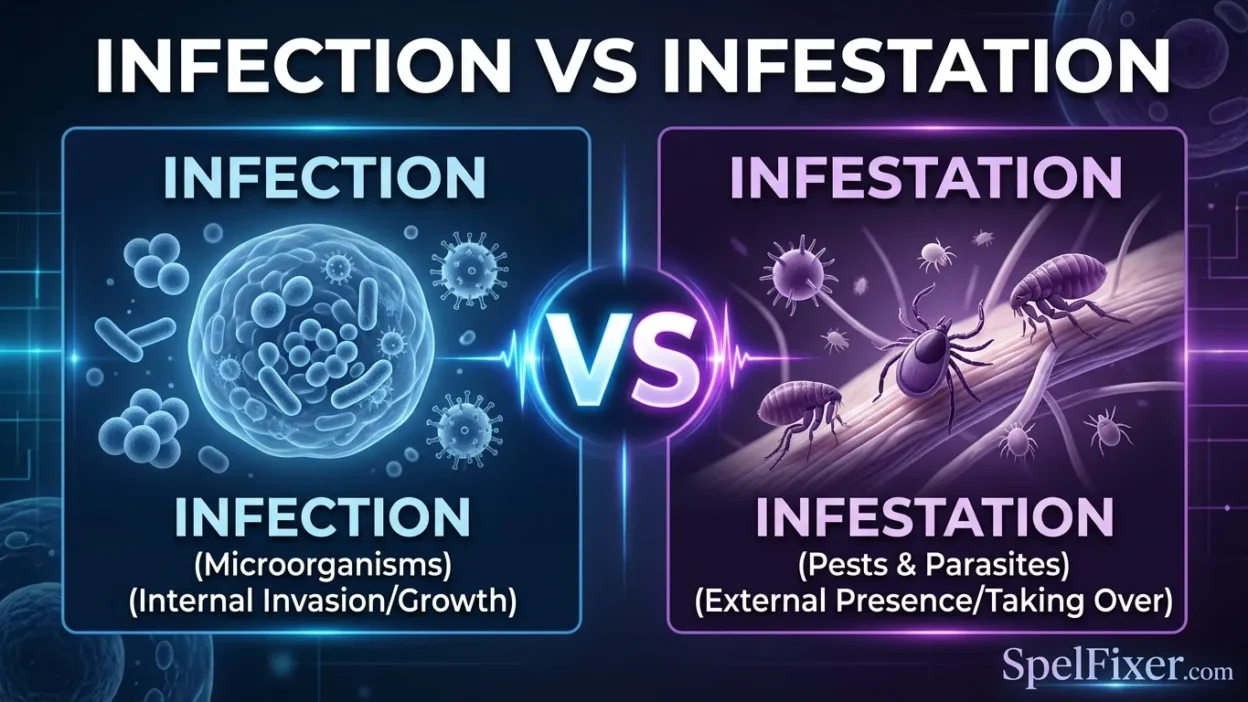
If you have ever wondered whether to say infection or infestation, you are not alone. The two words are closely related, but they describe different situations. In simple terms, an infection usually involves disease-causing microorganisms entering and multiplying in the body, while an infestation generally refers to parasites living on or in a host, especially external parasites such as lice, mites, fleas, or ticks.
Understanding the difference can make your writing more accurate and help you better understand medical information. In this guide, we will compare infection vs infestation, explain their meanings, provide clear examples, discuss common mistakes, and show when each word is appropriate.
Quick Answer:
Infection means harmful microorganisms have entered the body and multiplied, potentially causing illness. Bacteria, viruses, fungi, and some parasites can cause infections.
Infestation usually describes the presence of parasites on or in a person, animal, or sometimes a place. Common examples include a lice infestation, scabies infestation, or an infestation of fleas or bedbugs.
In one sentence:
Infection = disease-causing organisms invade and multiply in the body.
Infestation = parasites are present on or in a host, especially external parasites.
There can be some overlap because parasitic organisms can cause infections, so the exact word depends on the organism and the medical context.
What Does Infection Mean?
An infection occurs when microorganisms invade part of the body and multiply. These microorganisms can include bacteria, viruses, fungi, and parasites.
For example:
- A bacterial infection can cause strep throat.
- A viral infection can cause the common cold.
- A fungal infection can cause athlete’s foot.
- A parasitic infection can affect the intestines or other organs.
An infection can be localized, meaning it affects one area, or systemic, meaning it affects multiple parts of the body. Symptoms depend heavily on the organism and the location of the infection.
Examples of infection in a sentence
- The doctor diagnosed a bacterial infection.
- She developed a skin infection after the wound became infected.
- The laboratory test confirmed a parasitic infection.
- The child was treated for a respiratory infection.
The key idea is that infection focuses on the invasion and multiplication of an infectious organism and the resulting disease process.
What Does Infestation Mean?
An infestation generally refers to parasites being present on or in a host. The word is particularly common when talking about external parasites, also called ectoparasites. These include lice, ticks, mites, fleas, and bedbugs.
For example, head lice infestation means lice are living on the scalp. Similarly, scabies is associated with an infestation by mites that burrow into the skin.
Examples of infestation in a sentence
- The school informed parents about a head lice infestation.
- The veterinarian treated the dog for a flea infestation.
- The family discovered a bedbug infestation.
- The doctor diagnosed a scabies infestation.
The word infestation emphasizes the presence or colonization of parasites, rather than simply referring to a disease caused by microorganisms.
Infection vs Infestation: Key Differences
| Feature | Infection | Infestation |
| Basic meaning | Invasion and multiplication of harmful microorganisms | Presence of parasites on or in a host |
| Common organisms | Bacteria, viruses, fungi, parasites | Lice, mites, ticks, fleas, and other parasites |
| Typical location | Inside body tissues, organs, or other body sites | Often on the skin or body surface |
| Example | Bacterial skin infection | Head lice infestation |
| Main focus | Infectious disease process | Parasite presence |
| Common adjective | Infectious | Infested |
| Can involve parasites? | Yes | Yes |
| Typical wording | Infection caused by bacteria | Infestation caused by lice or mites |
One important point is that these categories are not completely separate. Parasites can cause infections, while some parasites are more commonly described as causing infestations, particularly when they live externally on the host.
Infection Examples vs Infestation Examples
Seeing the words in real situations makes the distinction easier.
Common infection examples
Urinary tract infection: Microorganisms cause infection in the urinary system.
Ear infection: An infection affects structures of the ear.
Skin infection: Bacteria, fungi, viruses, or other organisms can be responsible depending on the condition.
Parasitic infection: Parasites such as protozoa or worms can live inside the body and cause disease.
Common infestation examples
Head lice infestation: Lice live on the scalp and feed on blood.
Scabies infestation: Mites live in the skin and cause an intensely itchy condition.
Flea infestation: Fleas may live on an animal and can also bite humans.
Bedbug infestation: Bedbugs can establish themselves in an environment and feed on people.
External parasites are known as ectoparasites, and they include lice, ticks, mites, bedbugs, and fleas.
Why Do People Confuse Infection and Infestation?
The confusion is understandable because both conditions can involve organisms living in or around the human body.
For example, parasites can be involved in both terms. Giardia can cause a parasitic infection in the digestive system, while head lice are typically discussed as an infestation.
Another reason is that everyday language is often less precise than medical terminology. Someone might casually describe any unwanted organism as an “infection,” even when the more specific term is infestation.
A useful memory trick is:
Infection → think illness caused by invading microorganisms.
Infestation → think parasites occupying a host or environment.
This is a helpful shortcut, although medical terminology can be more nuanced depending on the organism and condition.
Common Mistakes to Avoid
Mistake 1: Calling every parasite an infestation
Not every parasitic disease is best described as an infestation. Parasites include protozoa, worms, and ectoparasites, and some parasitic diseases are specifically described as infections.
For example, giardiasis is a parasitic infection, whereas head lice infestation is standard wording for lice living on the scalp.
Mistake 2: Assuming infection always means bacteria
An infection does not necessarily mean a bacterial illness. Viruses, fungi, and parasites can also cause infections.
Mistake 3: Using infestation only for people
The word infestation can also describe parasites affecting animals or an environment.
For example:
- The cat has a flea infestation.
- The house has a bedbug infestation.
Mistake 4: Thinking infestation always means severe disease
Infestation describes the presence of parasites; it does not automatically tell you how serious the condition is. Symptoms and health effects vary depending on the organism and the person affected.
Infection vs Infestation in American and British English
There is no major American-vs-British English difference in the basic meanings of infection and infestation. Both varieties use the terms in essentially the same way.
You may see differences in other medical vocabulary, spelling, or preferred expressions, but infection and infestation retain their standard meanings in both American and British English.
For example:
- American English: The patient has a head lice infestation.
- British English: The patient has a head lice infestation.
The important distinction is therefore meaning and medical context, not regional English.
How to Remember the Difference
If you need a quick rule, ask yourself:
Is the focus on microorganisms causing disease?
Use infection.
Is the focus on parasites living on or in a host, particularly external parasites?
Use infestation.
Compare these examples:
- Bacterial infection → microorganisms are causing an infectious disease.
- Fungal infection → a fungus is causing an infection.
- Giardia infection → a parasite is causing an intestinal infection.
- Lice infestation → lice are living on the scalp.
- Scabies infestation → mites are present in the skin.
- Flea infestation → fleas are present on an animal or in an environment.
This simple distinction will cover most everyday uses.
FAQs
Is an infestation an infection?
Not necessarily. An infestation usually refers to parasites living on or in a host, particularly external parasites such as lice or mites. Some parasites, however, cause parasitic infections, so the terms can overlap in broader medical discussions.
Is lice an infection or an infestation?
Head lice are generally described as an infestation. Lice are ectoparasites that live on the body’s surface and feed on blood.
Is scabies an infection or infestation?
Scabies is commonly described as an infestation caused by mites. The mites live in the skin and can cause significant itching.
Can parasites cause an infection?
Yes. Parasites can cause parasitic infections, including diseases caused by protozoa and worms. These infections can affect different organs and produce a wide range of symptoms.
Is a bacterial infestation correct?
Usually, bacterial infection is the more appropriate phrase when bacteria invade and multiply in the body. The word infestation is more strongly associated with parasites, especially ectoparasites.
What is the easiest way to remember infection vs infestation?
Remember infection = infectious microorganisms and infestation = parasites occupying a host or environment. Then consider the specific organism before choosing the final term.
Are infection and infestation synonyms?
No. They are related but not exact synonyms. Infection describes an infectious process involving microorganisms, while infestation commonly describes the presence of parasites on or in a host.
Final Summary
The difference between infection vs infestation mainly comes down to what kind of organism is involved and how it interacts with the host. An infection occurs when microorganisms such as bacteria, viruses, fungi, or certain parasites invade and multiply in the body. An infestation usually refers to parasites living on or in a host, especially ectoparasites such as lice, mites, fleas, and ticks.
When choosing between the two words, focus on the context rather than simply memorizing a definition. If you are describing an infectious disease caused by microorganisms, infection will usually be appropriate.
If you are describing parasites occupying a person, animal, or environment, infestation is often the better choice. When the situation involves a specific medical condition, use the terminology provided by a qualified healthcare professional or a reliable medical source.
Actionable Takeaway
Use “infection” for an infectious disease process and “infestation” for the presence of parasites, especially external parasites. When in doubt, identify the organism first and then choose the term that accurately describes its relationship with the host.

Fenwick Quentin is a creative blogging author known for his analytical yet engaging writing style.
He explores topics such as innovation, digital culture, and personal development with depth and clarity.
Through his articles, Fenwick encourages readers to think critically and embrace continuous growth.