Have you ever wondered whether to use invoke or provoke when you want to describe causing a reaction? These two verbs look and sound somewhat similar, but they have very different meanings. Choosing the wrong one can change the meaning of your sentence.
In this guide, I’ll explain invoke vs provoke in simple English, with clear definitions, examples, common mistakes, and an easy comparison. By the end, you’ll know exactly when to use each word in everyday writing, academic English, and professional communication.
Quick Answer:
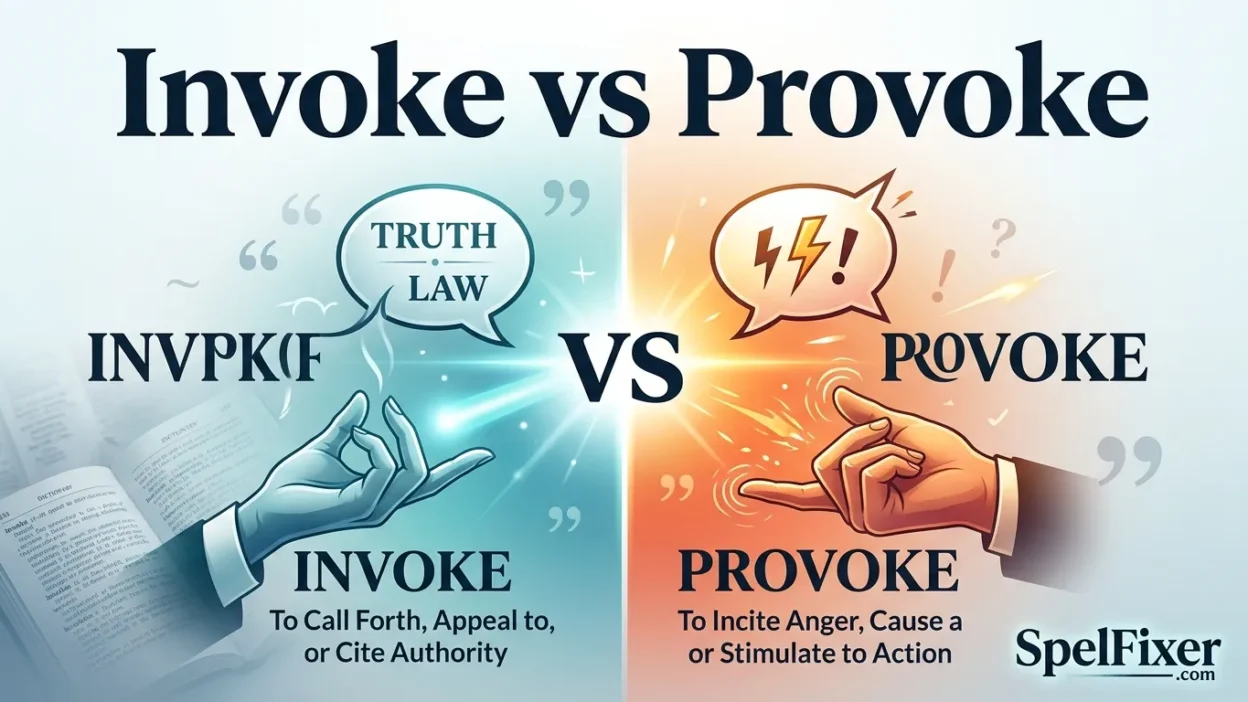
Invoke means to call upon, appeal to, or bring something into effect or consideration. It is often used with laws, authority, memories, emotions, traditions, or rules.
Provoke means to cause a reaction or response, especially an emotional or negative one. It can also mean deliberately irritating or challenging someone.
Easy way to remember:
- Invoke = call upon or bring forth
- Provoke = cause a reaction
For example:
- The lawyer invoked the constitutional right.
- His rude comment provoked an angry response.
Although both words can describe something being “brought about,” they are not interchangeable.
What Does Invoke Mean?
The verb invoke means to call upon something for help, authority, support, justification, or effect. It can also mean to bring a particular feeling, memory, image, or idea to mind.
The word is commonly used in formal, academic, legal, religious, and literary contexts.
Common meanings of invoke
1. To appeal to authority or a rule
- The defendant invoked his right to remain silent.
- The company invoked its privacy policy.
- The lawyer invoked an important legal principle.
2. To call upon someone or something for help
- The villagers invoked the protection of their ancestors.
- The speaker invoked the support of the community.
3. To bring a feeling, memory, or image to mind
- The old photograph invoked memories of childhood.
- The music invoked a feeling of nostalgia.
4. To put a rule, law, or procedure into effect
- The government invoked emergency powers.
- The contract allows the company to invoke a termination clause.
Synonyms for invoke
Depending on the context, useful synonyms include:
- appeal to
- call upon
- cite
- refer to
- summon
- bring to mind
- use
- employ
What Does Provoke Mean?
The verb provoke means to cause a reaction, feeling, action, or response. It is frequently associated with anger, disagreement, criticism, laughter, or other strong reactions.
It can also mean deliberately irritating or challenging someone.
Common meanings of provoke
1. To cause a reaction
- The announcement provoked a strong public response.
- The movie provoked an interesting discussion.
- Her question provoked laughter.
2. To make someone angry
- His comment provoked his coworker.
- Don’t say something just to provoke an argument.
3. To stimulate thought or discussion
- The article provoked readers to think differently.
- The teacher asked a question that provoked debate.
Synonyms for provoke
Depending on the sentence, synonyms can include:
- cause
- trigger
- stimulate
- prompt
- incite
- arouse
- spark
- irritate
- anger
- challenge
Invoke vs Provoke: Key Difference
The simplest distinction is that invoke involves calling upon or bringing something forth, while provoke involves causing a response or reaction.
Think of invoke as making something available, relevant, or present.
Think of provoke as making something happen in response to an action or situation.
| Feature | Invoke | Provoke |
| Basic meaning | Call upon or bring forth | Cause a reaction |
| Common use | Laws, rights, authority, memories, emotions | Anger, reactions, debate, responses |
| Tone | Often formal | Neutral, negative, or emotional |
| Typical object | Rule, law, right, memory, tradition | Reaction, anger, debate, response |
| Example | She invoked her legal rights. | His words provoked anger. |
| Easy synonym | Call upon | Trigger or cause |
Invoke vs Provoke Examples
Seeing the words in similar sentences makes the difference easier to understand.
Example 1: Law and reaction
- The attorney invoked the defendant’s legal rights.
- The accusation provoked an angry reaction.
The first sentence is about calling upon a right. The second is about causing a reaction.
Example 2: Memories and emotions
- The smell of fresh bread invoked memories of my grandmother’s kitchen.
- The criticism provoked strong emotions.
Here, invoke means bringing memories to mind, while provoke means causing an emotional response.
Example 3: Discussion
- The professor invoked an earlier theory during the lecture.
- The professor’s controversial question provoked a lively debate.
The professor called upon a theory, but the question caused a debate.
Example 4: Anger
- The speaker invoked an important religious tradition.
- The speaker’s insult provoked the audience.
The second sentence describes a reaction caused by the speaker’s behavior.
Can Invoke and Provoke Ever Be Used Interchangeably?
Usually, no.
While both words can involve the idea of bringing something about, their grammatical and semantic uses are different.
You would normally invoke a law, right, principle, authority, memory, tradition, or image.
You would normally provoke anger, laughter, debate, criticism, a reaction, or a response.
For example:
❌ She provoked her constitutional rights.
✅ She invoked her constitutional rights.
And:
❌ His insult invoked an angry reaction.
✅ His insult provoked an angry reaction.
The second incorrect example is especially tempting because “invoke” can mean “bring about” in some contexts. However, provoke is the natural choice when something causes a reaction.
Common Mistakes With Invoke and Provoke
Understanding common errors can help you use these words naturally.
Mistake 1: Using provoke for laws or rights
Incorrect:
- He provoked his right to remain silent.
Correct:
- He invoked his right to remain silent.
You invoke a right because you are calling upon or exercising it.
Mistake 2: Using invoke when you mean anger
Incorrect:
- Her rude behavior invoked the customer.
Better:
- Her rude behavior provoked the customer.
When someone intentionally irritates, challenges, or angers another person, provoke is generally the correct verb.
Mistake 3: Confusing “invoke” with “evoke”
Another common confusion is invoke vs evoke.
Invoke usually means call upon or appeal to something.
Evoke means bring a feeling, memory, image, or response to mind.
For example:
- The lawyer invoked the law.
- The photograph evoked childhood memories.
There is some overlap between invoke and evoke in literary contexts, but their most common uses are different.
Mistake 4: Assuming “provoke” is always negative
Although provoke often appears with anger or conflict, it isn’t always negative.
For example:
- The question provoked an interesting discussion.
- The comedian provoked laughter from the audience.
- The book provoked new ideas.
So, provoke can simply mean cause or stimulate a response.
Invoke vs Provoke in American and British English
There is no major difference in meaning or spelling between American and British English for invoke and provoke.
Both varieties use the words in essentially the same way.
You may encounter slightly different preferences in vocabulary or sentence style depending on the country, but the core distinction remains:
- Invoke = call upon, appeal to, or bring something to mind
- Provoke = cause or stimulate a reaction
For example, both American and British writers would naturally say:
The lawyer invoked the law.
And:
His comments provoked an angry response.
The pronunciation and standard spelling also remain consistent across both forms of English.
A Simple Trick to Remember Invoke vs Provoke
If you’re unsure which word to use, ask yourself one question:
Am I calling upon something, or am I causing a reaction?
If you’re calling upon something, choose invoke.
- Invoke a law
- Invoke a right
- Invoke authority
- Invoke tradition
- Invoke a principle
If you’re causing a reaction, choose provoke.
- Provoke anger
- Provoke debate
- Provoke laughter
- Provoke criticism
- Provoke a response
A quick memory trick is:
INVOKE → CALL UP
PROVOKE → CAUSE A REACTION
This distinction will work in most everyday situations.
Frequently Asked Questions
Is it “invoke” or “provoke” a reaction?
Usually, provoke a reaction is the natural choice.
For example:
- The announcement provoked a strong reaction.
However, “invoke” can be used in other contexts where something brings an idea, feeling, or image to mind.
Is it “invoke” or “provoke” a law?
Use invoke.
For example:
- The attorney invoked the law to support his argument.
You invoke a law, rule, right, principle, or authority.
Is it “invoke” or “provoke” anger?
Use provoke when you mean to cause anger.
For example:
- His insulting comment provoked anger among the audience.
What is the difference between invoke and evoke?
Invoke generally means to call upon or appeal to something, while evoke means to bring a feeling, memory, image, or idea to mind.
- She invoked her legal rights.
- The song evoked memories of her childhood.
Is provoke always negative?
No. Provoke can describe positive or neutral reactions as well.
For example:
- The joke provoked laughter.
- The question provoked discussion.
What is the easiest way to remember invoke vs provoke?
Remember:
Invoke = call upon.
Provoke = cause a reaction.
This simple distinction will help you choose the right word in most situations.
Are invoke and provoke synonyms?
They are related but not true synonyms. Both can involve causing something to appear or happen, but they have different meanings and typical collocations.
Summary:
The difference between invoke vs provoke becomes much easier once you focus on what happens in the sentence. Invoke means to call upon, appeal to, or bring something into consideration. You can invoke a law, right, authority, principle, tradition, or memory. It is especially common in formal, legal, academic, and literary writing.
Provoke, on the other hand, means to cause or stimulate a reaction. You can provoke anger, laughter, debate, criticism, discussion, or a response. When you’re talking about deliberately irritating or challenging someone, provoke is also the natural choice.
Actionable Takeaway
Before choosing between the two, ask yourself: “Am I calling upon something, or am I causing a reaction?” If you’re calling upon it, use invoke. If you’re causing a response, use provoke. Remembering this one distinction will help you avoid one of the most common verb-choice mistakes in English.