Many English writers struggle with one common grammar question: Is this word plural or possessive? The confusion often comes from apostrophes. Sometimes a word simply means “more than one,” while other times it shows ownership or association.
Learning the difference between plural and possessive nouns is essential for clear, professional writing. Once you understand a few simple rules, you’ll be able to use apostrophes confidently and avoid common mistakes.
Quick Answer
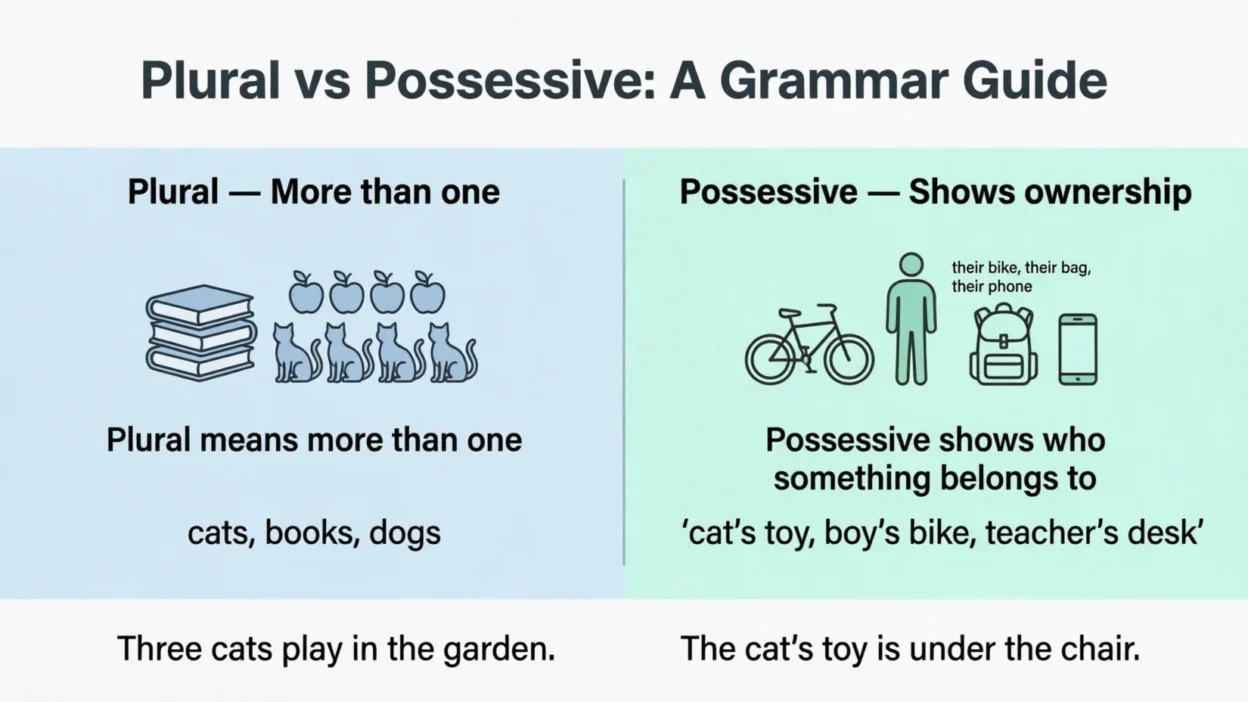
- Plural means more than one person, place, thing, or idea.
- Possessive means something belongs to someone or something.
Examples:
- The dogs are barking. ✅ (Plural: more than one dog)
- The dog’s leash is red. ✅ (Possessive: the leash belongs to one dog)
A simple rule:
👉 Plural = quantity
👉 Possessive = ownership
What Is a Plural Noun?
Definition of a Plural
A plural noun refers to more than one person, place, thing, or idea.
Most nouns become plural by adding -s or -es.
Examples
- Boy → Boys
- Dog → Dogs
- Book → Books
- Class → Classes
Sentences with Plural Nouns
- The boys are playing soccer.
- The dogs ran across the yard.
- Several books were on the table.
- The classes start next week.
Notice that no ownership is involved.
What Is a Possessive Noun?
Definition of a Possessive
A possessive noun shows ownership, belonging, or association.
Possessive nouns usually use an apostrophe.
Examples
- Boy’s bike
- Dog’s collar
- Teacher’s desk
- Student’s notebook
Sentences with Possessive Nouns
- The boy’s backpack is blue.
- The dog’s collar needs cleaning.
- The teacher’s office is upstairs.
- The student’s project won first prize.
In each case, something belongs to someone.
Plural vs Possessive: Key Differences
| Feature | Plural | Possessive |
|---|---|---|
| Meaning | More than one | Ownership or belonging |
| Apostrophe Needed | No | Usually yes |
| Example | Boys | Boy’s |
| Question Answered | How many? | Whose? |
| Sentence | The boys arrived. | The boy’s hat fell off. |
The easiest test is:
- Plural answers “How many?”
- Possessive answers “Whose?”
How to Form Plural Nouns
Most Nouns
Add -s.
Examples:
- Cat → Cats
- Car → Cars
- Student → Students
Nouns Ending in S, X, Z, CH, or SH
Add -es.
Examples:
- Box → Boxes
- Church → Churches
- Bus → Buses
Irregular Plurals
Some nouns change completely.
Examples:
- Man → Men
- Woman → Women
- Child → Children
- Person → People
How to Form Possessive Nouns
Singular Possessive
Add ‘s.
Examples:
- Boy → Boy’s
- Cat → Cat’s
- Teacher → Teacher’s
Sentences:
- The cat’s toy is missing.
- The teacher’s lesson was excellent.
Plural Possessive Ending in S
Add only an apostrophe.
Examples:
- Boys → Boys’
- Dogs → Dogs’
- Teachers → Teachers’
Sentences:
- The boys’ locker room was renovated.
- The teachers’ meeting starts at noon.
Irregular Plural Possessive
Add ‘s.
Examples:
- Men → Men’s
- Women → Women’s
- Children → Children’s
- People → People’s
Sentences:
- The men’s team won the match.
- The children’s playground is nearby.
Common Examples of Plural and Possessive
| Plural | Possessive |
|---|---|
| Boys | Boy’s |
| Girls | Girl’s |
| Dogs | Dog’s |
| Teachers | Teacher’s |
| Students | Student’s |
| Cats | Cat’s |
Remember that the possessive form usually includes an apostrophe.
Why People Confuse Plural and Possessive
Apostrophe Confusion
Many writers mistakenly add apostrophes to regular plurals.
Incorrect:
- Three dog’s barked loudly.
Correct:
- Three dogs barked loudly.
Similar Appearance
Compare:
- Boys
- Boy’s
Only one punctuation mark changes the meaning.
Uncertainty About Ownership
Sometimes writers know an apostrophe shows possession but aren’t sure when possession actually exists.
Common Mistakes to Avoid
Mistake 1: Apostrophes for Regular Plurals
Incorrect:
- Apple’s for sale.
Correct:
- Apples for sale.
No ownership exists.
Mistake 2: Missing Apostrophes in Possessives
Incorrect:
- The dogs leash broke.
Correct:
- The dog’s leash broke.
The leash belongs to the dog.
Mistake 3: Confusing Plural Possessives
Incorrect:
- The boys’s coach arrived.
Correct:
- The boys’ coach arrived.
The coach belongs to multiple boys.
Easy Memory Tricks
Plural Means More Than One
Think:
- One cat
- Two cats
No apostrophe needed.
Possessive Means Ownership
Ask:
Who owns it?
Examples:
- Cat’s toy
- Teacher’s desk
- Student’s project
Quick Test
If you can replace the phrase with:
- “belongs to”
then you likely need a possessive form.
Example:
- The girl’s bicycle
- The bicycle belongs to the girl.
Possessive is correct.
American vs British English Differences
There are very few differences between American and British English regarding plural and possessive nouns.
American English
- The student’s book.
- The students’ books.
British English
- The student’s book.
- The students’ books.
The same grammar rules generally apply.
Real-Life Examples
Plural Examples
- The players entered the stadium.
- The books are on the shelf.
- The teachers attended training.
Possessive Examples
- The player’s jersey was signed.
- The book’s cover is torn.
- The teacher’s instructions were clear.
FAQs About Plural and Possessive Nouns
What is the difference between plural and possessive?
Plural means more than one, while possessive shows ownership or belonging.
Does a plural noun need an apostrophe?
Usually no. Most plural nouns do not require apostrophes.
How do I know if a noun is possessive?
Ask whether something belongs to someone or something.
Is boys plural or possessive?
Boys is plural. Boy’s is possessive.
Is men’s plural or possessive?
Men is plural. Men’s is possessive.
Why do possessive nouns use apostrophes?
The apostrophe helps show ownership or association.
What is a plural possessive noun?
A plural possessive noun shows ownership by more than one person or thing.
Example:
- The students’ classroom.
What is the easiest way to tell the difference?
Ask whether the noun indicates quantity or ownership.
Final Summary
Understanding plural or possessive nouns is one of the most important grammar skills in English. A plural noun simply means more than one person, place, thing, or idea. A possessive noun shows ownership, belonging, or association.
The key difference is simple: plurals focus on quantity, while possessives focus on ownership. Learning to recognize that distinction will help you avoid apostrophe mistakes and improve your writing accuracy.
Actionable Takeaway
Whenever you’re unsure, ask yourself two questions:
- Am I talking about more than one?
- Yes → Use a plural noun.
- Am I showing ownership?
- Yes → Use a possessive noun.
Remember this simple phrase:
Plural = many. Possessive = belongs to.
Following this rule will help you master apostrophes and write with confidence.