The confusion between elude vs allude is one of the most common vocabulary mix-ups in English. These words sound somewhat similar, share Latin roots, and often appear in formal writing, literature, academic work, and professional communication. However, their meanings are completely different, and using the wrong one can make a sentence confusing or grammatically incorrect.
If you have ever wondered whether someone “alluded” to a topic or whether the meaning “eluded” you, you are not alone. Many English learners and even native speakers pause before using these words. Fortunately, once you understand the meanings and sentence patterns, the difference becomes much easier to remember.
In this guide, you will learn the meanings of “elude” and “allude,” grammar rules, pronunciation tips, sentence examples, common mistakes, regional differences, and practical memory tricks that will help you use both words correctly with confidence.
Quick Answer
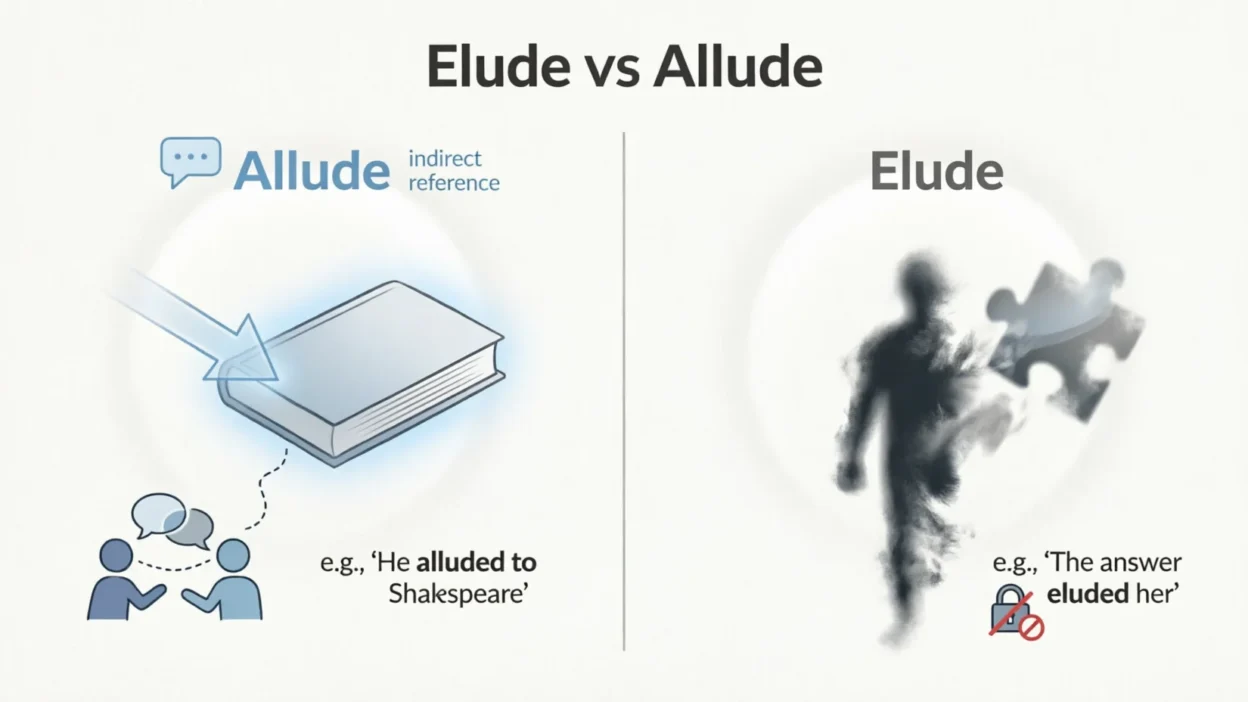
Use “allude” when referring indirectly to something.
Use “elude” when something escapes, avoids, or remains difficult to grasp.
Examples:
- The speaker alluded to recent political events. ✅
- The solution continued to elude the researchers. ✅
What Does “Allude” Mean?
“Allude” means:
- to refer indirectly to something
- to hint at a subject without mentioning it directly
People often allude to:
- events
- ideas
- books
- historical references
- sensitive topics
Examples of Allude
- The author alluded to Shakespeare in the novel.
- She alluded to a possible promotion.
- His speech alluded to past mistakes.
- The movie alludes to real historical events.
Common Contexts for Allude
“Allude” frequently appears in:
- literature
- speeches
- academic writing
- political discussions
- formal communication
What Does “Elude” Mean?
“Elude” means:
- to escape
- to avoid capture
- to remain difficult to understand or remember
It often describes:
- ideas
- answers
- people escaping pursuit
- memories that are hard to recall
Examples of Elude
- The criminal eluded police for weeks.
- The answer eluded me during the exam.
- Success continued to elude the struggling team.
- The meaning of the poem eluded many readers.
Common Contexts for Elude
“Elude” commonly appears in:
- mystery writing
- academic discussion
- emotional reflection
- problem-solving situations
Elude vs Allude Comparison Table
| Word | Meaning | Main Function | Example |
|---|---|---|---|
| Allude | Refer indirectly | Hint or mention subtly | She alluded to the issue |
| Elude | Escape or avoid | Remain out of reach | The answer eluded him |
How to Use “Allude” Correctly
Use “allude” when someone:
- hints at something
- indirectly references a topic
- mentions something subtly
Examples
- The teacher alluded to upcoming changes.
- The article alluded to financial problems.
- He alluded to his childhood experiences.
- Her joke alluded to an inside story.
Grammar Tip
“Allude” is often followed by:
- to
Examples:
- allude to a problem
- allude to history
- allude to an event
How to Use “Elude” Correctly
Use “elude” when something:
- escapes understanding
- avoids capture
- stays difficult to obtain
Examples
- Sleep eluded him all night.
- The suspect eluded investigators.
- Happiness seemed to elude her.
- The exact reason still eludes scientists.
Grammar Tip
“Elude” usually takes a direct object.
Examples:
- elude police
- elude understanding
- elude capture
Common Mistakes With Elude vs Allude
Because these words sound alike, many writers confuse them.
Mistake 1: Using Allude for Escaping
Incorrect:
- The solution alluded me. ❌
Correct:
- The solution eluded me. ✅
Mistake 2: Using Elude for Indirect References
Incorrect:
- She eluded to the problem. ❌
Correct:
- She alluded to the problem. ✅
Mistake 3: Forgetting the Preposition
“Allude” typically requires:
- to
Correct:
- He alluded to the scandal.
Incorrect:
- He alluded the scandal. ❌
Practical Example Paragraphs
Real-world examples help clarify the difference naturally.
Example Using Allude
During the interview, the actor carefully alluded to tensions behind the scenes without directly criticizing anyone. His subtle comments quickly attracted media attention.
Example Using Elude
Even after hours of studying, the final math concept continued to elude Sarah. She understood most of the material, but one formula still seemed impossible to grasp completely.
Placement and Grammar Rules Table
| Word | Sentence Placement | Tone | Example Sentence |
|---|---|---|---|
| Allude | Usually followed by “to” | Formal/Professional | The speaker alluded to history |
| Elude | Followed by direct object | Neutral/Formal | Sleep eluded him |
| Allude subtly | Academic/Literary | Sophisticated | The novel alludes to mythology |
| Elude understanding | Analytical/Reflective | Intellectual | The meaning eluded readers |
Pronunciation Difference
Although similar, the words are pronounced differently.
Allude
Pronounced:
- uh-LOOD
Elude
Pronounced:
- ee-LOOD
The beginning vowel sound changes slightly.
American vs British English Differences
There are no major spelling differences between American and British English for these words.
American English
Both “allude” and “elude” are used similarly in formal and everyday writing.
British English
British English follows the same meanings and grammar structures.
Why This Difference Matters
Using the correct word improves:
- writing clarity
- professionalism
- academic accuracy
- reader understanding
Confusing them may completely change sentence meaning.
For example:
- “The politician alluded to corruption.” ✅
- “The politician eluded corruption.” ⚠️
The second sentence suggests escaping corruption rather than mentioning it indirectly.
Synonyms and Related Terms
Learning related vocabulary strengthens language skills naturally.
Synonyms for Allude
- hint
- imply
- mention indirectly
- reference
- suggest
Synonyms for Elude
- escape
- evade
- avoid
- slip away
- remain unreachable
Related Grammar Searches
People searching for “elude vs allude” also search for:
- affect vs effect
- imply vs infer
- assure vs ensure
- discreet vs discrete
- compliment vs complement
Helpful Memory Trick
Simple associations make these words easier to remember.
Allude = Allusion
An allusion is an indirect reference.
So:
- allude → indirect mention
Elude = Escape
Think:
- elusive = hard to catch
So:
- elude → escape or avoid
Elude vs Allude in Literature
These words appear frequently in literary analysis.
Allude in Literature
Authors often allude to:
- mythology
- religion
- historical events
- famous books
Example:
- The poem alludes to Greek mythology.
Elude in Literature
Writers use “elude” to describe:
- mystery
- hidden meanings
- difficult truths
Example:
- The story’s message eluded readers.
Everyday Usage Examples
Both words appear regularly in daily English.
Everyday Allude Examples
- My friend alluded to a surprise party.
- The teacher alluded to future exams.
- The article alluded to economic problems.
Everyday Elude Examples
- The answer suddenly eluded me.
- Success seemed to elude the company.
- Sleep eluded him before the interview.
FAQs About Elude vs Allude
What is the difference between elude and allude?
“Allude” means refer indirectly, while “elude” means escape or avoid understanding.
Is allude always followed by “to”?
Yes, in most cases “allude” is followed by “to.”
What does elude mean in simple words?
It means to escape, avoid capture, or remain difficult to understand.
Can elude refer to ideas?
Yes. Answers, meanings, and solutions can elude people.
What does allude mean in writing?
It means hinting at something without stating it directly.
Are elude and allude interchangeable?
No. Their meanings are completely different.
How can I remember the difference?
“Allude” relates to allusions and indirect references. “Elude” relates to escaping or avoiding.
Final Thoughts
The difference between elude vs allude becomes much easier once you focus on their core meanings. “Allude” involves indirect references or subtle hints, while “elude” describes something escaping, avoiding capture, or remaining difficult to understand.
Mastering this distinction improves your vocabulary, strengthens professional writing, and helps your communication sound more polished and precise. Whether you are writing essays, business documents, speeches, or casual messages, choosing the correct word helps readers understand your meaning instantly.
Actionable Takeaway
Remember this simple shortcut:
- allude = indirect hint
- elude = escape or avoid
Quick test:
- If someone is hinting at something → use allude
- If something escapes understanding or capture → use elude
This simple memory trick will help you use both words correctly and confidently in everyday English.